A Tuesday in America
Listen to the story.
The dog hears him before the alarm does. He always does. By the time Hollis is out of bed the dog is at the kitchen door asking to go out, and Hollis lets him out into the soft blue of the yard and stands for a moment in the open doorway with the cold on his bare feet.
Five-fifty in the morning. The sky is just starting. Across the alley a kitchen light comes on at the Markham house and a minute later another one comes on two doors down. Down the block an upstairs window at the Cooley place, where the new baby is, has been on for some time. The country wakes up the way it has always woken up. That part nobody had to fix.
He puts the coffee on and stands at the window while it works.
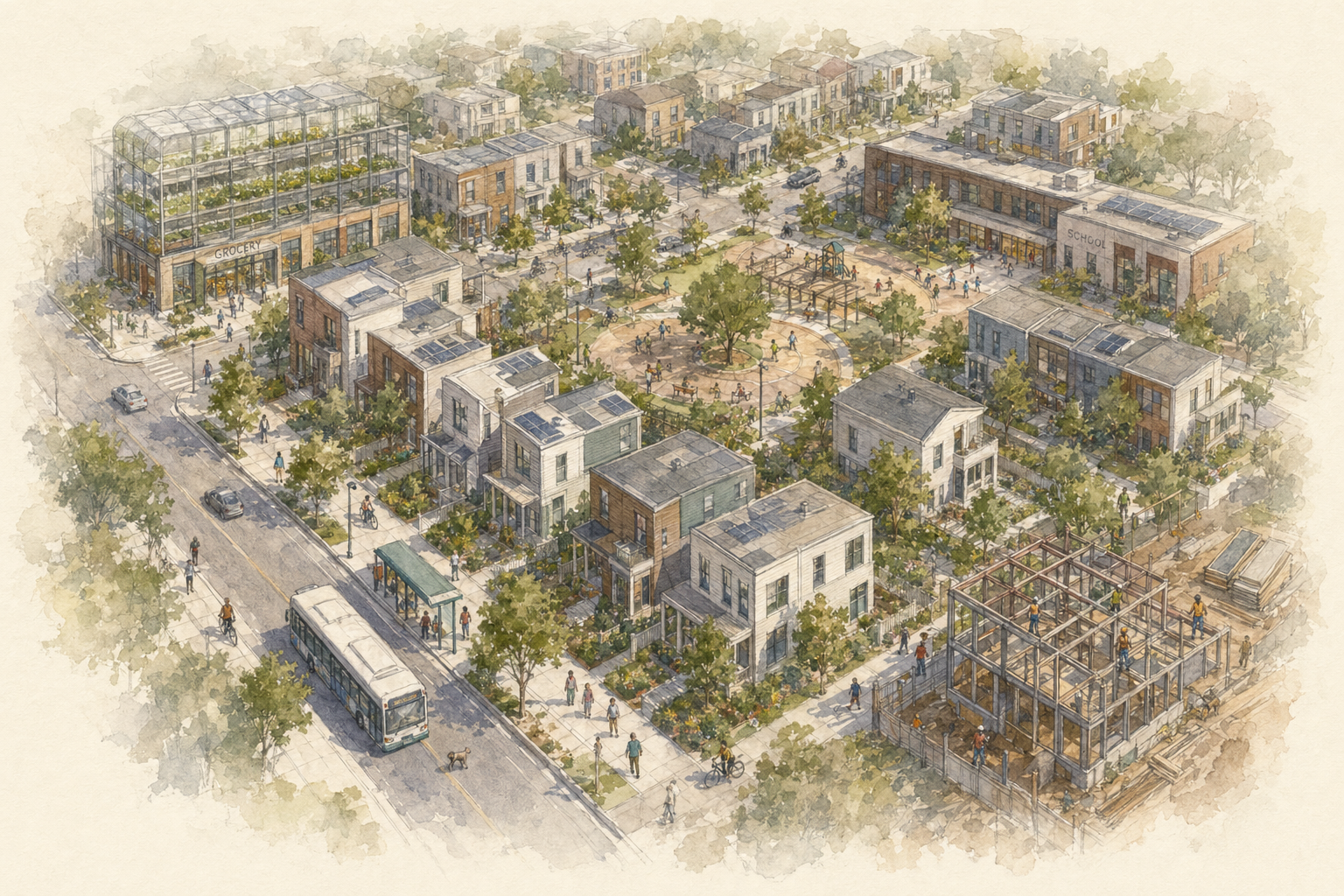
Beyond the alley fence the next block of houses sits in the same dawn. Past those houses, the public square with the campus on its north side. Past that, the school where Wren will start fourth grade after Christmas. Past that, the clinic on Fourth where Dr. Ramos will see her at nine, and the vertical farm on Maple where the lights have been on all night for the lettuce that will be on the shelves at six. At the east edge of the development, where the land begins to roll, a foundation was poured last week for the next block of houses, and a flatbed will arrive Friday with the wall sections.
This is the neighborhood. He has lived in it since 2037. It was three streets and a square when he moved in. It is twelve streets and three squares now, and the families who came in the second and third waves are the ones whose kids his granddaughter goes to school with, and the families who are coming in this fall are people he has not yet met but will, because in a country like this one a man comes to know the people he lives next to.
He drinks the first cup standing.
On the wall by the back door is the photograph of his wife that he has not moved in twenty-seven years. She is forty-six in the picture. She is laughing at something the man behind the camera said. The man behind the camera was him.
Wren is asleep down the hall. Eight years old, his only granddaughter, here for the night because Mike is on second shift and Mike's wife is in St. Louis at her mother's. The girl sleeps the way her father slept at that age — flat on her back, mouth open, both arms over her head like she's about to be arrested. He looked in on her at midnight when he got up for water. She had not moved.
He goes to wake her at seven.
“Grandpa.”
“Yeah.”
“Can I have the brown sugar on it.”
“You can.”
“A lot of it.”
“A reasonable amount of it.”
“What's reasonable.”
“What I give you.”
She accepts this. She is a serious child. She eats her oatmeal with both elbows on the table and reads from the book propped against the napkin holder while she chews, and Hollis does not tell her to take her elbows off the table because he does not care about her elbows. He cares that she is reading. He cares that the book is one she chose. He cares that when she gets to a hard word she says it under her breath twice and figures it out and does not look up.
The book is about a girl who builds a flying machine out of a bicycle and a kite. The reading program on her tablet had picked it for her last week — read her last six books, watched what she lingered on, watched what she skipped, picked the next one. The kind of attention a one-on-one tutor used to give a rich kid in 1890. The technology to give it to every kid had existed since before Wren was born. Khan had been running it for free in 2014. They had simply not been allowed to use it in any school Hollis's own children attended. There had been reasons. He cannot now remember the reasons. Nobody can.
“Grandpa.”
“Yeah.”
“What's a gyroscope.”
He tells her what a gyroscope is. She nods and goes back to the book. Outside the window the light has come up enough to see the maple in the yard. The leaves are starting to turn. It is the first week of October and the country is still warm in the afternoons but in the mornings now you can feel the year.
At quarter to nine they put their coats on and go.
He stops at the bottom of the porch steps to wait for her. She is tying her shoe on the top step with the seriousness of a person who has just learned. He looks back at the house while he waits.
It is two stories, three bedrooms upstairs, deep eaves all around. The cladding is charred cedar on the gable end and warm fiber-cement panels on the front. The porch he is standing in front of runs the width of the south face and is wide enough for two chairs and a table between them, which is where he sits in the evenings. There is rooftop solar integrated into the south slope of the roof, dark blue, almost the color of the slate below it. A young maple — planted by the city in the spring — stands in the corner of the front yard, no taller than Wren.
Mike's plant built the house. The deed has Hollis's name on it and a paid-in-full stamp from 2042 that he still likes to look at sometimes when he is paying his other bills. It cost forty-six thousand dollars to build. He paid forty-six thousand dollars for it.
The technology that built it is older than Wren by two decades. The Swedes had been raising houses this way since before Hollis was a young man. Volumetric modules off a line, raised on a foundation in a week, weather-tight in two. Mike likes to say his plant did not invent anything. They just started doing what other countries had figured out a long time before, and which his country had been told for forty years was impossible.
He thinks somebody decided.
Wren finishes her shoe. They go.
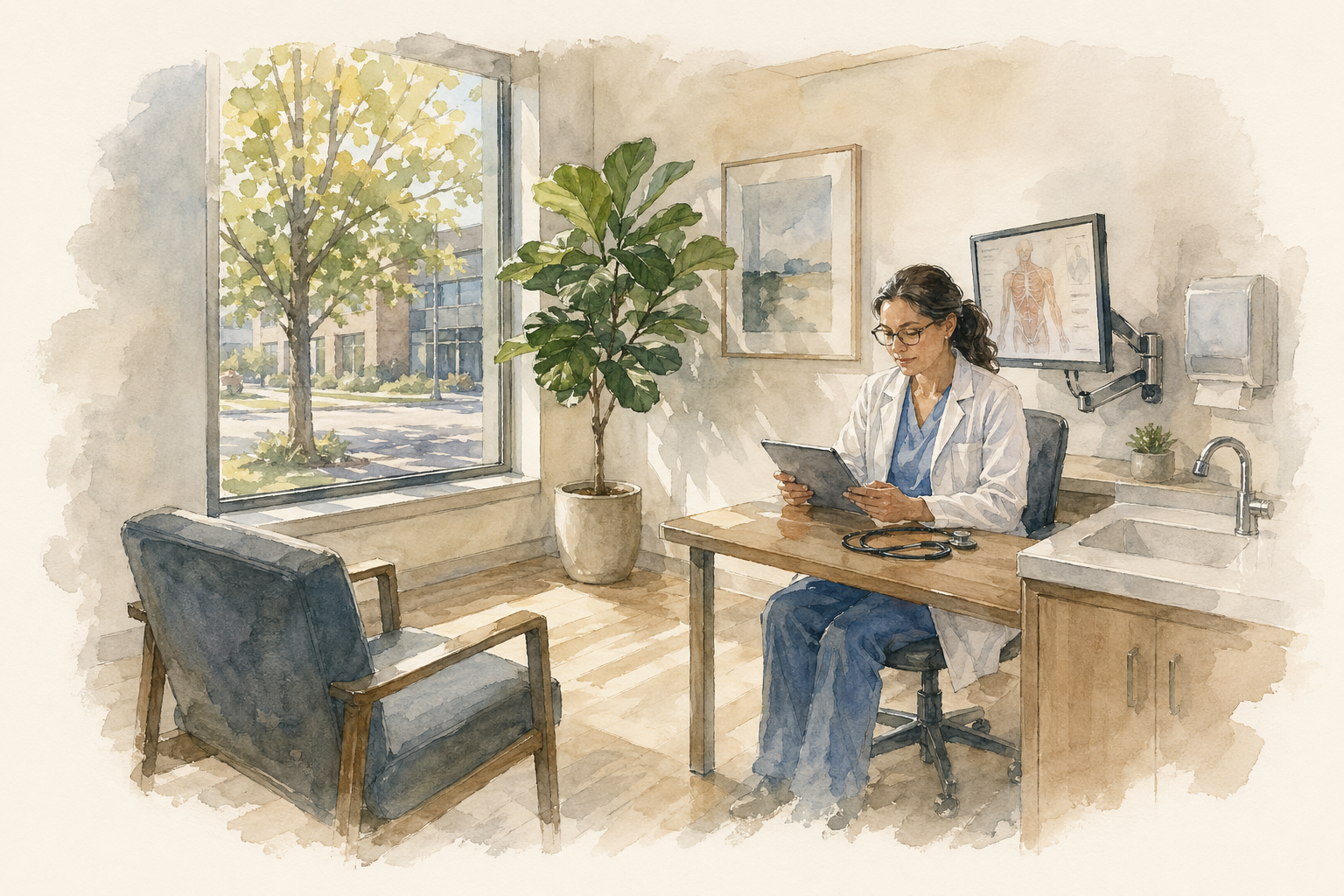
Dr. Ramos's office is on the second floor of the clinic. The exam room has a window that looks west at a maple the city planted the same year as the one in his yard, but bigger now, in its sixth October, the leaves the color of a stoplight that means slow down and look. Her desk is wood. The diploma on the wall is from 2027. The stethoscope on the desk is the one her father used. She has told Hollis the story.
Dr. Ramos has been Wren's doctor since she was born. She has been Mike's doctor since Mike was thirty. Before that Mike's doctor was Dr. Patel, who retired in 2038. Before that — there had not really been a doctor. There had been emergency rooms. There had been the urgent care in the strip mall by the old K-Mart. There had been the woman at the free clinic who did what she could on a Tuesday afternoon. There had not been continuity.
Dr. Ramos takes Wren's height and her weight and her blood pressure and runs the wand over her wrist that reads the panel her smartwatch has been keeping for the last six months. Heart rhythm, sleep, oxygen, temperature variance, gait. The watch is a child's watch with a green strap and a cartoon frog on the face. The technology in it is technology Apple was selling to adults in 2018. They had known then it could catch atrial fibrillation. They had known by 2022 it could flag early signs of a dozen things. The country had let them sell it as a fitness gadget for nine years before anybody decided it should be in every clinic in every town as a piece of basic preventive care.
Hollis's cousin Larry died of an aneurysm in 2019. He was fifty-four. He went to bed and did not wake up. His wife found him in the morning. He had been having warning signs for six weeks that the watch on the wrist of an eight-year-old in 2049 would have flagged in the first afternoon. Hollis does not say this to Wren. He does not say it to Dr. Ramos. He sits in the corner of the exam room with his coat on his lap and watches the doctor swab the inside of Wren's cheek for the genetic panel that will, if it finds anything, put her in front of a treatment before she is ever sick.
The bill at the door is zero. There has not been a bill at the end of a doctor's visit, anywhere in this country, since the year Wren was born. The phrase medical bankruptcy has gone the way of polio. The kids learn it in history class. They have a hard time believing it was real.
When they leave the clinic Wren wants the ice cream he promised her. They cross the square to the small place that sells it. She picks a flavor that is mostly food coloring. He picks coffee, because at his age you stop pretending. They sit on a bench while she eats hers.
He thinks about his wife.
Her name was Helen. She was a labor and delivery nurse for thirty-one years. She delivered seven hundred and twelve babies in this town. He knows the number because she knew the number. She would have been seventy-three this year, the same age as him, just about. She would have been on the bench next to him with her granddaughter, who she would have wanted to deliver herself, in the way nurses who have done it that long want to deliver the babies of their own family.
She did not get to. She was diagnosed in March of 2021. She died in February of 2022.
The swab Dr. Ramos took ten minutes ago will be sent — has been sent — to the cardiology institute in Cleveland that does the genome panels, and from there the result will come back to Wren's chart by Friday, and by next Friday a treatment plan will be queued for any flag the panel finds before any flag becomes a thing. That is the order of operations in the country he lives in.
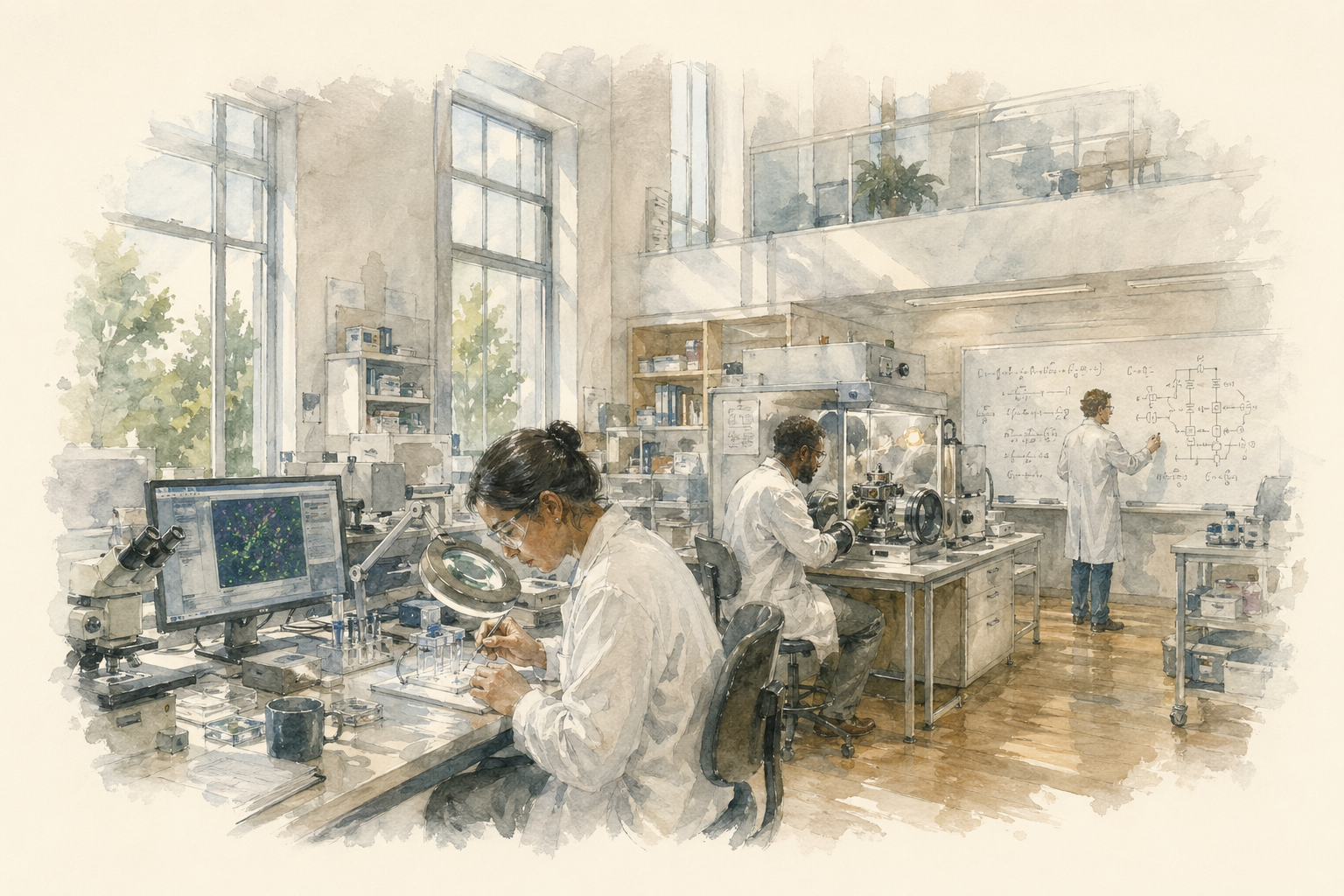
The institute itself, Hollis has never been to. He has read about it. He has seen pictures. Tall windows, wood floors, long benches with the equipment the country pays for the way the country pays for highways. While his granddaughter eats blue ice cream on a bench beside him, somewhere in that building a researcher is reading the rate at which a piece of woven platinum filament thinner than a hair is firing pulses inside an artificial heart that has been running on the bench for nine months. The filament is a new pacemaker electrode. The country is testing it for sixty years of fatigue. The country will ship it next year if it holds.
The institute he is thinking of is also doing — among other things — the work that would have saved his wife. The mRNA platform that is the standard now for every solid-tumor diagnosis in this country was working in trials at four institutions in the year she was diagnosed. It was working then. They knew it was working. It was twelve years from working in trials to being standard of care.
He does not say this to Wren. Wren is eight. There is plenty of time later.
He says: “You done?”
She is done. They go to the station.
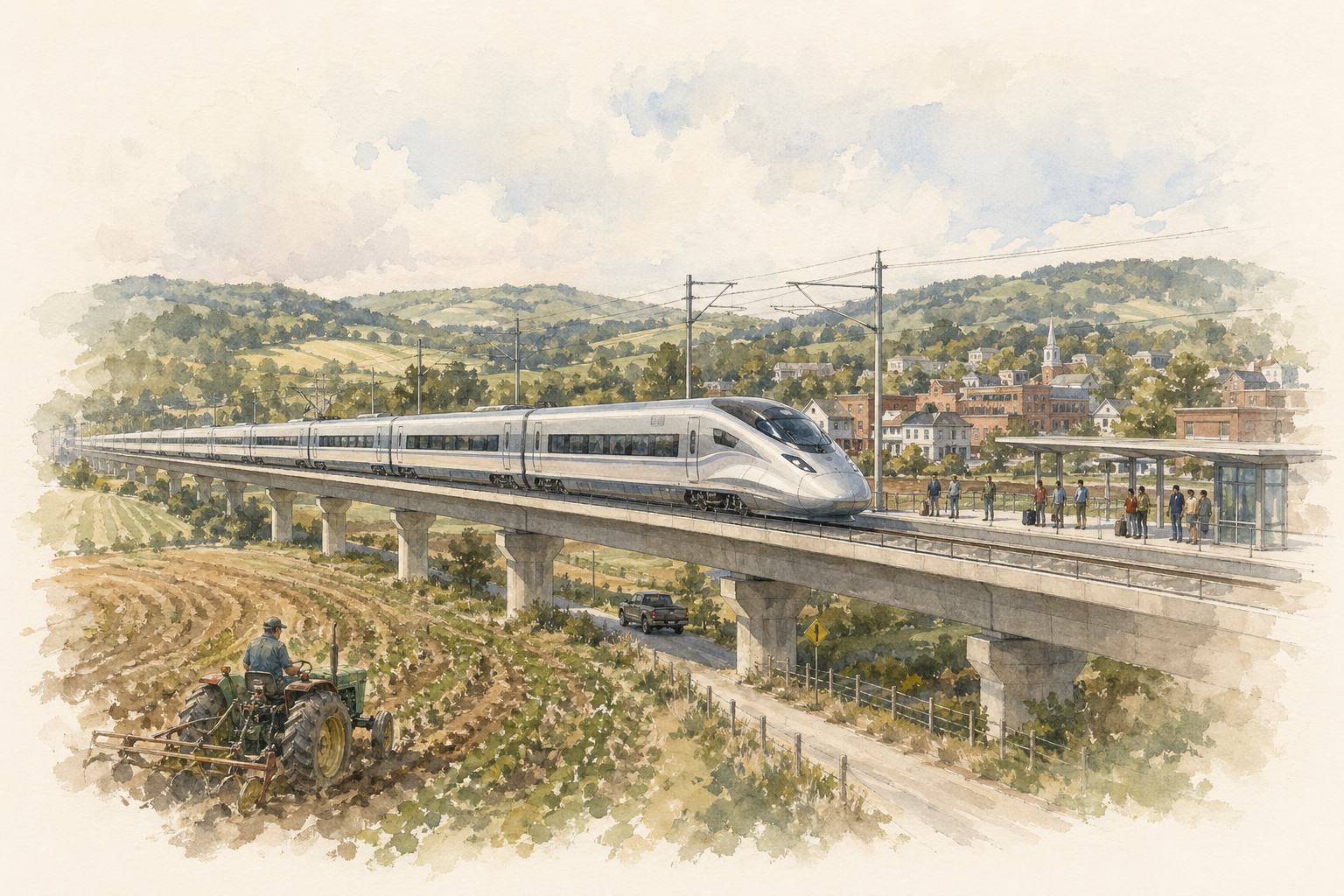
The station is the one built ten years ago, all stone and steel, with the platforms canopied against weather and the great hall warm in winter and shaded in summer. The 9:42 to Bayfield is at the platform. They board.
The train is the new fleet, the white ones with the dark stripe. They have a four-seat group with a small table between them. Wren sits on the side that faces forward and has her face against the glass before they are out of the station.
By Lincoln they are at ninety. By Bloomington they are at two hundred. The train glides on the new viaduct that was built to carry it. Outside the windows the heartland of the country slides past in the morning: rows of corn already harvested, the lights of small towns, a river, another river, a freight train on a parallel line going the other way, slower than it used to look because they are moving so much faster than it.
The Japanese had been running trains like this one since 1964. The Chinese had built twenty-five thousand miles of rail like this between 2008 and 2020 — about a continent's worth, in twelve years. Hollis had been alive for all of it. He had read about it in the newspaper on a kitchen counter in a house he could not afford to keep. He had thought, if they can do that, why can't we. He had thought it for forty years. The answer, when it came, was that they could. They had simply been told they could not, by men whose business it was to keep them buying gasoline and cars and the loans on the cars.
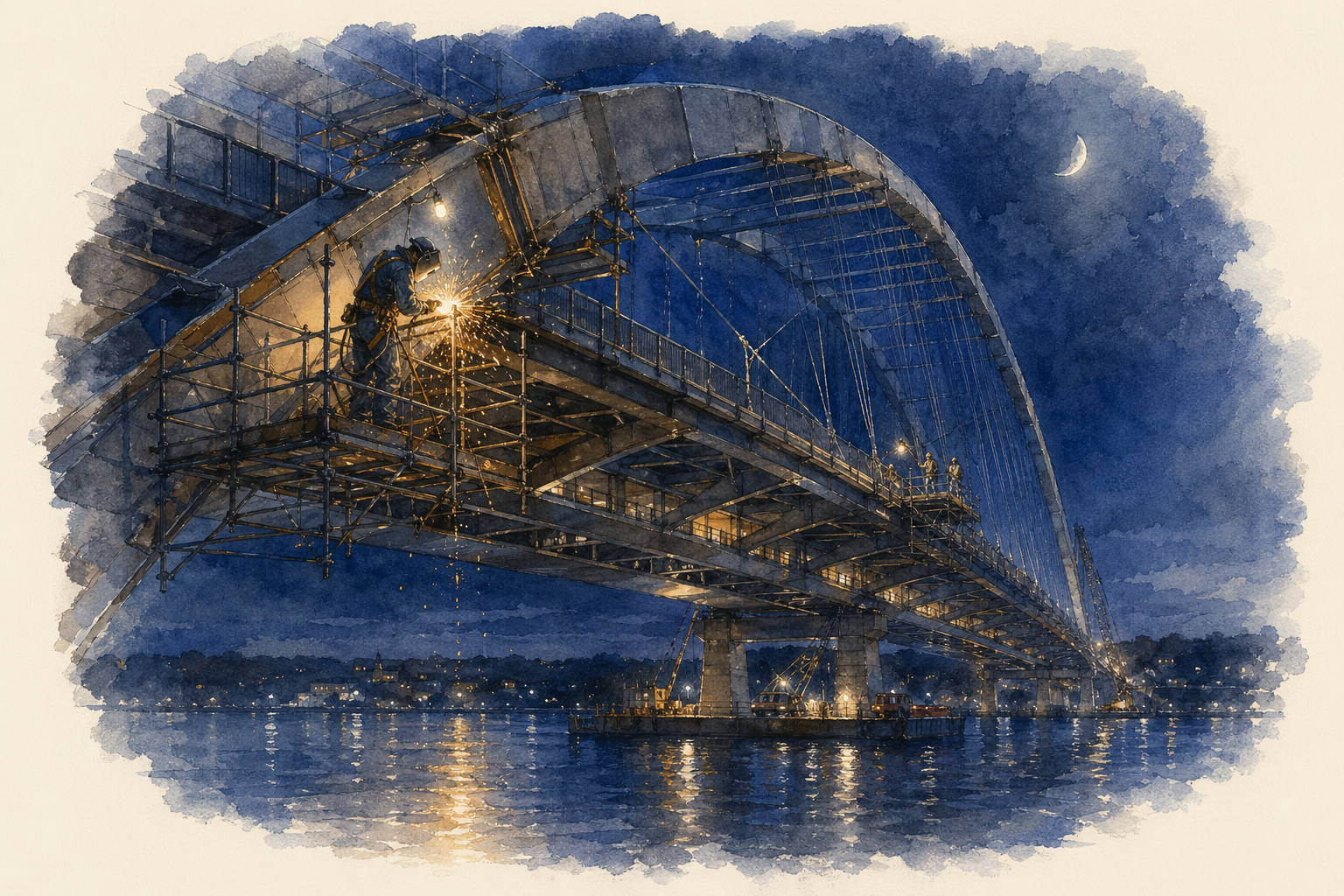
After Bloomington they cross the river on a long viaduct, and a mile up the river there is another bridge being built. He taps Wren's shoulder and points.
She presses her face harder against the glass.
There are cranes on both banks. The arch of the bridge rises in steel ribs that are not yet joined at the top. A scaffold runs the length of the unfinished span. Even from this distance she can see the small figures of people working on it — two on the deck, one on the south abutment, one on the scaffold. It is mid-morning and the work goes on in mid-morning and at noon and through the afternoon and all night.
“Are they working now,” she says.
“They're working now.”
“Even at night?”
“Even at night.”
“Why.”
“Because the bridge has to be done.”
She thinks about this.
“Is it cold at night.”
“Yeah.”
“Do they get cold.”
“They wear what they need to.”
“What do they wear.”
He tells her what a welder wears at three in the morning under the steel. The leather and the hood and the gloves, the boots that are heavy in a way her own boots are not. The lamps on the scaffold that throw the shadow of her work behind her. The shower of sparks when the rod meets the steel. The weld she will finish at the end of her shift, that will hold the south span of an arch that will carry road one way and rail the other and a path for people walking on the side, and that will be there a hundred years after she is gone.
“What do they think about,” Wren says.
He has not been asked this before by anyone.
“I don't know,” he says, after a minute. “Different things, probably. The same things you and I think about when we're working. Their kids. Their dinner. The weld in front of them. Whether the bridge will hold.”
“Will it hold.”
“It'll hold.”
“Will my name be on it.”
He looks at her.
“Yeah,” he says. “Your name'll be on it.”
She accepts this. She turns back to the window. The bridge falls behind. The country opens out on the other side.
Mike is on the floor when they come in, in the orange vest, with the radio at his shoulder. He sees Wren first. His whole face changes. He drops to one knee on the concrete and she runs at him from twenty feet out and hits him in the chest hard enough that another man would have rocked back. Mike does not rock back. Mike is built like the side of a hill.
“Hi Daddy.”
“Hi baby.”
“Grandpa took me to the doctor.”
“I heard.”
“I got a sticker.”
“What kind of sticker.”
“A frog.”
“Show me.”
She shows him.
Mike looks up at his father over the top of his daughter's head. They do not need to say anything. Hollis nods at him. Mike nods back.
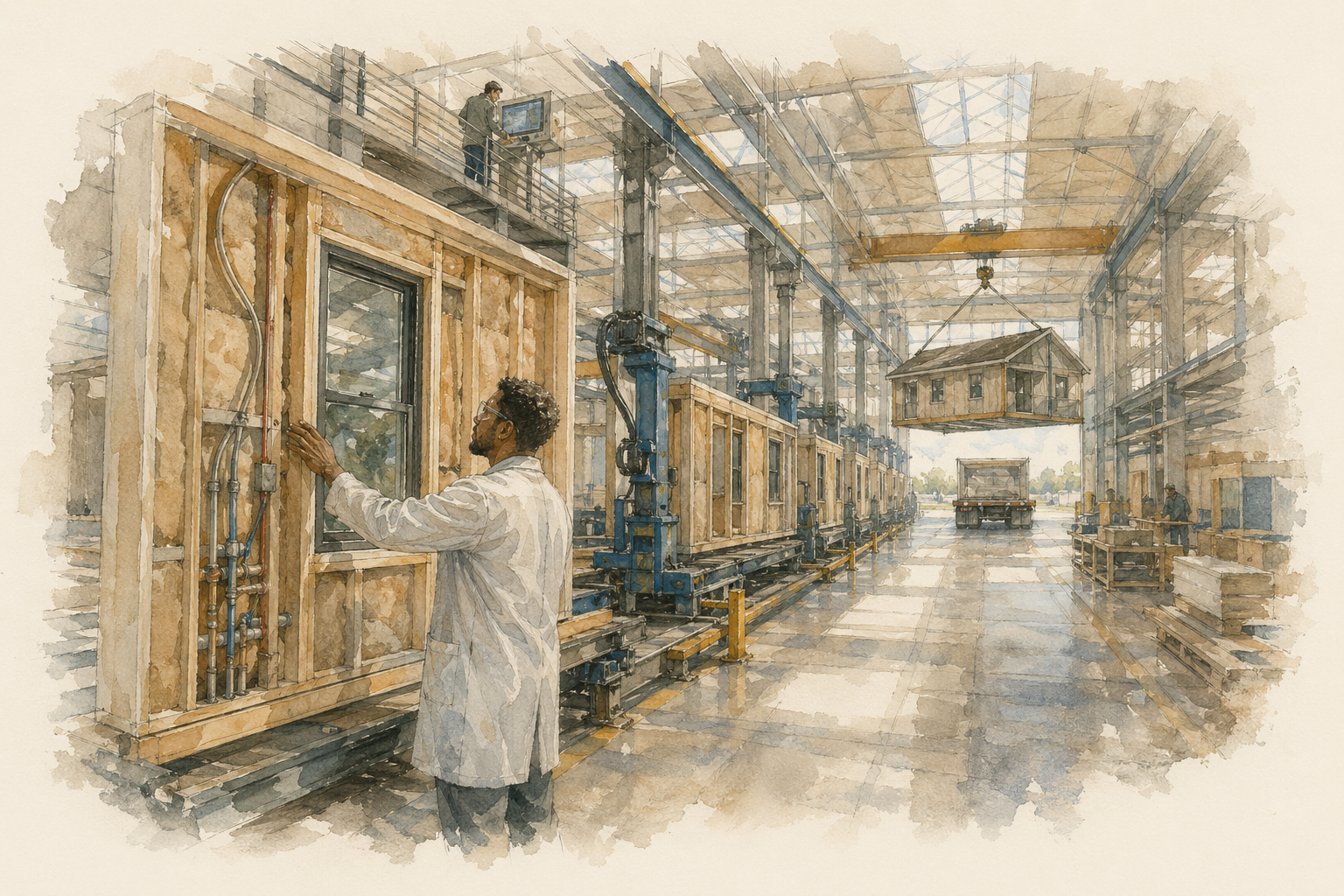
The plant is the size of three football fields under one roof. The line runs from the south end, where the steel comes in on flatcars, to the north end, where the finished modules go out on flatbeds to wherever the foundations are waiting. Today they are framing a six-house run for a town in southern Illinois that lost most of itself in the 2031 floods and is being rebuilt, all of it, by the same plant that built the house Hollis lives in.
A finished module — a two-bedroom single-story, framed and wired and plumbed and glazed, the front door on its hinges already — comes off the line at the north end as they walk in. The overhead crane catches it and lifts it slowly, slowly, in the way you lift something that weighs eleven tons but cost thirty-eight thousand dollars to build, and it travels the length of the bay and settles onto the bed of a flatbed waiting under the loading-dock lights.
The driver of the flatbed sets down his coffee and climbs into the cab of a truck he has been climbing into for eleven years. He'll be on Route 65 by lunch and at a foundation in another town by suppertime.
Mike is the foreman of the day shift. He has been at the plant for fourteen years. Before that he was a contractor on his own, and before that he had worked for another contractor, and before that he had been a kid Hollis was teaching to use a level. He had lost his shirt twice — in 2009, when he was twenty-eight and just starting, and in 2026, when he was forty-five and should have been at the height of his earning. The second time had nearly killed him. Hollis remembers driving down to his apartment in October of that year and finding him sitting on the couch in the dark with the television off.
The plant opened in 2035. Mike walked in on the first day and never left. He earns thirty-six dollars an hour, which is what the country pays for the work he does, which is enough. The check at the end of last quarter — his share of what the plant cleared — was sixteen hundred and forty dollars. His name is on the deed of the plant. So is the name of every man and woman on the floor.
He gives Wren the safety helmet that lives in his locker for these visits. She puts it on. The strap is too loose. He fixes the strap. He walks her down the line, holding her hand, and at every station he stops and tells her what is happening. The cutting station. The framing station. The plumbing rough-in. The electrical. The window installation. The cladding. The paint.
She listens with her whole body the way an eight-year-old listens to her father. Hollis stands ten paces back and does not interfere. He is a man watching his son be a man with a daughter. There is no piece of him that needs to be in the picture.
A woman on the inspection line — fifty, round-faced, hair under a kerchief — sees Wren and waves. Wren waves back.
“Who's that, Daddy.”
“That's Miss Velma. She inspects.”
“What does she do.”
“She looks at every panel that comes off the line and decides if it's good.”
“What if it's not good.”
“She sends it back.”
“Even yours.”
“Especially mine.”
Wren considers this. “Do you ever send hers back.”
Mike laughs. The laugh of a man who has not had to lie to his daughter about his work in a very long time. “Hers don't come to me, baby. Hers go out the door.”
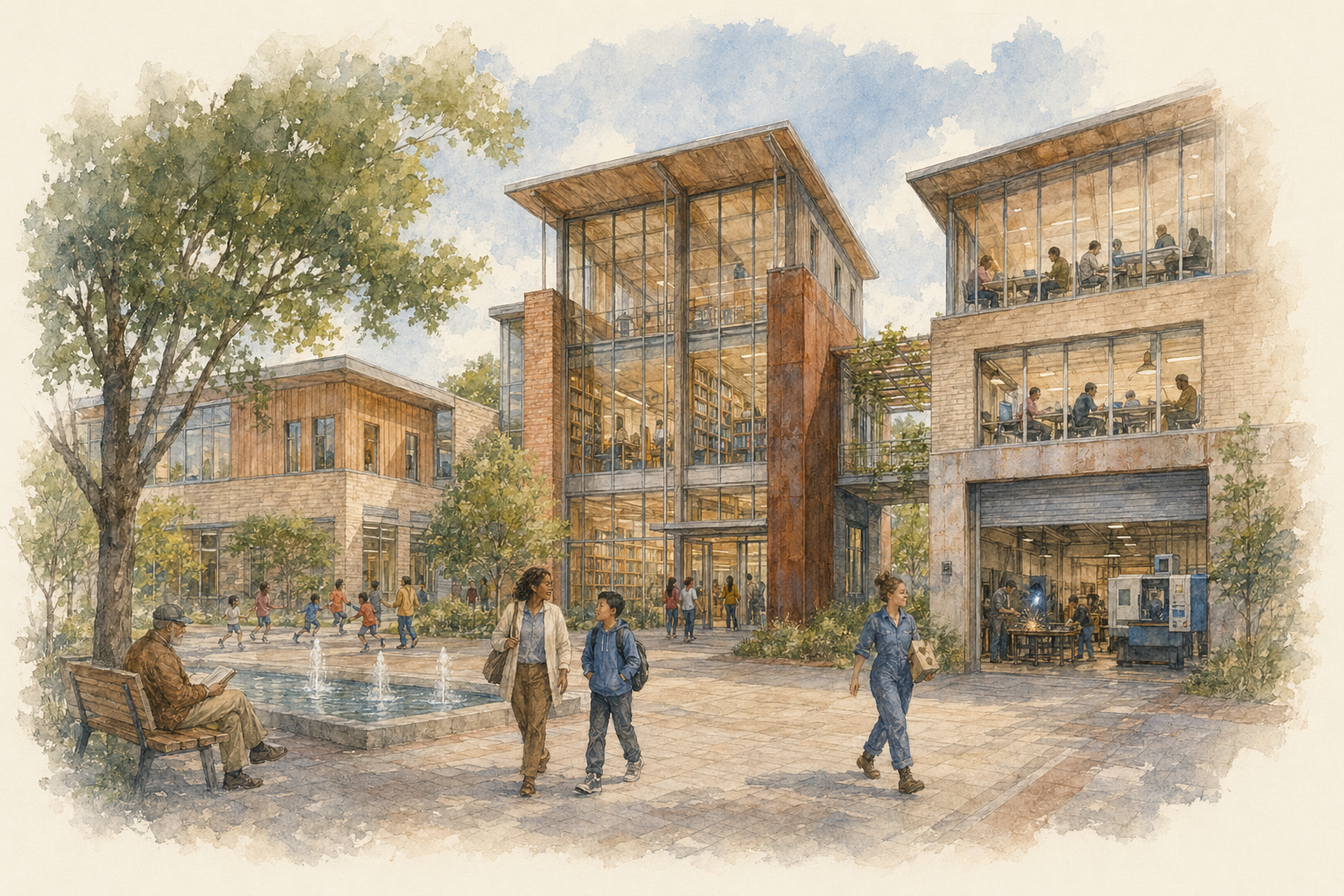
The campus is on the public square three blocks east of the plant. They cross the square at lunchtime, and a teacher is crossing the square the other way with a student of high-school age, talking to her about something Hollis cannot hear and which the student is taking seriously. The library wing is to their left as they walk. Through its tall front windows he can see the long reading tables full at noon. A man in his thirties is at one of them with a textbook open and a pencil in his hand.
The workshop wing has its big roll-up door open to the square, the way it always does in good weather. Through the open door he can see the welding bays.
A boy of fourteen is working a coupon of steel — first MIG pass of his life, sweating it. Two stations down, a woman of forty-two is doing the same. She has decided to retrain for high-speed-rail maintenance after eighteen years in retail logistics. Their instructor — sixty-one, a lifetime of welding behind her — watches both of them with the same patient eye and says nothing until she has to.
In the cafeteria Wren sits across from him with her tray and looks around at all the older people in the room. There are three retirees at the next table playing some game with cards. There is a young woman with a baby on her lap at the corner table with another young woman who appears to be teaching her.
“Grandpa.”
“Yeah.”
“Why are there so many old people at school.”
He thinks about how to answer this.
“Because school is for everybody now,” he says. “Not just kids.”
“Was it just for kids before.”
“Mostly.”
“Why.”
“Because somebody had decided to charge for it. And once you charged for it, only people who were going to use it for a job could afford to do it. And mostly the people who were going to use it for a job were young.”
She thinks about this. She is eight. She gets most of it.
“That's stupid,” she says.
“It was.”
She eats her macaroni.
On the train home she falls asleep against his arm before they are out of the third stop.
Outside the window the country slides past in the late-afternoon light. They cross back over the river — the bridge still there, still under construction, still being built by the people whose names will be on it.
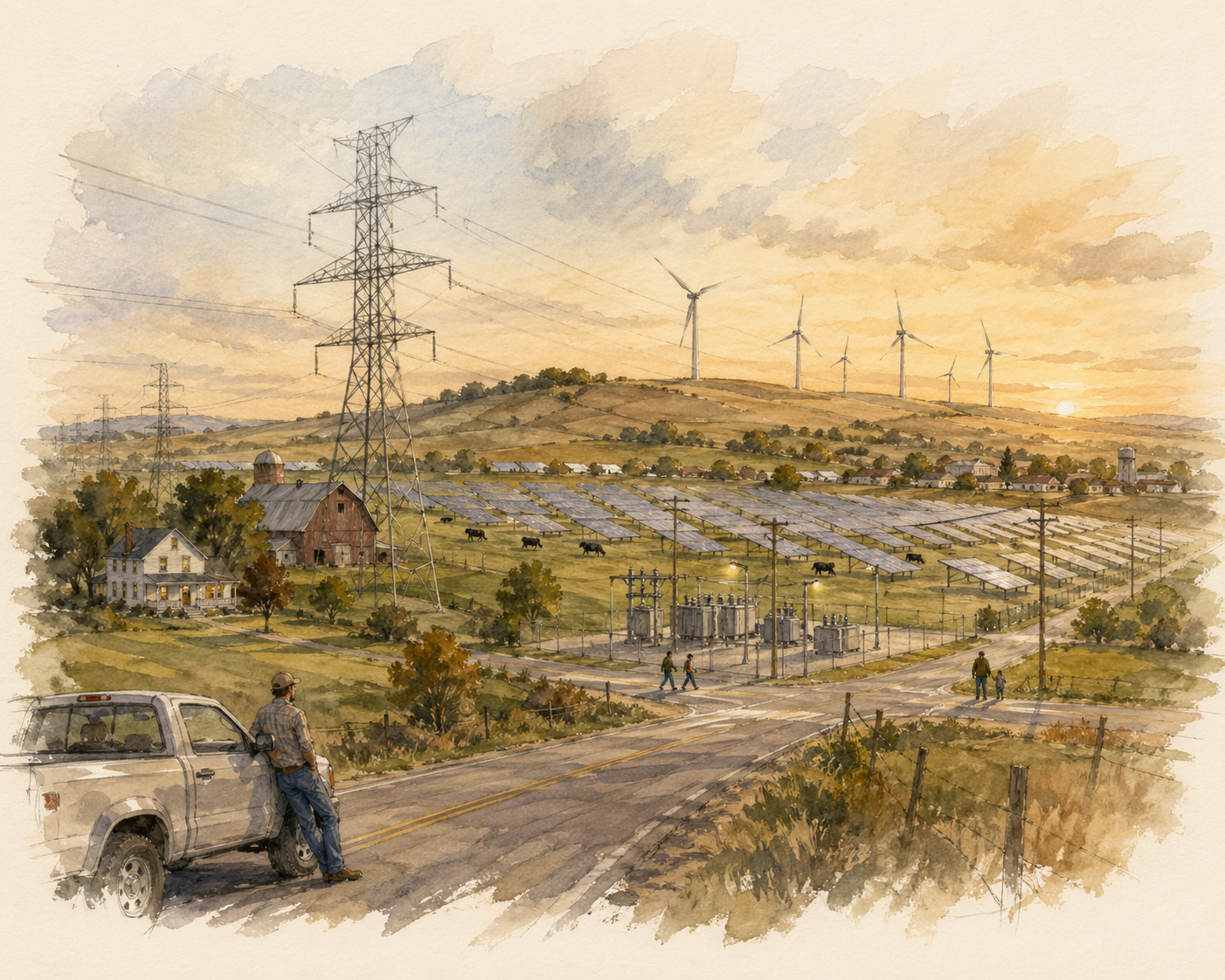
After the river the country opens out into farmland. They pass a field where the panels stand in long rows down the length of the land and the cattle have figured out that the rows drop the temperature ten degrees and that the shade does not move. A row of slim white turbines stands on the ridge beyond the field, turning at the unhurried rate they turn. Closer to the track, a small farm — barn, silo, two outbuildings — and a man in a cap leaning against his pickup truck watching the train go past, the way men have leaned against their pickup trucks watching trains go past for a hundred and fifty years.
The man who farms that land leases the surface of his field to the country for the panels. The country pays him a small lease and credits his account for the power his herd does not need. His electric bill is the cost of keeping the wire that runs to his barn in good repair, divided across the families on the same rural feeder.
The technology to put solar panels above grazing land had been on the table since 2010. By 2020 a researcher in Oregon had run it on a working farm and shown that the cattle gained weight faster, the grass kept more moisture, and the panels generated power at the same rate as panels mounted in the desert. The country had taken thirteen more years to start using what the researcher had proven.
His grandfather had farmed in the dust bowl years. There were photographs in a box at the back of Hollis's closet that he had not opened in a decade — his grandfather standing in a field that had blown away, with a hat in his hand. The country had known how to keep that from happening again by the time Hollis was a young man. Cover crops. Drip irrigation. Soil science. They had simply not deployed any of it at scale until the amendment passed.
Wren stirs against his arm and settles. He does not move. He does not want to wake her.
He thinks about Helen.
He thinks about the way she would have been an old woman now. The same age as him, just about. He thinks about her hands, which had been beautiful, and which he had not been able to fix. He thinks about the conversation they had in the kitchen in October of 2021, about the bills, and about the look on her face when he told her not to worry, and about the way she had looked at him like she knew he could not stop it, and about the way she had taken his hand anyway.
She would have liked this country. She would have liked this train. She would have liked this kid. She would have liked this kid more than anything.
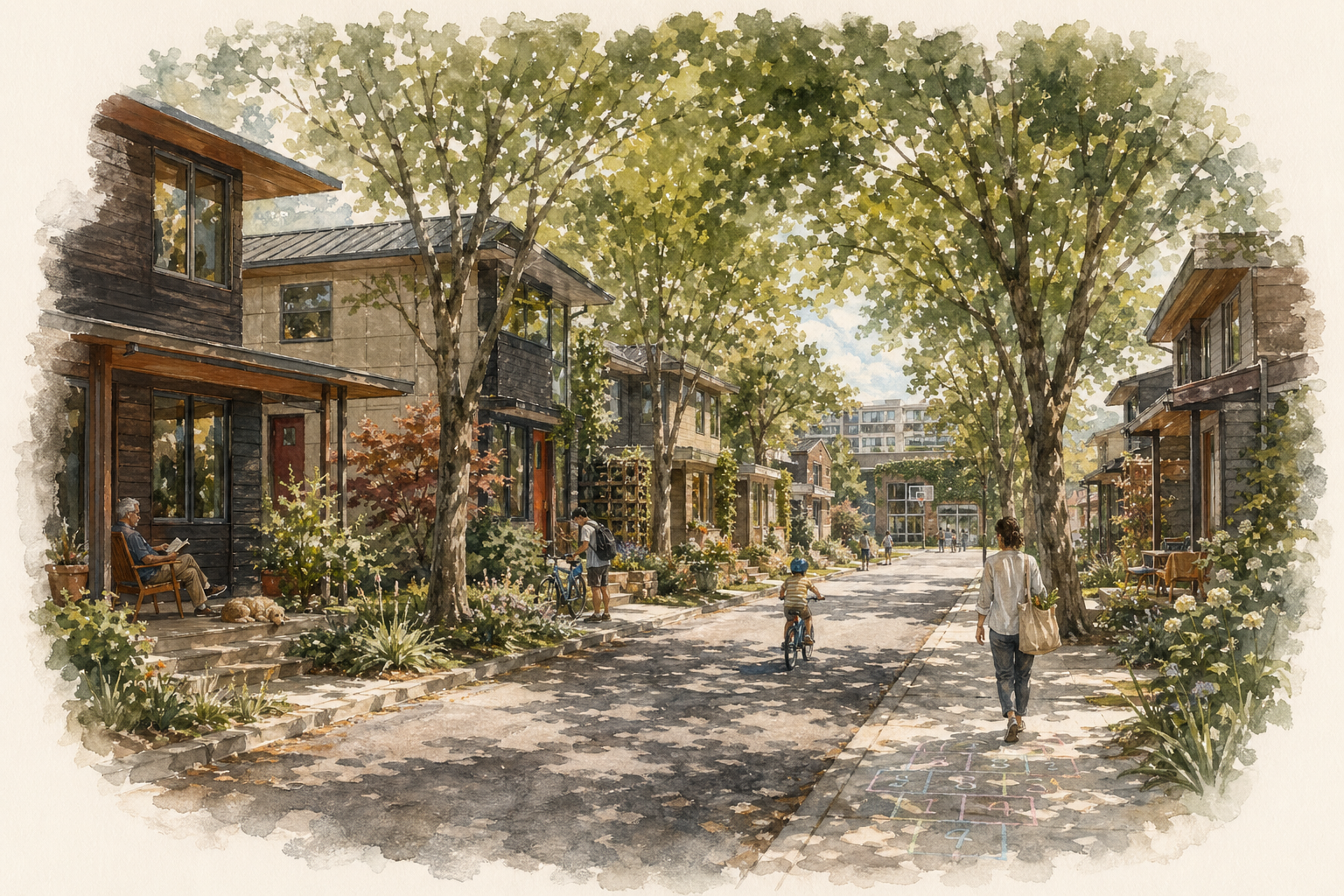
They get off at their station as the afternoon is settling. The trees on the way home are big. The maples were planted as saplings in 2031 and 2032, when the first streets went in, and they came into their full size sometime around when Wren was learning to walk. Now they vault the streets. Light comes through them in patches and moves on the sidewalk as you walk.
A girl Wren's age is on a bicycle on the sidewalk going the other way. She raises her hand off the handlebar in a small wave. Wren raises hers back. They do not stop. They know each other from school.
A woman of fifty is walking home from the corner store with a paper bag of groceries and her phone in the other hand. She nods to Hollis as they pass. He has known her since she moved in. Her son went to high school with Mike's middle nephew, two years apart. She lost her husband last winter. She is doing all right.
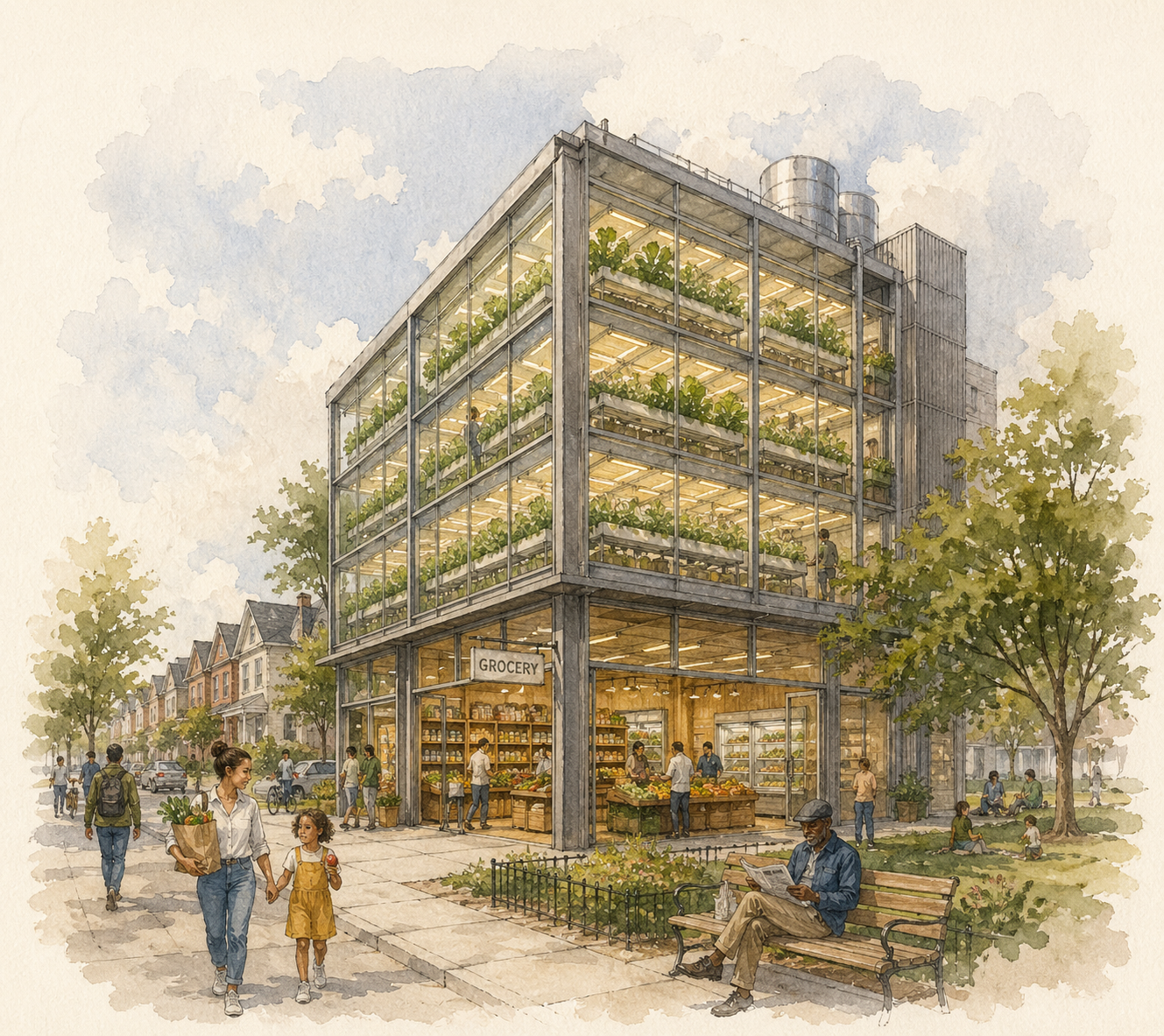
They pass the vertical farm on Maple Street. It is the building that stands at the corner of the development where the houses give way to the avenues, glass and steel and eight stories tall, and through the windows of the upper floors you can see the long shelves of greens — lettuces and herbs and the small tomatoes — going up and back.
The grocery on the ground floor is open. A young mother with a toddler on her hip is choosing tomatoes through the front window. The lettuces from upstairs are already restocked from the morning cut.
The technology to grow food on a tenth of the water in the city the food was eaten in had been working in Singapore in 2012. Newark had run a pilot in 2016. The country had let it stay a curiosity for fifteen years.
He thinks about Helen at the dollar store in 2018 with the cans in her hands, doing the math.
He keeps walking.
Mike comes by at eight to get her. She is awake by then, on the couch under a blanket, watching a show about a girl who builds a flying machine. She does not want to leave. Mike negotiates with her. She negotiates back. They settle on terms. She gets her shoes. She gives Hollis a hug at the door that is harder than it needs to be.
“Bye, Grandpa.”
“Bye, sweetheart.”
“Thanks for the doctor.”
“You're welcome.”
“Tell Grandma I said hi.”
She says it the way she has been saying it since she was four — looking past him at the photograph on the wall by the back door. She has never met the woman in the photograph and never will. She has been told, in the way an eight-year-old is told these things, that her grandmother is in the house in the way somebody who is loved is in a house, and that you can say hi to her, and that it counts.
Hollis says he will tell her.
He stands at the door until the truck's lights are gone from the end of the street.
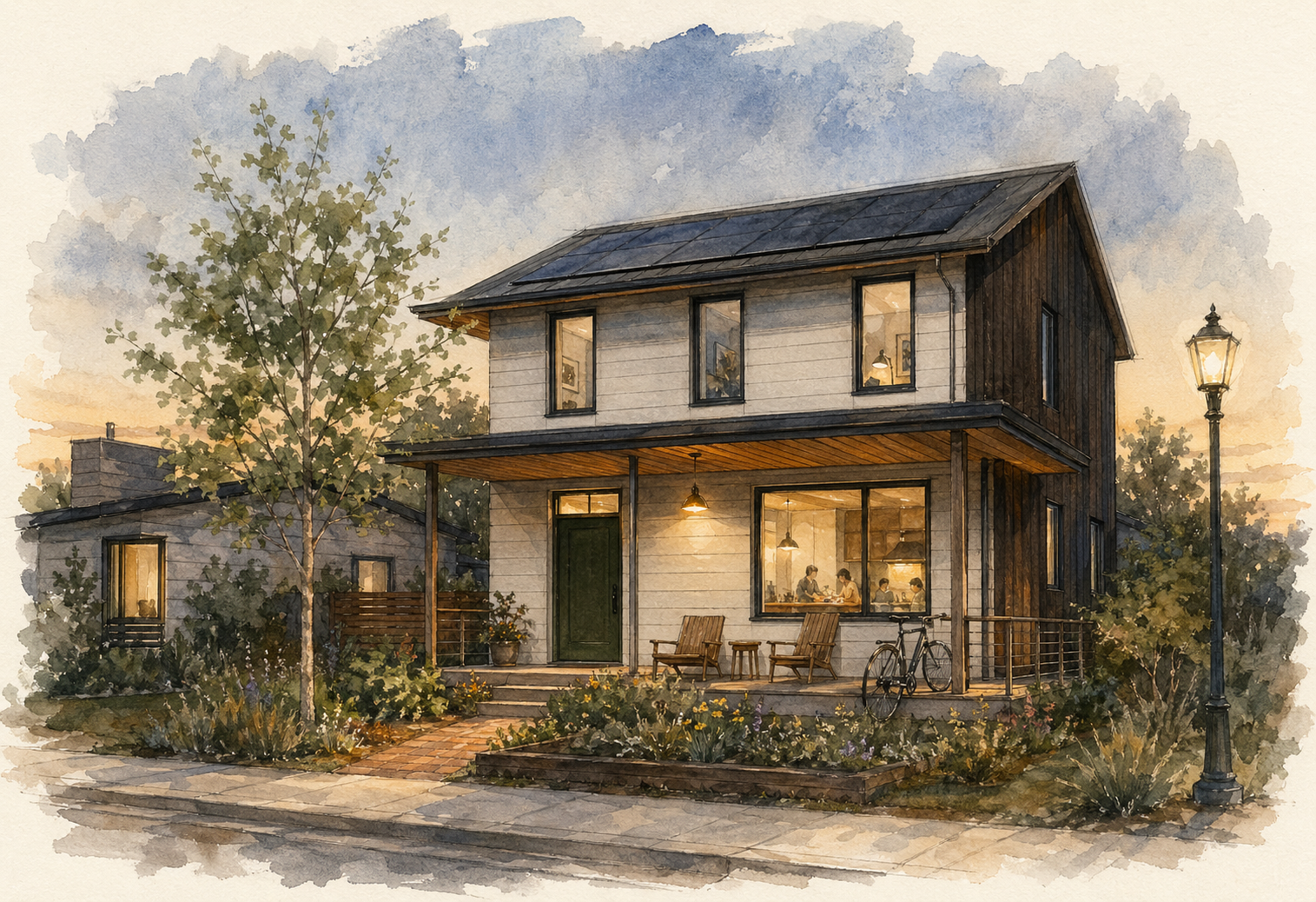
He sits on the porch for a while in the dark. The dog comes out and lies at his feet.
The kitchen window behind him is gold. The pendant light over the chairs on the porch is on, throwing its small circle. Across the street the Markhams' kitchen is lit, and somebody two doors down is laughing at something on a porch he can't see, and the streetlight at the end of the block stands in the warm color the country decided streetlights should have, after a long argument that ended in the right place.
He thinks about everything they had. He thinks about everything they did not use. He thinks about the men who decided not to use it, who he could name if anyone asked, and about the years they cost his wife and his cousin and his sister-in-law and his neighbor and the three million Americans whose names he does not know.
He thinks about the country he is sitting on the porch of.
He thinks about the kid in the truck.
He thinks about Sunday, when he took her to see the bridge that opened last year — the south span done, the deck open to traffic, the plaque at the abutment with the names of the welders and the engineers and the laborers and the inspectors on it. She had run out to the middle of the deck. She had put her hands on the railing. She had looked down at the water going by under her feet. He had stood ten paces back and watched her.
He gets up after a while. He goes inside. He stops at the photograph by the back door, the way he stops every night, and he puts his hand on the frame.
“She said hi,” he says.
Then he turns out the kitchen light and goes to bed in the country he lives in now.
Every technology in this story exists. The houses can be built for fifty thousand dollars. The mRNA platform cures pancreatic cancer. The trains run two hundred miles an hour and have for sixty years. The watch on the eight-year-old's wrist was sold to adults in 2018. The school for everyone has been possible since the printing press.
All of it is already here.
The amendment is what we use to start using it.