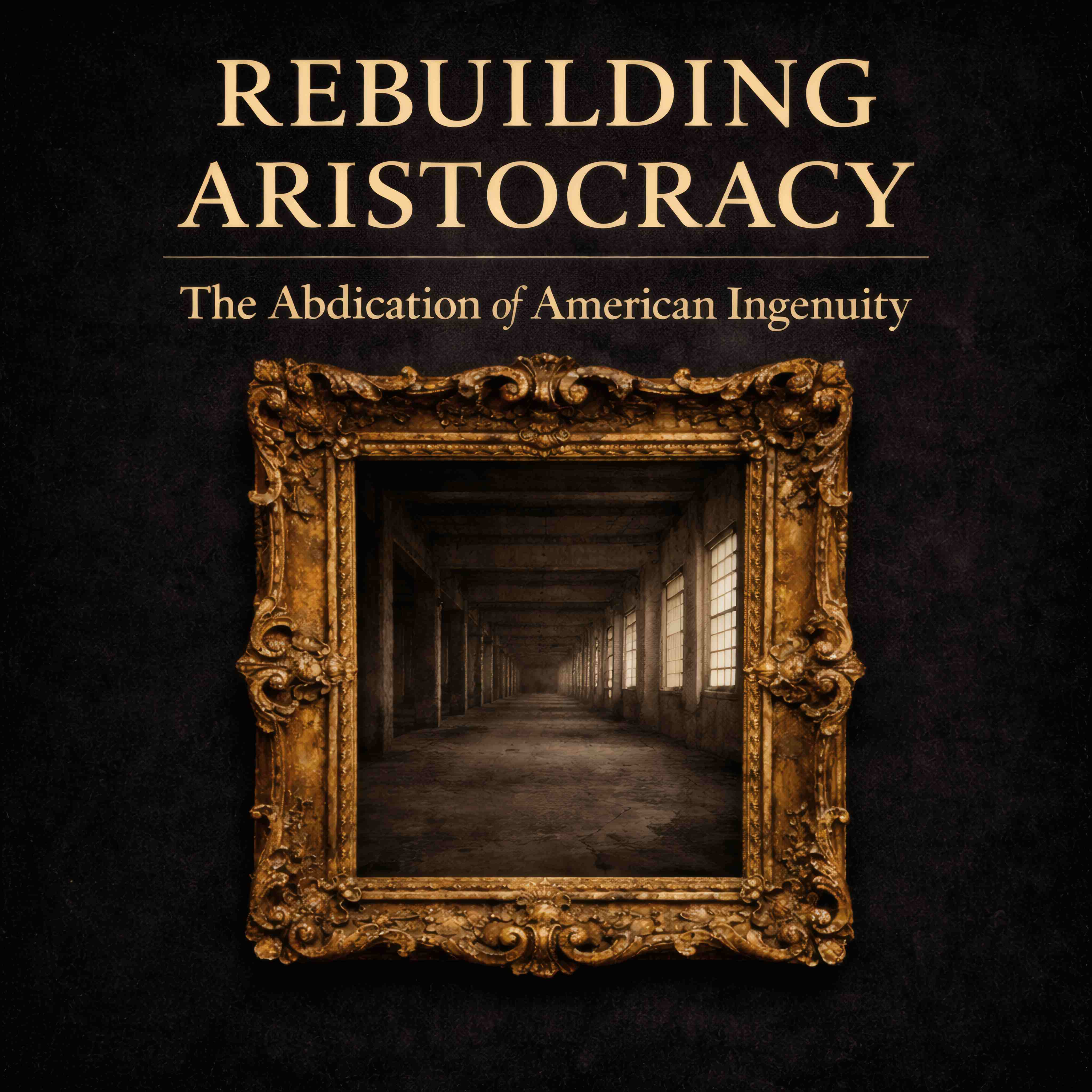
Rebuilding Aristocracy
The Abdication of American Ingenuity
The full case. 25 chapters. Names, dates, votes.
Listen free. All of it.
Introduction
America was built on a promise: if you produce, you prosper. This chapter reveals what that promise looked like when it worked, and what began tearing it apart.
Part I: The Inheritance
Before the unraveling, there was a bargain. This part examines what middle-class prosperity actually looked like, how it was constructed, and the assumptions that made it vulnerable.
Chapter 1: The Deal
In 1955, a factory worker with a high school diploma could buy a house for two years' salary and retire with dignity. This is the story of how that life was made possible, who it was built for, and the fragility that would be exploited.
Part II: The Pivot
Between 1971 and 1986, a series of deliberate decisions redirected the American economy. This part documents the memos, the votes, the rules, and the men who wrote them.
Chapter 2: The Blueprint
A secret memo circulated among corporate executives in 1971 outlined a thirty-year plan to reshape American capitalism. The infrastructure they built, from think tanks to lobbying networks, is still in place today.
Chapter 3: The Shock
When Paul Volcker raised interest rates to 19%, he knew exactly which Americans would pay the price. This is the story of Youngstown, Ohio, and the deliberate calculation that broke the industrial heartland.
Chapter 4: The Mechanism
While PATCO made headlines, an obscure SEC rule passed quietly in 1982 that would redirect trillions from workers to shareholders over the following decades. This is how stock buybacks became the extraction engine that powers modern corporations.
Chapter 5: The Seeds
The 1986 tax reform was celebrated as bipartisan triumph. It was also the moment that froze housing supply, subsidized housing demand, and began converting your shelter into someone else's investment vehicle.
Part III: The Selloff
With the mechanisms in place, the liquidation began. This part traces the deregulation of finance, the offshoring of production, and the rise of extraction as business model.
Chapter 6: The Deregulation Sequence
The wall separating your savings account from Wall Street's casino took sixty years to build and fifteen years to demolish. This is how Glass-Steagall was hollowed out, merger by merger, until Sandy Weill hung a trophy on his wall.
Chapter 7: The Trade Sequence
"America will do the thinking. They will do the making." This was the theory behind NAFTA and China trade. It was also mathematically wrong, and the executives who profited from it knew what they were sacrificing.
Chapter 8: The Extraction Machine
When KKR bought Toys "R" Us, they loaded it with $5 billion in debt, extracted $470 million in fees, and left 33,000 workers with nothing. This is how private equity turned company-building into company-harvesting.
Chapter 9: The Ratchet
CEO pay rose from 20 times worker pay to 376 times in thirty-five years, not because executives became nineteen times more talented. This chapter reveals the compensation consultants, interlocked boards, and ratchet mechanisms that ensure it can only go up.
Part IV: The Epistemic Rot
Money wasn't the only thing extracted. This part documents the systematic degradation of American competence: the credential inflation, the contempt for makers, and the institutional forgetting.
Chapter 10: The Toll Booth
In 1975, a bank teller started Monday with a high school diploma. In 2020, the same job requires $34,000 in non-dischargeable debt. The work didn't change. The gate in front of it did.
Chapter 11: The Contempt
When Boeing moved its headquarters from Seattle to Chicago, it was to "run like a business rather than a great engineering firm." Then the planes started falling out of the sky.
Chapter 12: The Forgetting
America built more ships in World War II than the rest of the world combined. Now we can't find enough qualified welders to repair a single destroyer. This is what happens when knowledge that took generations to build is abandoned in a budget cycle.
Part V: The Four Extractions
Four systems now consume most of what Americans earn: housing, healthcare, retirement, and the cost of raising children. This part examines each extraction point and how it was engineered.
Chapter 13: Housing
The median home now costs eight times the median income. This isn't a market failure. It's a market engineered to transfer wealth from the young to the old, from families to funds, from renters to owners.
Chapter 14: Healthcare
A system that started with doctors listing prices like restaurants became one where the price is unknowable until the bill arrives. This is how insurance companies, hospital monopolies, and pharmacy middlemen turned getting sick into getting extracted.
Chapter 15: Retirement
The 401(k) was never designed to be America's retirement system. It was a tax loophole for executives that became everyone's problem when corporations abandoned pensions. Now 56% of Americans have no retirement plan at all.
Chapter 16: Family
The fertility rate has been below replacement since 2007. This isn't a cultural choice. It's arithmetic: when the extractions take everything before family formation can begin, families don't form.
Part VI: The Self-Inflicted Wound
No foreign power did this to America. This part documents the voluntary surrenders: the technology transfers, the hollowed supply chains, and the crisis that revealed everything and changed nothing.
Chapter 17: The Suicide Pact
Everything documented in this book flows from one decision: to separate production from prosperity, to let ownership replace work as the source of wealth. This chapter names the pact that America made with itself.
Chapter 18: The Surrender
American executives signed thousands of technology transfer agreements with China, trading intellectual property for market access and quarterly earnings. They called it partnership. It was abdication.
Chapter 19: The Empty Arsenal
In March 2020, American hospitals needed 290 million N95 masks per month. Domestic production capacity was 80 million. This is what happens when you offshore the ability to make what you need to survive.
Chapter 20: The Revelation
The 2008 financial crisis was supposed to be the moment of reckoning. The banks were saved. The homeowners were not. No one went to prison. This is how the system learned to absorb critique without changing structure.
Part VII: The Incapacity
The institutions that created these problems cannot solve them. This part explains why transformation fails, what the clocks are counting down to, and what happens if nothing changes.
Chapter 21: The Obstacle
Seventy to eighty-eight percent of corporate transformations fail. Not for lack of money, awareness, or willingness. This chapter explains why the organizations that broke America cannot rebuild it.
Chapter 22: The Proof
Google invented the technology behind ChatGPT. Google invented the transformer. Google had the data, money, and infrastructure. Google did not ship it. This is why.
Chapter 23: The Clocks
Four clocks are running: demographic, geopolitical, fiscal, technological. Each was set by the decisions documented in this book. Each makes the others worse. None of them pause for deliberation.
Chapter 24: The Default
This is not prophecy. It is extrapolation. The same forces that produced the last fifty years, extended for the next twenty-five. The future that arrives automatically if nothing changes.
Part VIII: What Comes Next
The diagnosis is complete. This part presents the restructuring: not a policy wish list, but a constitutional architecture designed to be capture-proof.
Chapter 25: The Restructuring
The diagnosis is complete. This chapter presents the specification: how to build a system that cannot be captured, cannot be conditioned, cannot be raided, cannot be corrupted. Not a policy wish list. An architecture.