One of three first-generation works · The American Shareholder Amendment
Issued · May 2026 · Filed under THE WORKS
Sections I–XII
The Rivergate Works.
One parcel on the Willamette. A melt shop cold since 2003, a building line that takes the relit furnace's steel and turns it into the wall a family lives behind. One Tuesday, drawn at the scale of operation.
This is a walk through one piece of ground — the Oregon Steel works at Rivergate, on the Willamette in north Portland, one of three first-generation works the corps system would operate. The metal side of the parcel is Manufacturing Corps' work: a melt shop — furnace, ladle, degasser, slab caster — cold since 2003; a plate mill running today on purchased slabs; and a thin-strip line — hot mill, cold mill, galvanizing — that would come online alongside the relit furnace. The build side is Building Corps' work: a modular fabrication line that takes the coil south and turns it into the wall a family lives behind. Same parcel. Two corps in handoff. Every stage running at once.
The trade exists. The technology runs on real shop floors in this country today. The infrastructure — rail, dock, grid, the Bonneville intertie — is in the ground. The workers are trained or trainable. None of this has to be invented. The country has not lost the capability. It has lost the institution that puts the capability under one owner whose time horizon is a century.
Everything below is in present tense — the furnace pours, the wall frames, the family moves in — because that is the only honest way to show what the institution would do at the scale a family lives at. Imagine the corps took this parcel tomorrow. None of it is built. All of it could be.
I. The same ground.
sit on a hundred and forty-three acres at the confluence of the Columbia and the Willamette, nine miles northwest of downtown Portland. Furnace 1 came online in 1969 — a hundred-ton electric arc, fed by Bonneville power through the transmission corridor that crosses the parcel's east edge. The plate mill rolls today. The melt shop — the furnace, the ladle station, the degasser, the slab caster — has been cold since May 2003. The apprentice who will stand at the panel station this afternoon was born that same month.
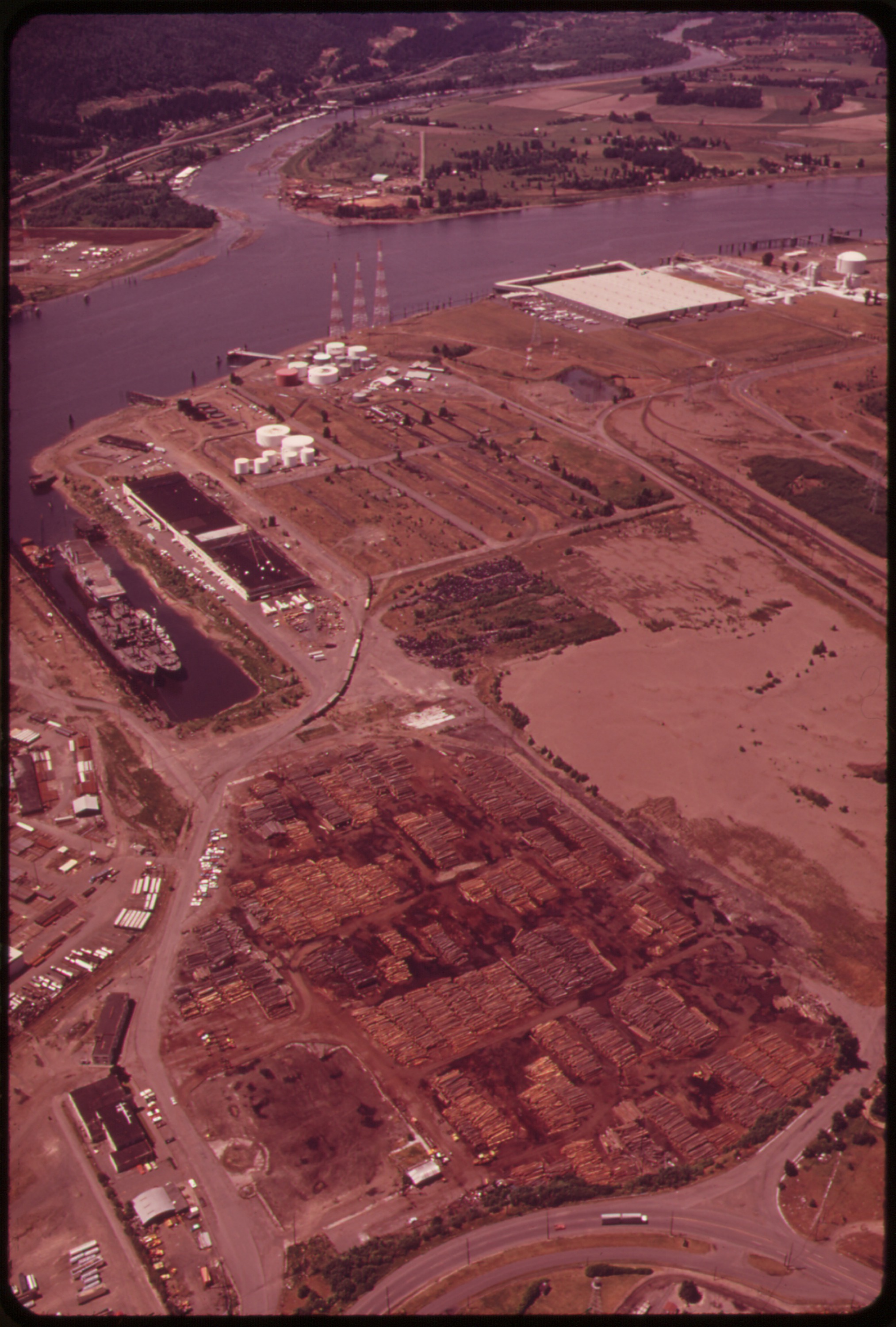
Figure I · The Rivergate peninsula, 1973.
An oblique aerial of the industrial ground at the confluence of the Columbia and the Willamette — log piles in geometric stacks, the fuel-tank farm at mid-frame, a ship at the deep-water dock, warehouses and rail yards threading between facilities, the river running past all of it. The country that still built. Photographed, not imagined.
Photograph · David Falconer, June 1973 · Records of the U.S. Environmental Protection Agency · NARA · public domain.
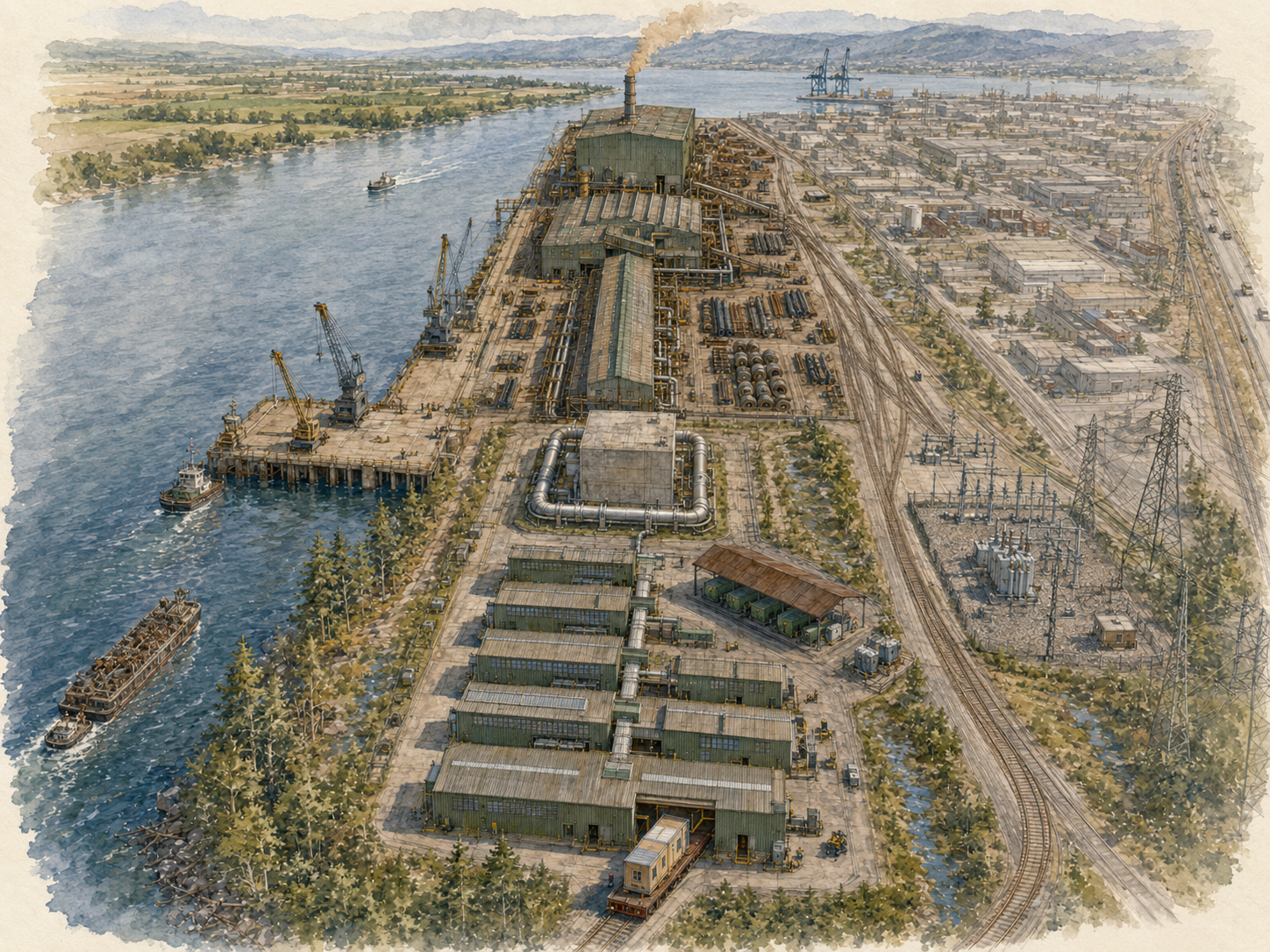
Figure II · The same ground, under one owner.
The parcel from a higher vantage, drawn rather than photographed — the mill at the head of the line with a plume rising from its stack, the rolling halls south of it, the modular fabrication buildings at the lower half of the parcel, rail spurs threading to the consist yard, the deep-water dock and a barge at the crane, the BPA substation at the east edge, the Terminal 6 container cranes at the upper right. The same ground, running.
The peninsula.The Rivergate Industrial District is three thousand acres of working ground — the same ground that fed the Kaiser shipyards in the forties, the same Bonneville power that lit the aluminum smelters at the river's edge, the same deep-water dock that loaded plate onto barges for the coast. Two transcontinental railroads cross the peninsula from the east. A foreign-trade zone wraps the parcel. The infrastructure was sized for a melt shop at full charge, and it has been running at a fraction of itself for twenty-three years. It is not a memorial. It is in place.
The works.The Steckel plate mill runs today, rolling purchased slabs into wind-tower shell and structural beam. Two helical-weld pipe mills came back online in April 2023 and brought two hundred workers onto the floor. But the melt shop at the head of the line went cold in May 2003, when the company that owned it decided the quarterly return on the furnace was lower than the quarterly return on selling the parcel. Two hundred steelworkers walked off that floor for the last time in the same month. Some of them are still in Portland. Some of their children work the pipe mills now. The company was right about the return. It was not thinking in centuries.
The ground south.South of the rolling mills, along the river frontage, sit roughly a hundred and fifty acres of flat, served, zoned industrial land — largely undeveloped. The dock is there. The spurs are there. The cold stack is visible from every corner of it. If a single institution took this parcel tomorrow, the question would not be whether the infrastructure can support what follows. The question is whether the institution exists. Everything else is already in the ground.
II. The first tap.
Furnace 1 has been cold for twenty-three years — the refractory relined, the electrodes re-clamped, the transformer re-insulated, the water-cooling panels pressure-tested, but the shell itself is the shell that poured the steel that built the wind-tower bases and the structural plate and the line pipe that walked off this parcel from 1969 to 2003. The tap opens. The first metal pours.
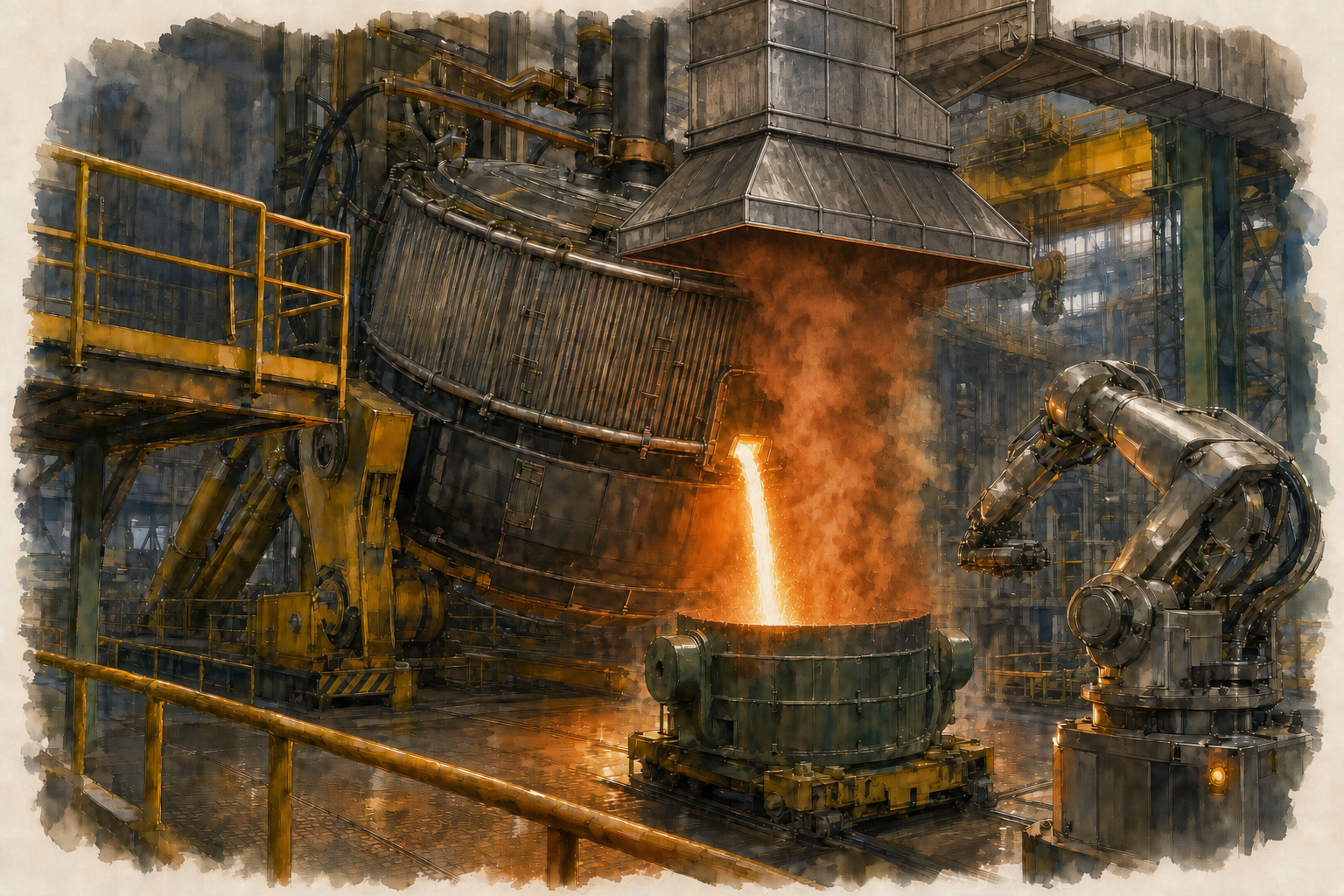
Figure III · Furnace 1, on tap.
The tilted electric-arc furnace pouring molten steel into the ladle on its rail car below — a sustained column of orange-white liquid falling twelve feet, sparks scattering across the deck plate, the fume hood drawing the plume overhead, a heavy industrial arm parked on standby at the right side of the bay. The yellow safety railings, the catwalks, the radiant halo washing every surface the color of the metal. The first heat in twenty-three years.
The bay.The furnace is the same design it was in 1969 — the same geometry as every American electric-arc furnace built in the last sixty years. Twenty-five feet across, tilted forward on its cradle, three graphite electrodes through the dome. The steelworkers who poured the last heat in 2003 are on the floor this morning. They recognize every surface — the tilt mechanism, the fume hood, the position of the safety railings. The apprentices around them are learning what the men already know: that the technology never left, that the skill is in the hands, that what went cold on this parcel was not the capability but the will to hold it.
The pour.The taphole opens and liquid steel descends — orange-white at the lip where the temperature is north of twenty-nine hundred degrees, dimming to deep orange as it falls twelve feet into the ladle below. The light from the pour washes everything the color of the metal — catwalk, railing, the underside of the hood, the faces of the crew. The apprentice on the platform has her visor down and her radio up. She has trained on cold runs and simulators for six months. The video did not prepare her for the heat on her forearms at forty feet, or the sound — not a roar but a sustained tearing, the sound of twenty-nine hundred degrees falling through air. She will tell her own apprentices about this morning. The steelworkers beside her are quiet. They have seen this before. They are watching her see it for the first time.
What the morning sets in motion.When the ladle is full, the rail car moves it south — to the ladle-metallurgy station for chemistry trim, then to the vacuum degasser, then to the slab caster. By mid-morning the liquid steel is a solid slab on the roller table. By noon the slab is rolling to coil on the hot-strip mill. In the days that follow, the coil cools, runs through the cold mill, passes through the galvanizing line, and crosses the parcel to the building line. Every stage of that journey is running right now, on steel that poured earlier this week — the caster casting, the mill rolling, the cold mill reducing, the galvanizing line coating, the building line framing. The parcel is a river, not a sprint. Every section of it is moving at once, and the apprentice who watched this morning's pour will work that steel at her panel station later this week. None of the downstream has happened to this heat yet. The pour is still running.
III. The metal walks south.
is walking south through every station on the parcel right now — scrap to liquid, liquid to slab, slab to coil, coil to the building line. Every stage running at once, on one piece of ground, under one institution. The reader walks the line in one morning. The metal takes its own time.
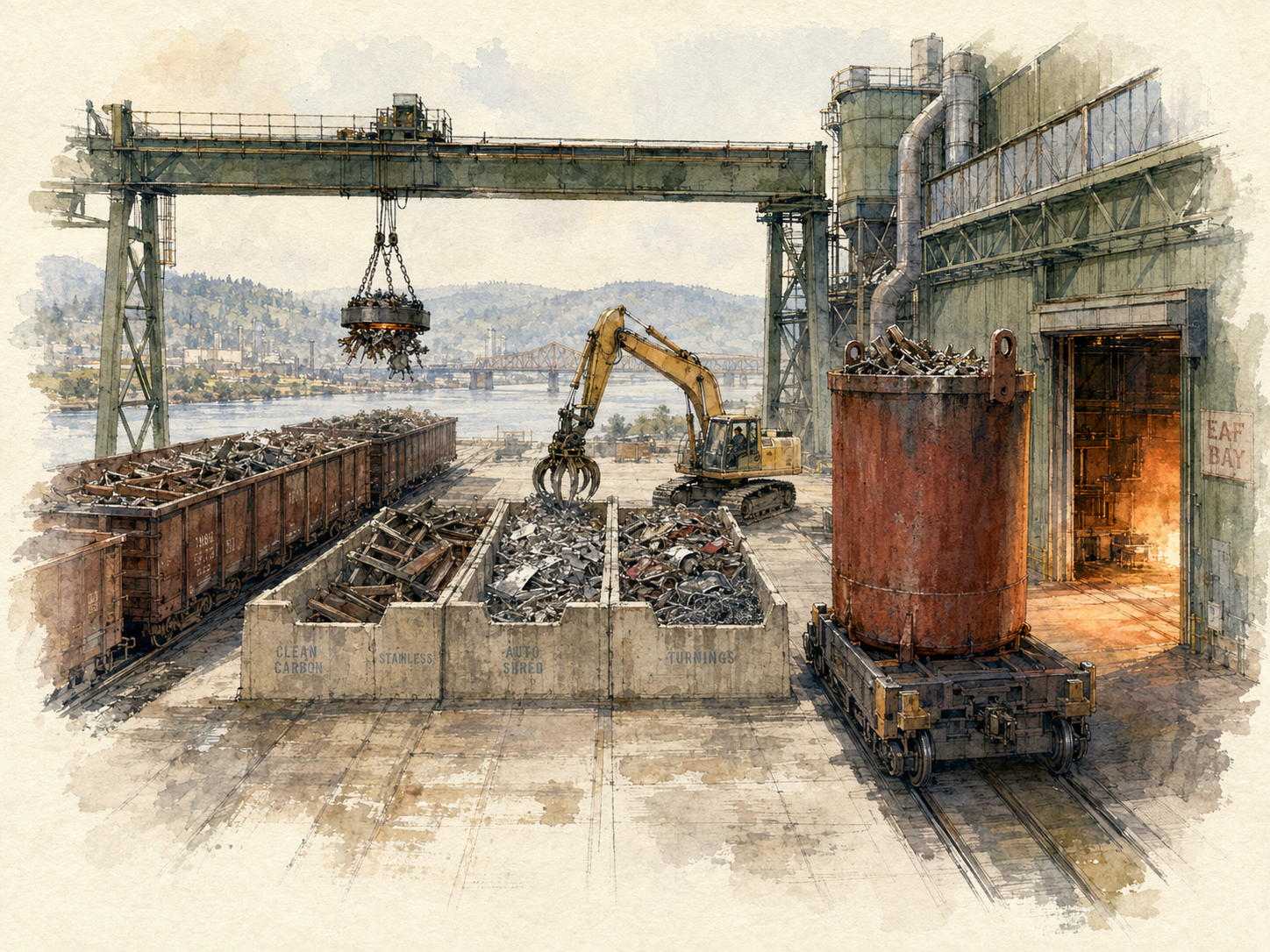
Figure IV · The scrap bay.
Gondola cars in the sorted scrap yard — a gantry crane lowering a round electromagnet over the bins, an excavator with an orange grapple sorting the near bin, a conical charging bucket on its rail bogie heading toward the furnace bay door, which glows orange from the heat inside. The Willamette and the far hills visible through the open yard. The old country goes in. The new country comes out.
The scrap.Every piece of steel in those bins was something else first — a bridge girder from an overpass in Eugene, a car body from a shredder in Longview, plate offcuts from the wind-tower shop a mile downriver. An electric-arc furnace is the most American form of steelmaking: it does not mine ore; it recycles the country. The scrap arrives by gondola car overnight, sorted by grade in the concrete-walled bins — heavy melt, plate-and-structural, shredded auto body, industrial turnings — and by morning the charging bucket is riding its rail car through the bay door. The Willamette behind the yard is the same river that brought the scrap barges when the mill ran three shifts. The dock still serves.
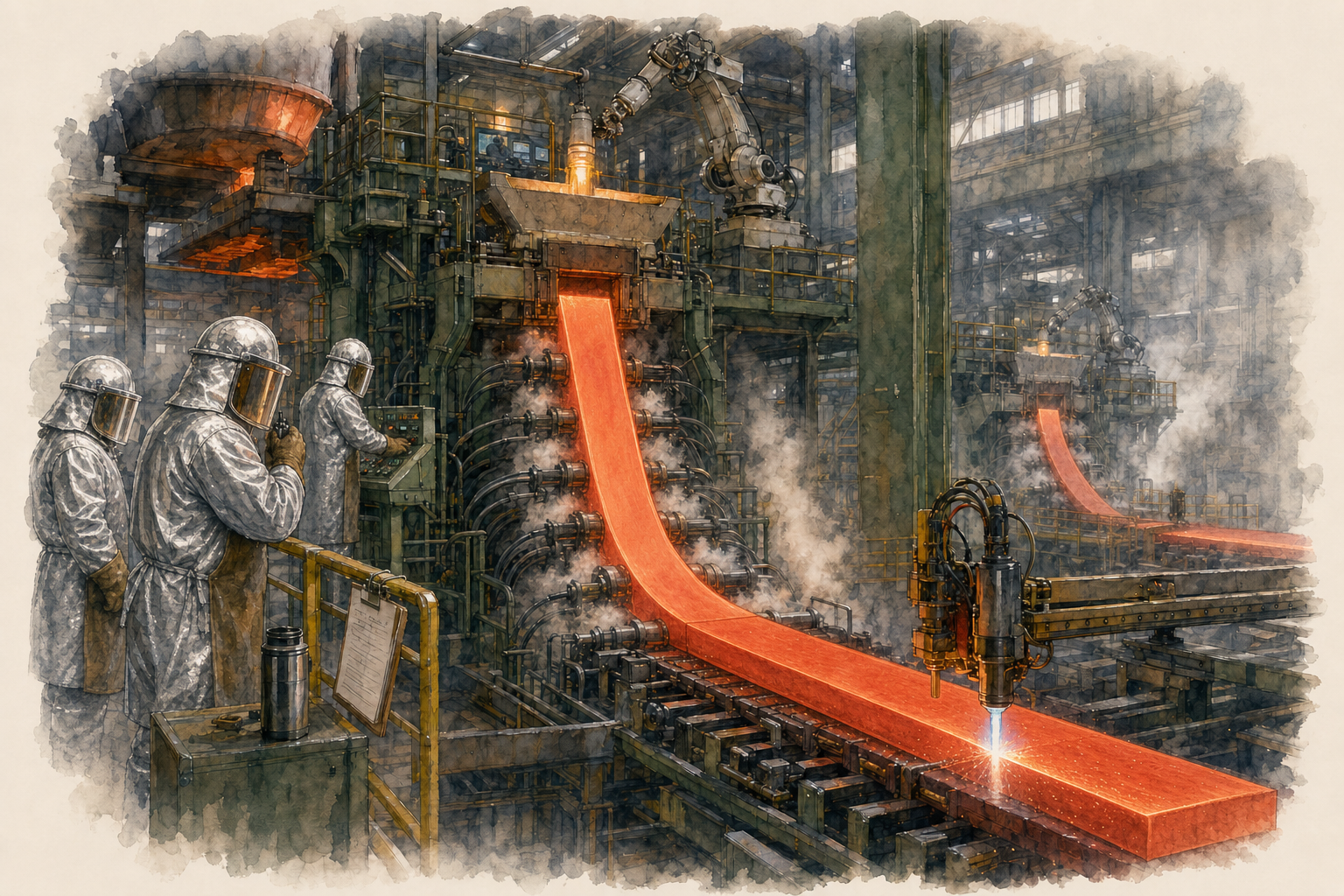
Figure V · The caster strand.
Three workers in aluminized proximity suits at the operating platform, watching a bright-orange strand of solidifying steel curve down from the tundish through the spray chamber on driven rolls — the liquid core narrowing as the strand bends from vertical to horizontal, a torch cutting the strand into slabs at the far end, steam rising from the water-cooled containment rolls. The liquid in the ladle twenty minutes ago is a solid slab on the roller table now.
The caster.Twenty minutes after the pour, the steel is solidifying — a bright-orange strand curving from vertical to horizontal, the outside surface frozen against the copper mold, the core still molten, the color gradient readable from the operating platform the way a baker reads an oven. The workers at this station have been reading that gradient for years — color, speed, the behavior of the meniscus at the mold. The slab that comes off the roller table weighs eight tons, still hot enough to glow at the edges. By noon it will be a coil on the hot-strip mill, and after that it is headed south.
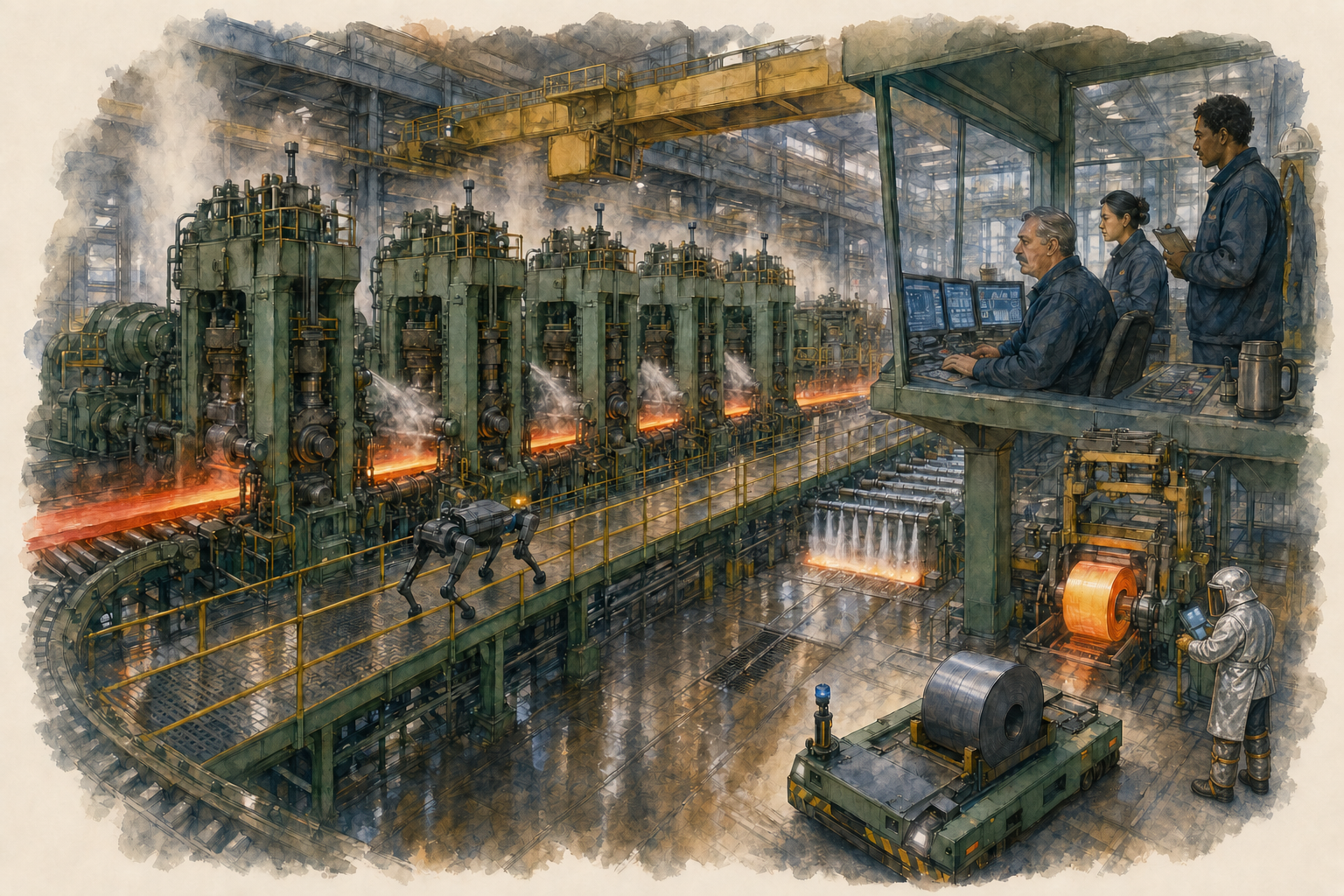
Figure VI · The hot-strip mill.
A long view down the mill — multiple roll-stand housings in sequence, an orange-hot strip threading between them at speed, steam and spray rising from the descale headers, a quadruped inspection unit walking the mill floor, operators in an elevated pulpit running the schedule from a bank of monitors. At the far end, a finished coil being banded on the mandrel. The slab that left the caster enters one end. The coil that leaves the other end is the wall.
The hot mill.The slab enters the reheat furnace at one end of a quarter-mile building and exits as a coil at the other — a sequence of rolling stands reducing the thickness and increasing the speed until the strip is moving faster than a man can run. A quadruped walks the line between stands, reading strip temperature and surface quality on every pass; three operators in the elevated pulpit at the exit end run the rolling schedule on their monitors. The coil that comes off the mandrel is still hot-rolled gauge — too thick and uncoated for the building line. It has two more stations ahead: the cold mill and the galvanizing line. But the metal that was liquid three hours ago is now a coil, and it is headed south.
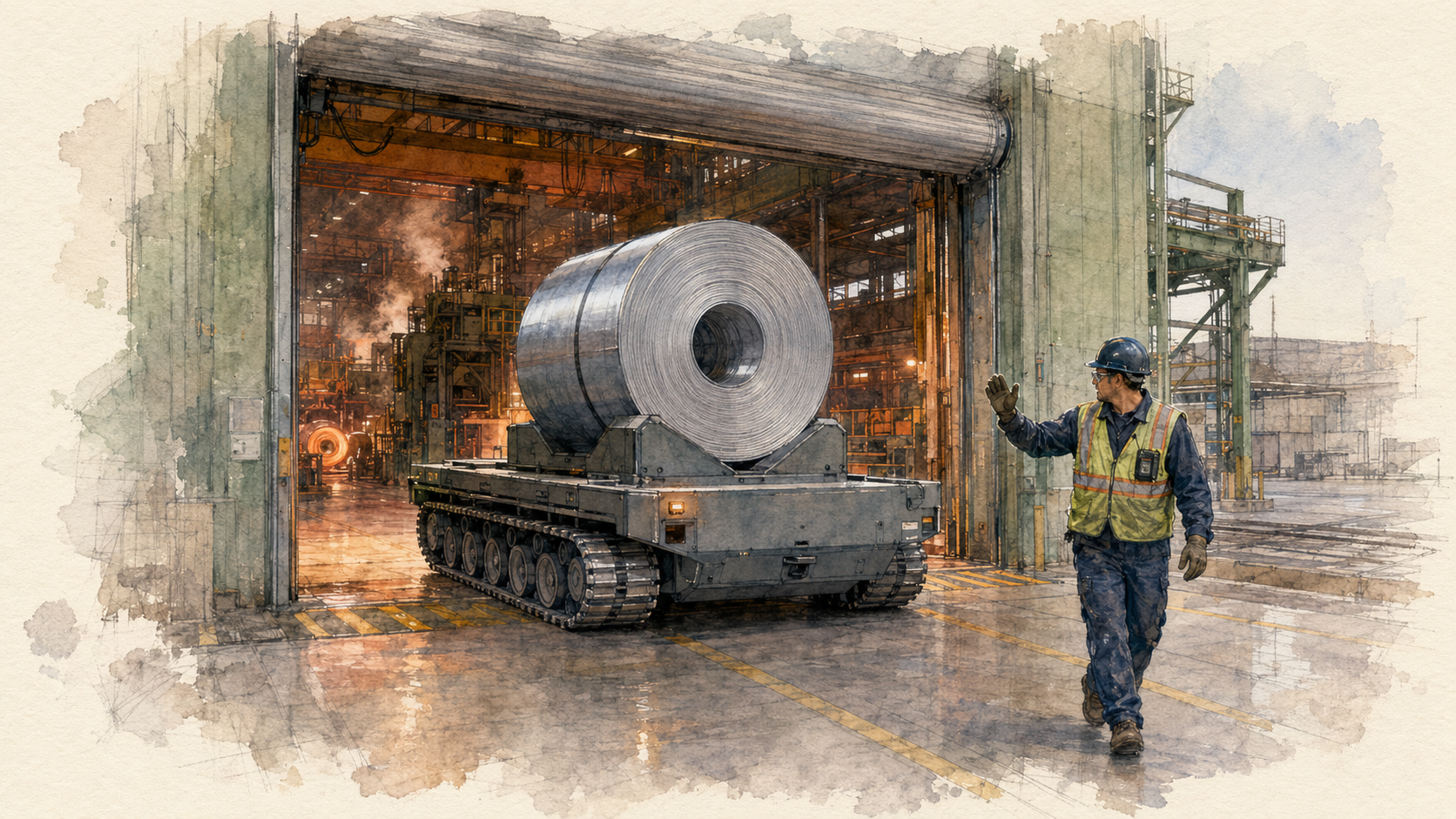
Figure VII · The coil walks south.
A single worker in a hard hat and high-visibility vest guiding an enormous steel coil on a tracked carrier through a large roll-up door — the warm orange glow of the mill interior behind him, the daylight of the yard ahead. The coil is massive against the scale of his body. This is the handoff. Manufacturing's work is done. Building's work begins.
The handoff.A coil sits on a tracked carrier — twenty tons, enough steel for six to eight complete houses — and a worker guides it through the roll-up door from the mill into the yard. Behind him the mill glows orange; ahead, the Building Corps' fabrication hall is two hundred yards south. This is the threshold. The metal crossed the parcel under Manufacturing Corps' ownership — their furnace, their caster, their mill. The building it enters next is Building Corps' floor, Building Corps' trade, Building Corps' apprentices at the panel station. Two corps, one parcel, one handoff. The worker's hand is up — checking the track ahead. The metal that poured on this parcel earlier this week is about to become a wall.
IV. Inside the wall.
is hot-rolled gauge — too thick and uncoated for the building line. After it cools, it runs through the cold mill, reduced pass by pass to twenty-gauge sheet, then through the galvanizing line, where it passes through a bath of molten zinc that seals the surface for the life of the wall. The galvanized coil reaches the roll-form station a few days after the pour, and the roll-former bends the flat strip — cold, no welding — into the C-channel studs and track that frame the wall.
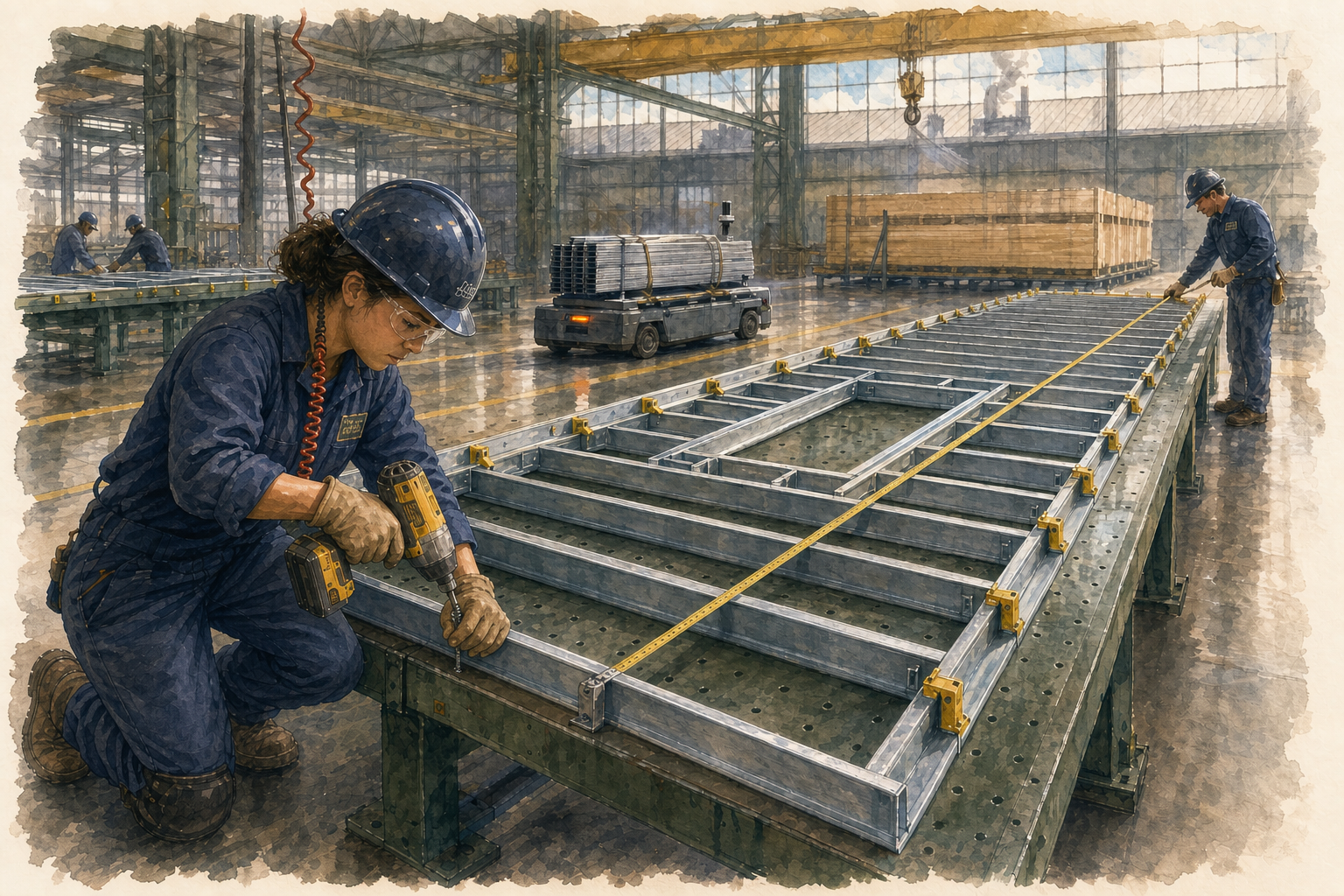
Figure VIII · The panel jig.
A woman in a navy hardhat kneels at the near end of a long steel-framed wall panel laid flat on the green jig, driving a fastener through the stud flange with a cordless impact driver. A second worker at the far end pulls a yellow tape measure along the panel's length. A powered floor cart passes in the aisle behind, the high-bay lights and structural steel of the factory extending overhead and away. The metal that was liquid on this parcel three days ago is the steel in her hand this afternoon.
The jig.The panel is twelve feet long and eight feet high — studs at sixteen on center, top and bottom tracks fastened, the frame squared on the jig before sheathing goes on. The apprentice is at the near end with a cordless impact driving a self-drilling screw through the stud flange, and the angle of her wrist says the tool has been in her hand long enough to be part of it. Down the jig, another worker checks the diagonal. Behind them, an autonomous cart delivers the next stud stack from the roll-form station. The metal she is fastening was liquid on this parcel three days ago — walked the entire line, furnace to caster to mill to cold reduction to galvanizing to roll-form — and it is in her hand now, becoming a wall.
The wall.The studs are the galvanized steel that walked south from the mill. The exterior sheathing is magnesium-oxide board — MgO does not rot, does not burn, does not feed mold, and it will be the same board in year sixty that it is today. The insulation is mineral-wool batt, which gives the wall its fire rating and its acoustic separation without the moisture problems closed-cell foam develops in its second decade. The interior face is gypsum over a vapor-smart membrane that opens in summer and closes in winter. Any builder knows these materials. What changes them is the specification — because the institution that writes it is the same institution that pays the energy bill in year thirty, replaces the cladding in year fifty, and remodels the kitchen in year seventy-five. When the spec-writer and the bill-payer sit on the same balance sheet for the century, every material in the wall is chosen against a hundred-year question. The wall is the answer.
V. The building line.
in about forty minutes. Four walls, a floor cassette, and a roof panel make a module. A module is a room — or two rooms, depending on the floor plan. A finished house is two to four modules set on a slab. The line that assembles them runs the length of the fabrication hall, and it runs the way any production line runs when the pace is set by the trade rather than the quarterly.
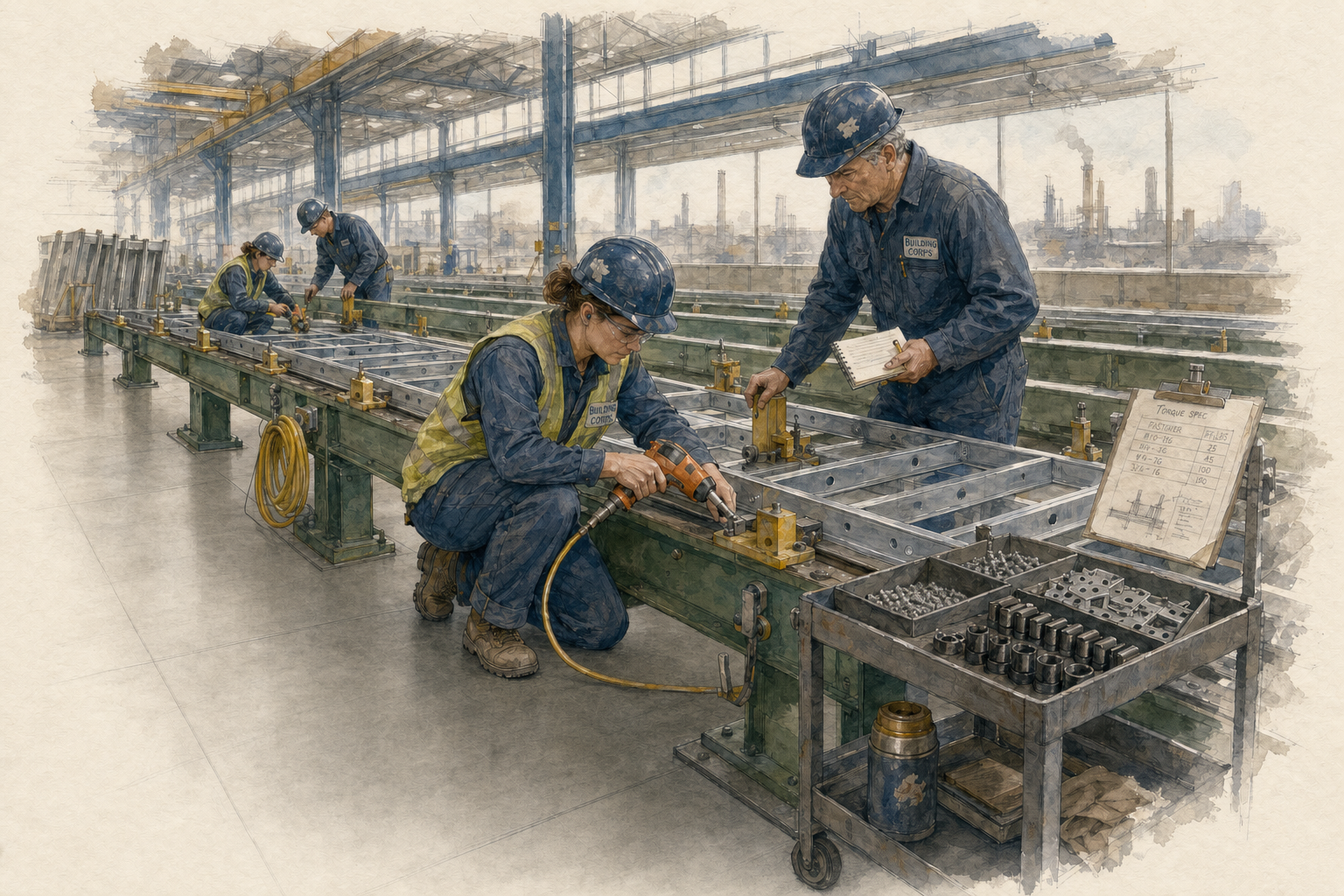
Figure IX · The apprentice at her station.
A woman in navy coveralls and a yellow hi-vis vest kneeling at a long green panel jig, fastening a stud connection with a pneumatic torque wrench — both hands on the tool, the air hose coiled at the jig's edge in safety yellow. Behind her, an older bearded man in matching coveralls and hardhat watches her work, an open notebook and pencil in his hands, logging the count. A wheeled tool cart between them and the camera with a hardware tray of fasteners, a clipped spec sheet on its stand, and a thermos on the lower shelf. A second two-person crew works at the next jig in the middle distance. The silhouette of mill stacks visible through the clerestory windows beyond. The trade's quality lives in the witness as much as in the hand.
The apprentice.She is in her third rotation on the building line — sixteen weeks at the panel station, the same station her journeyworker ran for six years before he moved to quality lead. Behind her, her journeyworker stands with a clipboard and a pen, logging the fastener count on her station sheet — the tally that turns a day's work into a witnessed hour on her credential. He is not supervising her. He is witnessing her work, the way a journeyworker witnesses an apprentice's work on every shift of every week of a four-year journey. His signature on that sheet is what tells the journey board she was here and the fastener held. The trade has been carried this way for two centuries. A hand does the work. Another hand witnesses it. The institution holds the record.
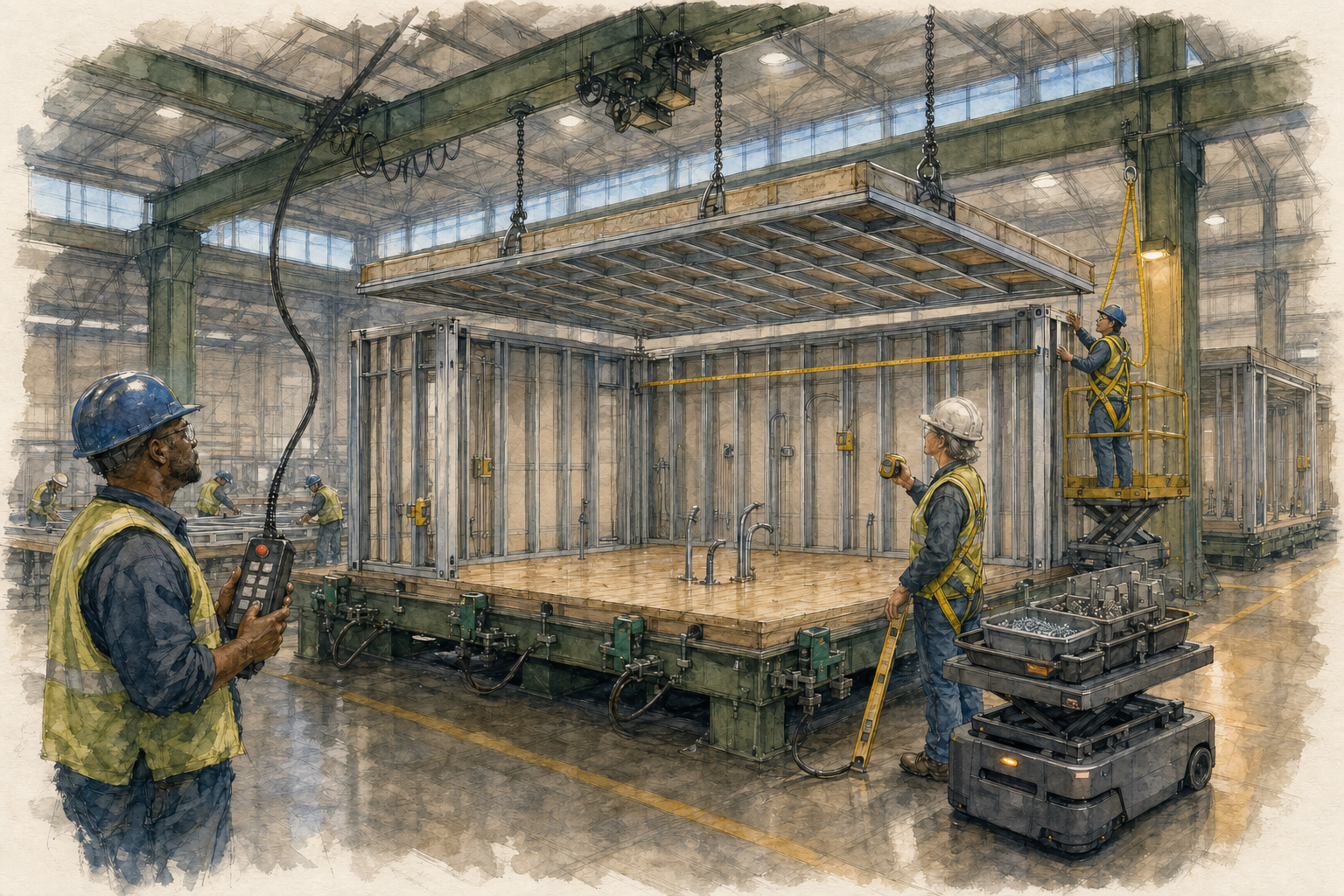
Figure X · The frame set.
A module under assembly inside a green-trussed industrial bay — the steel-stud frame on its green jig, chains from overhead cranes attached at the upper corners. The foreground worker holds a tethered pendant, governing the lift. A second worker in a white hardhat watches the set with a measuring tool in hand. A third works from a yellow scissor lift at the far corner, mid-task. A wheeled tool cart at the platform edge with the next batch of hardware. This is the moment a set of wall panels becomes a room. It takes about ninety seconds.
The frame set.Four wall panels stand on the module platform — assembled, sheathed, insulated, wired, plumbed where the wet wall requires it — and the overhead crane is lowering the roof panel into position. One worker with a radio calling the lift. One checking wall plumb. One on a scissor lift connecting the mechanical chase between the ceiling joists. The moment the roof seats and the bolts drive, a set of panels becomes a room — and that transition takes about ninety seconds. The room that did not exist two minutes ago will have a family behind its walls by the end of the week.
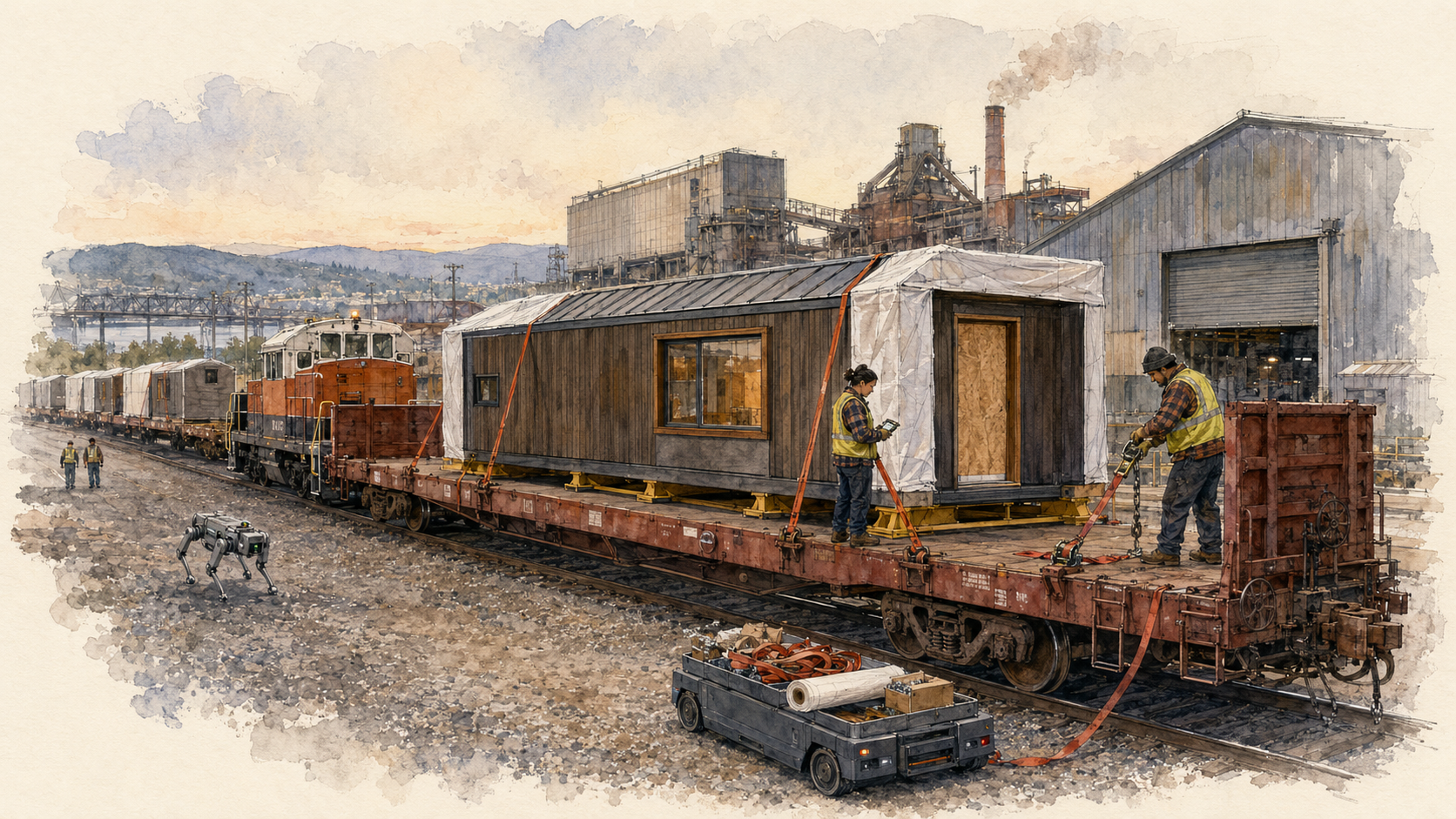
Figure XI · The flatcar.
A finished module on a heavy-duty flatcar at the consist siding — dark-stained wood cladding, windows glowing warm from the test lighting inside, the protective wrap pulled back for tie-down inspection. Two workers securing the load with red-orange ratchet straps. The consist stretching north with more flatcars behind, a road-switcher locomotive at the head. The mill complex in the background — stacks, roofline, a pale plume. A quadruped and a tool cart in the gravel. Late afternoon light, the sky pink-gold over the hills. A house is leaving the parcel tonight. By Friday a family lives behind the wall that was liquid steel on this parcel last week.
The flatcar.A finished module sits on a flatcar at the consist siding — dark-stained cladding, windows glowing from the test lighting inside, the protective wrap pulled back for the tie-down check. Behind it, six more cars stretch north with the locomotive at the head. Behind the consist, the mill fills the horizon — stacks, rooflines, the pale plume from the furnace that has been pouring all day. The light is late afternoon. Some of tonight's consist goes north on the spur to the Portland blocks — the same eight-minute ride the apprentice takes home. Some goes east on the main line, as far as the rail runs. The wall the apprentice made this morning will be standing in a kitchen in Boise or Missoula or Salt Lake by the end of the week. She will never see the family that lives behind it. The wall will outlast her.
VI. The morning the house arrives.
of the works by the spur line — one of the first the building line ships to, the same rail that carried the scrap in last night carrying the finished modules out this morning. The consist ran overnight: three modules on three flatcars, the crane truck and the crew van on a fourth. By six the street is coned and the crane is rigged and the crew is drinking coffee in the dark.
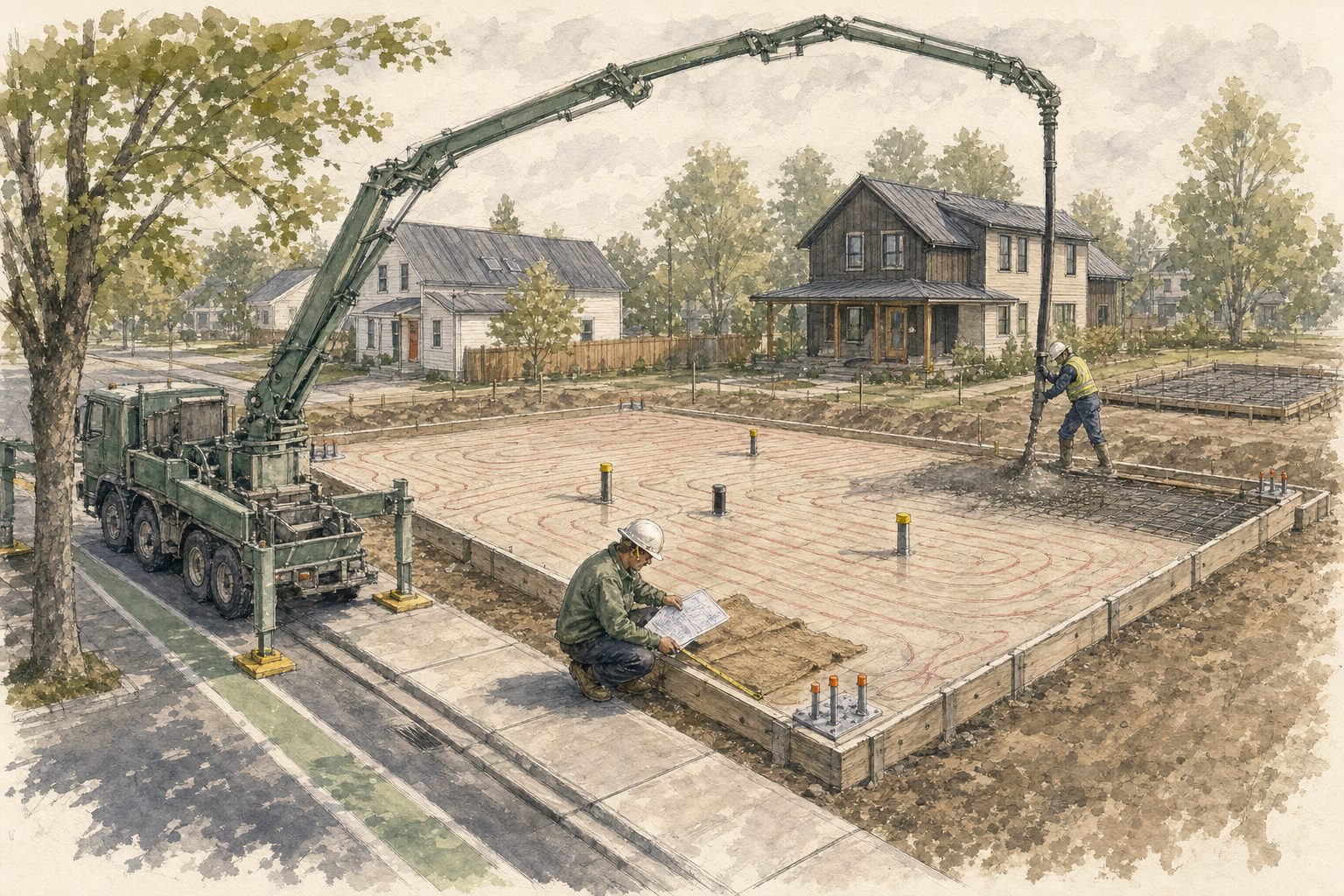
Figure XII · The foundation.
A green concrete pump truck on a residential lot, the articulated boom arcing over the slab — radiant-heat tubing curved across the pour, anchor bolts and plumbing stubs at the edges. A worker in a white hardhat squats at the near edge with plans on a board; a second worker guides the discharge hose at the far corner. Existing corps houses on the block behind — dark vertical-board cladding, gabled metal roofs, mature trees framing the lot. One more lot filling in on a block that has been here.
The foundation.The slab was poured two weeks ago — post-tensioned concrete, radiant-heat tubing cast into it, plumbing risers stubbed through their sleeves, electrical conduit at the service panel location. The tubing connects to the district loop that runs under every house and civic building on the block — the same thermal circuit, the same institution's heat, delivered to the institution's floor. Across the street, three houses are already standing — dark wood cladding, standing-seam metal roofs, deep porches. The trees between them are young, two or three seasons in the ground. The block is still being built.
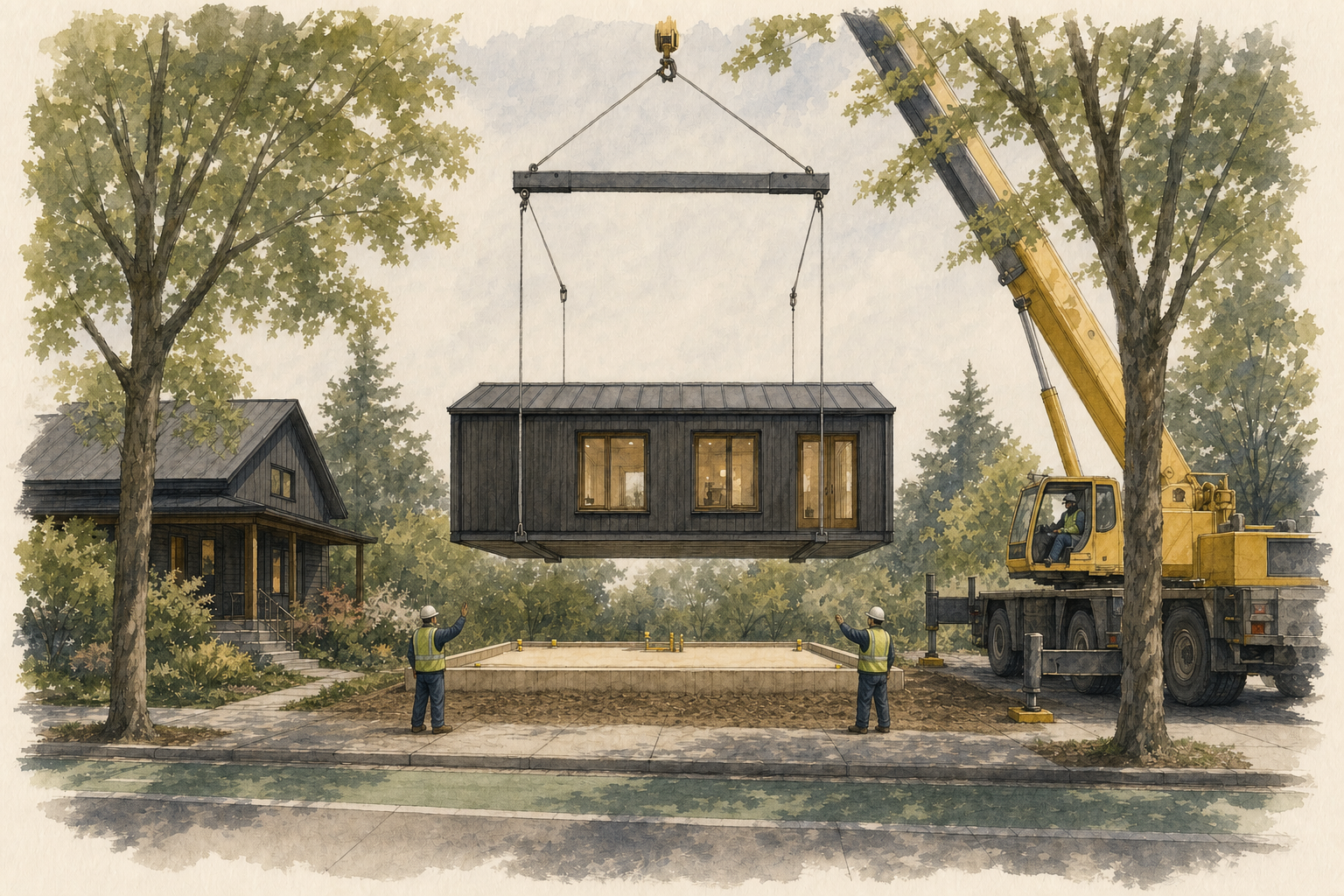
Figure XIII · The set.
A yellow mobile crane setting a dark-wood-clad module onto a foundation between two mature trees — the module hanging level from a four-point spreader bar, two workers guiding it with arms raised from opposite corners of the pad. A neighboring gabled house visible at left, lit windows behind the trees. Quiet, green, residential scale. The room that was a steel coil yesterday is between the trees today.
The set.The crane has the first module in the air between two trees — spreader bar level, the module's shadow falling across the slab. Two workers guide it: one on a tag line, one signaling the crane operator. The module that left the parcel on a flatcar last night is between houses now, between trees, on a block where a bicycle leans against a porch railing and a neighbor's kitchen window is open. Twenty minutes from first lift to bolted connection. By the time the second module lands, the first is torqued to the slab anchors and the crew is pulling the wrap.
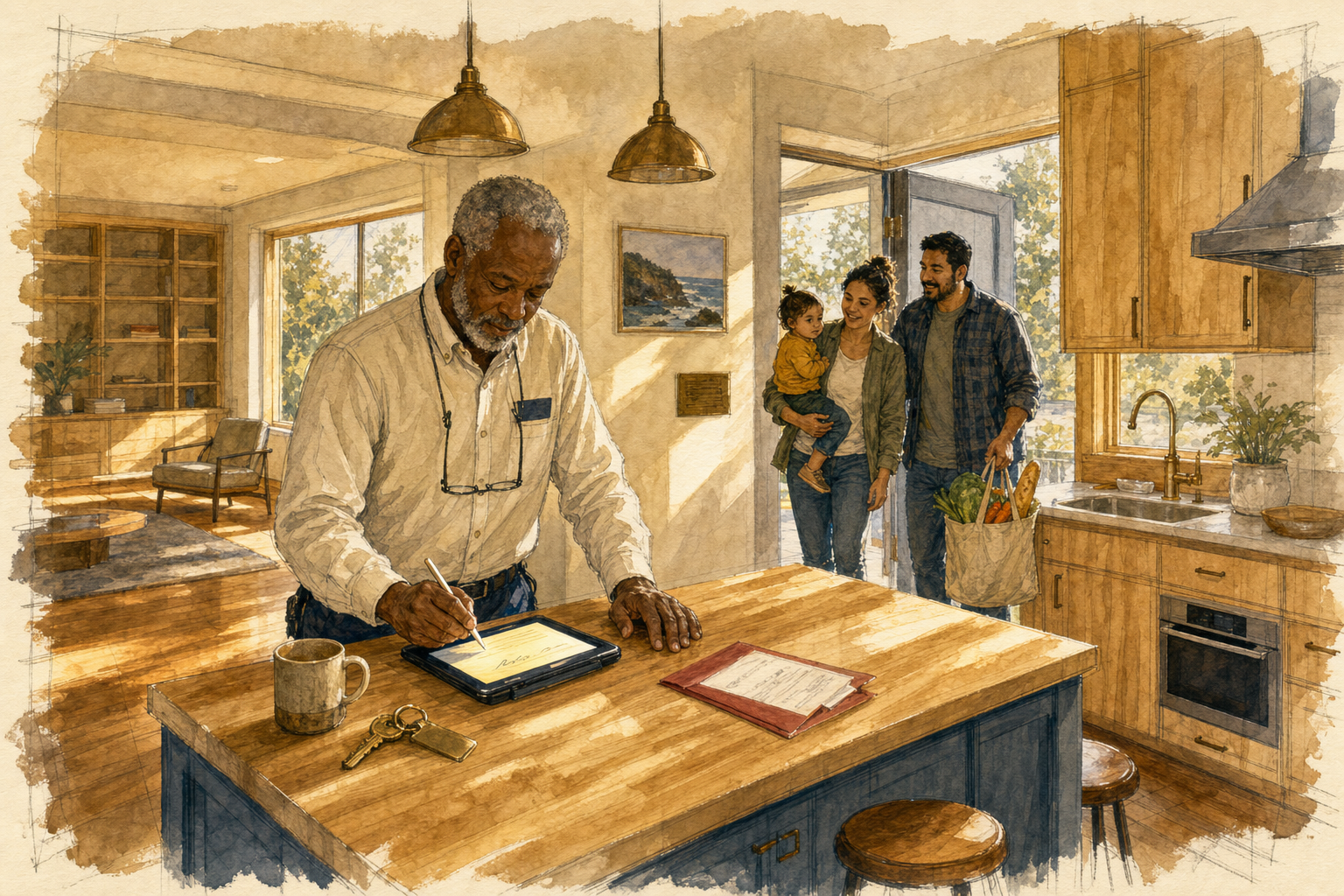
Figure XIV · The sign-off.
An inspector at the kitchen island signing an occupancy authorization on a tablet with a stylus, reading glasses on a chain at his collar, a coffee mug and a ring of keys beside him on the counter. Through the open doorway behind him, a young family arriving — a woman with a toddler on her hip, a bearded man carrying a paper bag of greens. Two brass pendants over the island, hardwood floors, warm afternoon light through the windows. The kind of kitchen where the light tells you someone cared about the angle. The family is already in the doorway. The groceries are for tonight.
The sign-off.The inspector at the kitchen island signs the occupancy authorization on a tablet. He has been the corps inspector on this block for four years — he knows the crew that framed this module, the journeyworker who signed the station sheets, the specification the wall was built to. Behind him, down the hall, a family is arriving: a woman with a toddler on one hip, a man with a grocery bag in each hand, the front door open to the porch and the trees. The light through the kitchen windows is the kind of light that happens when someone cared which direction the room faces. The groceries are for tonight. The family is home.
VII. Behind the wall.
Not a ceremony, not an open house — a working Tuesday, the kind of morning the page exists to show. The shift starts early and the morning starts earlier, and between the alarm and the front gate, everything that holds a working morning together has to be running already — the house, the heat, the grandfather four doors down, the attendant at seven-fifteen, the eight-minute train.
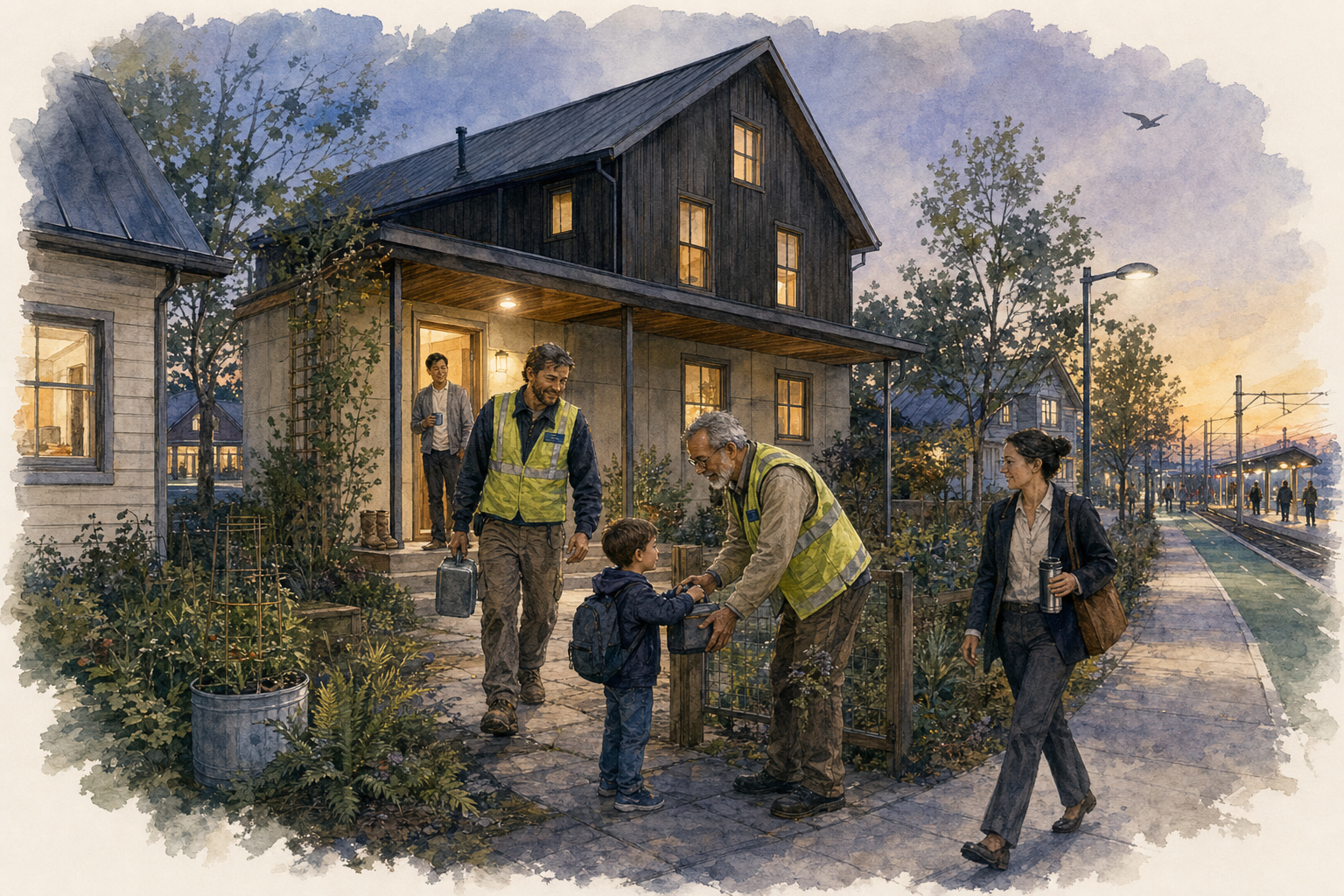
Figure XV · Before light.
A corps-house porch at dawn — an older man in a hi-vis vest crouching at the front gate, handing a backpack to a small boy; a bearded younger man in matching vest stepping off the porch behind them with a lunch pail. A woman in a dark coat walking past on the brick walkway toward the train platform at the end of the block, the catenary wire catching the first orange light. The house warm behind them — two stories, dark wood, climbing vines on the porch column, the upstairs windows lit, a figure in the doorway. The family is dividing for the day the way every working family divides for every working day.
Before light.The grandfather retired from the works ten years ago. He lives four doors down — the same block, the same vocabulary, a house the building line framed before his granddaughter was born. Every morning he walks to his son's gate and takes the boy, and every morning the boy goes without argument, because this is a man he has known every day of his life. At seven-fifteen they will arrive at the Learning Corps attendant's door — the same woman who has been on this block for twelve years, who watched this boy learn to walk, who will walk him to the campus when the bell rings. The boy's mother is already on the platform, the catenary wire catching the first light above the rail. His father left for the works before dawn. The family divides the way every working family divides — and the morning holds, because the distance between the grandfather and the gate, the gate and the attendant, the attendant and the school, is measured in houses, not in highway miles.
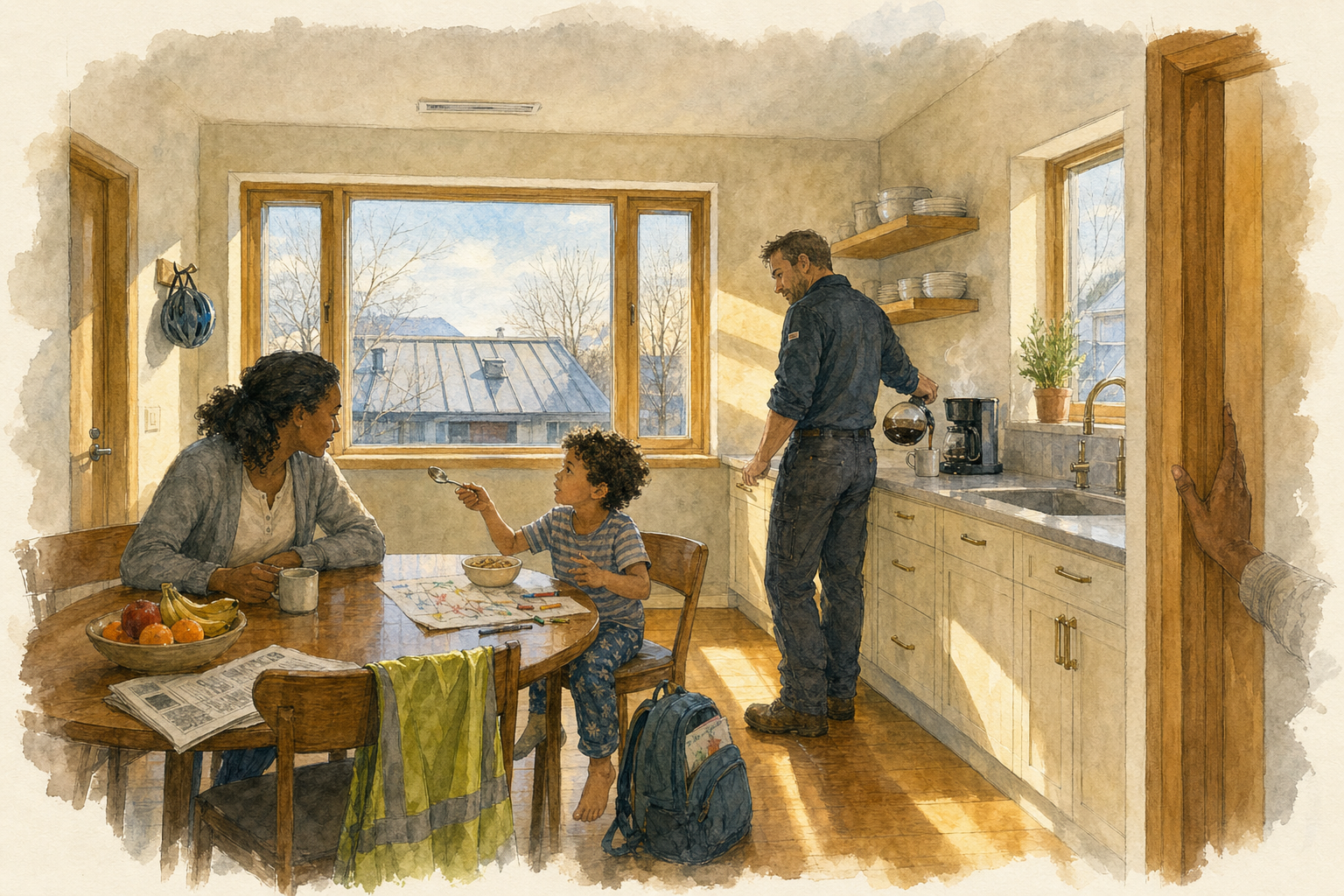
Figure XVI · Eight in the morning, February.
A kitchen — winter light through windows showing snow on the rooftops across the street. A woman at the table with a mug watching her child eat cereal, a man at the counter pouring coffee in corps blues. A backpack on the floor. A newspaper on the table. Fruit in a bowl. The wood at the door frame. The ventilator grille at the ceiling line no bigger than a shoebox. The country in one room.
Eight in the morning.A kitchen. February. Winter light through the windows, steam from a coffee mug, the roofline across the street where another family is doing the same thing behind the same kind of wall. The slab beneath the floor is warm — district heat, the same loop that runs under every house and clinic and school on the block. The woman at the table does not think about where the heat comes from. The man in corps blues at the counter does not think about the thermal circuit under his feet. The child eating cereal does not think about anything except the cereal. That is the point. The institution is invisible from the inside — the way gravity is invisible, the way a foundation is invisible, the way the slab under a sixty-year-old house is invisible to the family that has always lived above it. The wood at the door frame is Douglas fir. It will be the same wood in year sixty. The ventilator at the ceiling line is the size of a shoebox and the family does not hear it running. The child lifts the spoon. The country is in this room.
VIII. The block at five.
The ride home is eight minutes on the spur. By five the block is doing what blocks do when the light goes long.
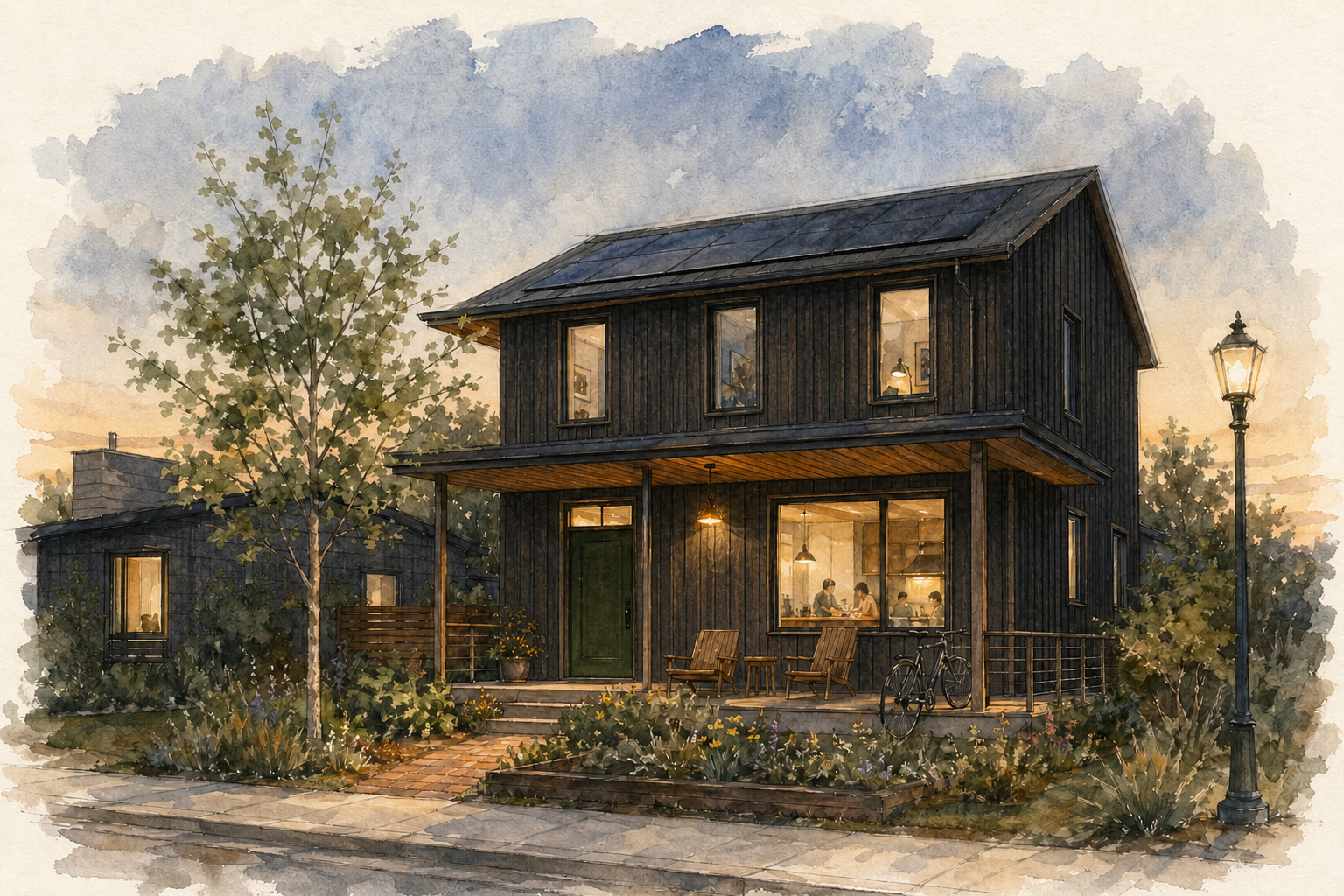
Figure XVII · The house.
A corps house at dusk — two stories, dark-stained vertical-board cladding, standing-seam metal roof with solar panels on the front pitch, a deep front porch with timber posts and a green door. A couple visible through the front window at the dining table, the warm pendant light above them. Porch chairs out, a bicycle at the railing. A gas lamp lit at the street. The neighbor's house — one story, same vocabulary — visible at left through a young tree.
The house.Two stories, dark-stained vertical-board cladding, a standing-seam metal roof, a deep front porch with timber posts — the proportions of a farmhouse, the materials of a century. A couple visible through the front window at the dining table. Porch chairs with the wear of a family that has stopped thinking about whether they will stay. The neighbor's house through a young tree — smaller, same vocabulary, same roof pitch. The gas lamp at the street is on. This is not a development. The houses went up as the building line produced them, and the families moved in one at a time, and the neighborhood became a neighborhood the way neighborhoods do — by staying.
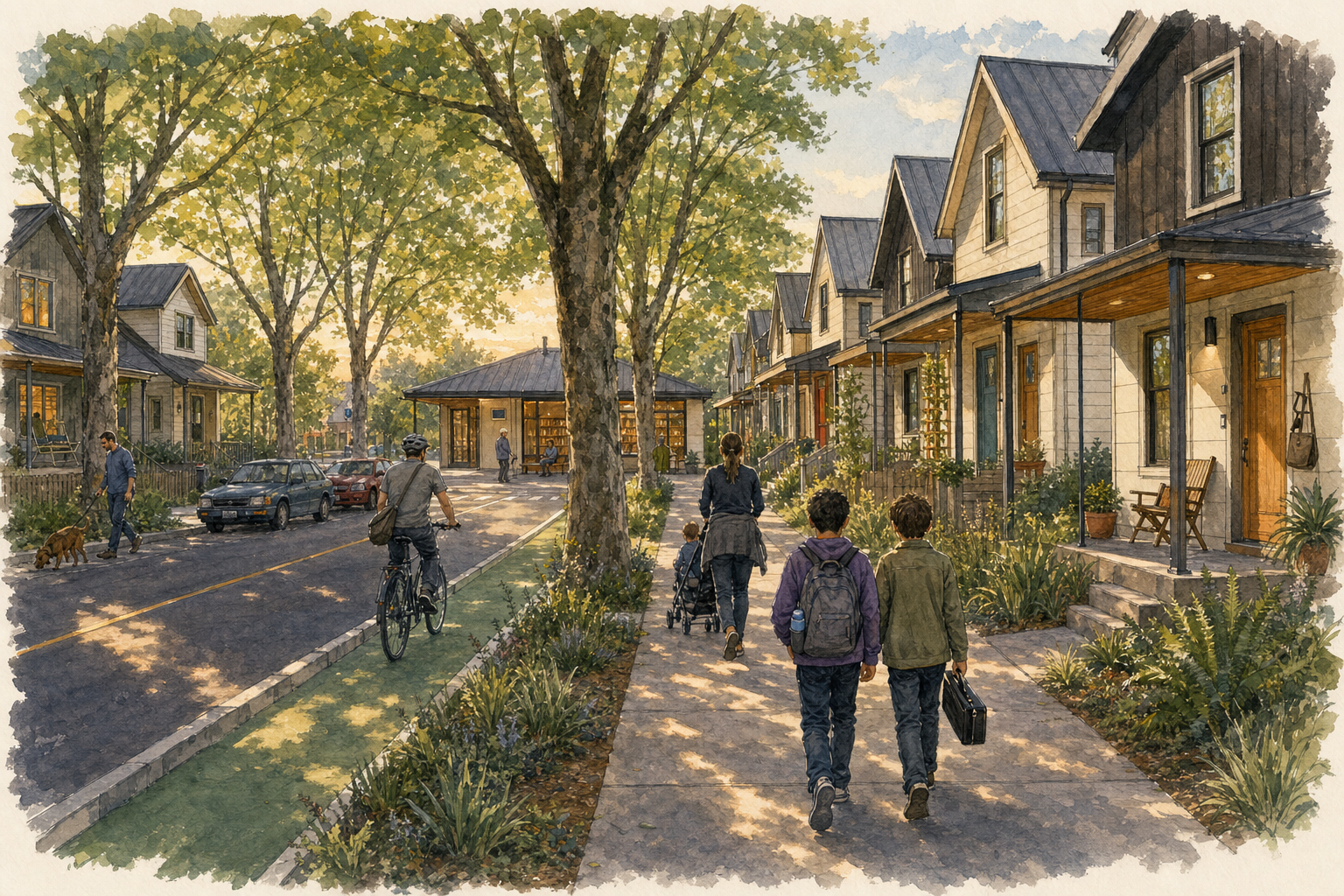
Figure XVIII · The street.
A tree-lined residential street at golden hour — paver sidewalks, low curb, planted garden strips. Two teenage boys walking with backpacks and a case, a woman pushing a stroller beside them, a cyclist in a planted bike lane, a figure with a dog further down by parked cars. Houses on both sides of varied cladding — some dark-clad, some pale — sharing standing-seam metal roofs, deep porches, timber posts. The canopy arching across the street.
The street.The houses are different sizes — some two-story, some single, a duplex with shared-wall entries — but they share the vocabulary: dark wood, standing-seam metal, deep porches, timber details. The variety is fifteen years of building, different families, different lots, the same line underneath. Teenagers walk home with backpacks. A cyclist passes. A woman pushes a stroller under the canopy. The sidewalks are wide enough for two strollers to pass, which is a decision someone made before the concrete was poured — and it is the kind of decision an institution makes when it plans to be here in forty years.
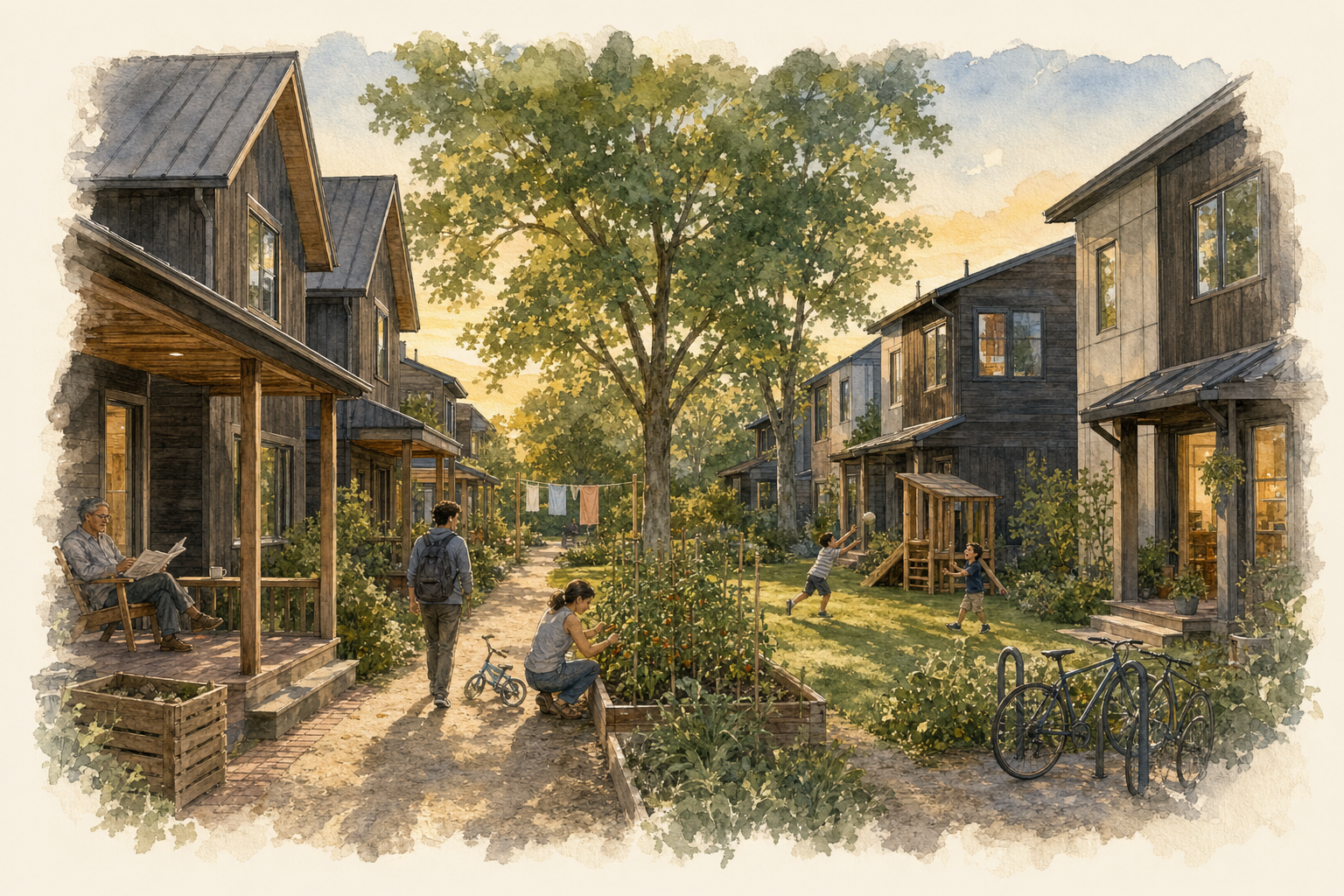
Figure XIX · The commons.
Behind the houses, a shared courtyard between two dark-clad rows — raised planters in timber frames with summer growth, a brick path winding through. A man in a rocking chair on a covered porch at left, watching. A woman crouched at a raised bed tending plants, a child's bicycle beside her. A man with a backpack walking the path. Two children playing on the lawn at right near a small wooden play structure. Bike racks loaded with bicycles at the far porch. A central tall tree. Warm dusk light over the rooflines.
The commons.Behind the houses, in the interior of the block, the shared ground — garden beds in timber frames, a compost station, a clothesline between posts. A man walks through with a crate of greens. A boy fixes a bicycle on the path. The houses face inward here — kitchen windows onto the courtyard, back porches open, a reading chair on a second-floor balcony. A tree older than the block stands at the center, preserved when the lots were laid. The commons is not a park. It is the back yard the block shares — and it works because the institution that owns the block designed the lots to face inward, years before the first family arrived.
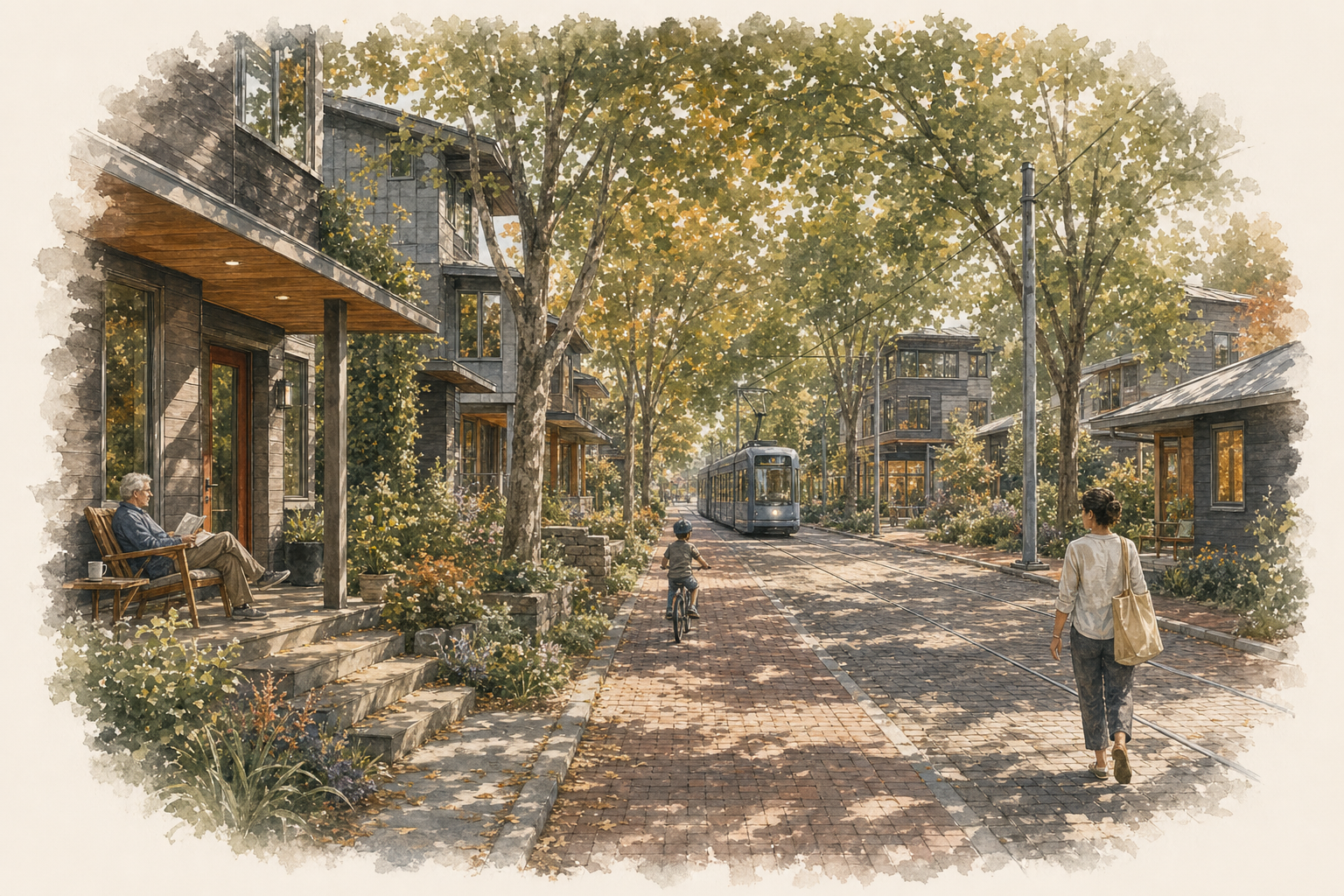
Figure XX · Forty years on.
The same architectural vocabulary — dark wood, metal roofs, stone bases — but the trees are enormous now, their canopies arching over the street in a green vault. An older couple on their covered porch at left, one with a book. A cyclist coming down the brick-paved street. A woman with a shoulder bag walking past on the right. A streetcar in the middle distance on the rail set into the pavement. Vines climbing the facades. Autumn light through the leaves. The trees are forty years old. The gardens have had time.
Forty years on.The same vocabulary — dark wood, metal roofs, stone bases — but the trees are enormous now. Forty years of growth, the canopies arching over the street in a green vault. An older woman on her porch with a book and her feet up. A streetcar on the rail that connects the block to the works and the city. Vines on the stone-and-timber facades. The gardens matured into something that takes forty years and cannot be bought or accelerated. The density is the density of a place lived in by people who never left — because they never had a reason to leave.
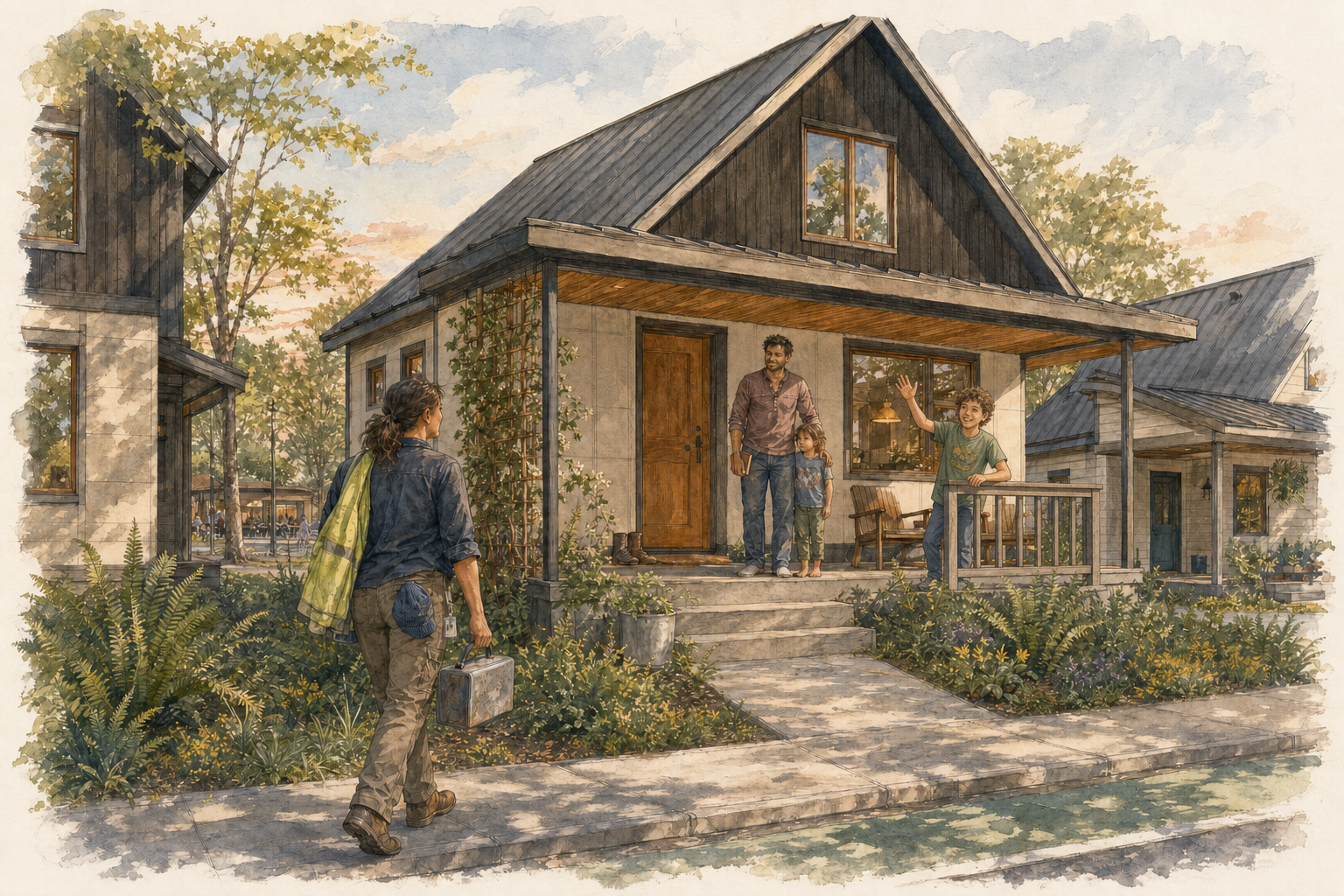
Figure XXI · The homecoming.
A woman walking up a stone path through ferns and flowering plants — a green jacket in one hand and a metal lunch pail in the other, her hair tied back from the shift. On the covered porch, a bearded man in the doorway with a small child beside him; another figure waves from the lit interior. Pale board siding, dark metal gabled roof, stone steps, lit porch lamps. A second similar building visible through the trees at left. Late evening light — long, level, golden. She is home. The shift is over. The dinner is started.
The homecoming.A woman walks up the front path — hard hat in one hand, tool bag over the other shoulder, her hair still tied back from the shift. On the porch, a man with one hand on the railing, a boy leaning forward with a wave. She is home. The shift is over. The dinner is started. The boy has homework. The light is late May — the long, level, golden light that falls across the Willamette Valley at the end of a working day when the street faces west.
IX. Every Corps' shell.
does not build only houses. The same wall, the same roof, the same trade — framed on the same jig, shipped on the same flatcar, set by the same crane — builds every shell the five corps need on the ground. The clinic on the corner. The school in the courtyard. The library at a sister works a thousand miles east. The platform where the morning train stops. Same chest patch on the coverall. Different room.
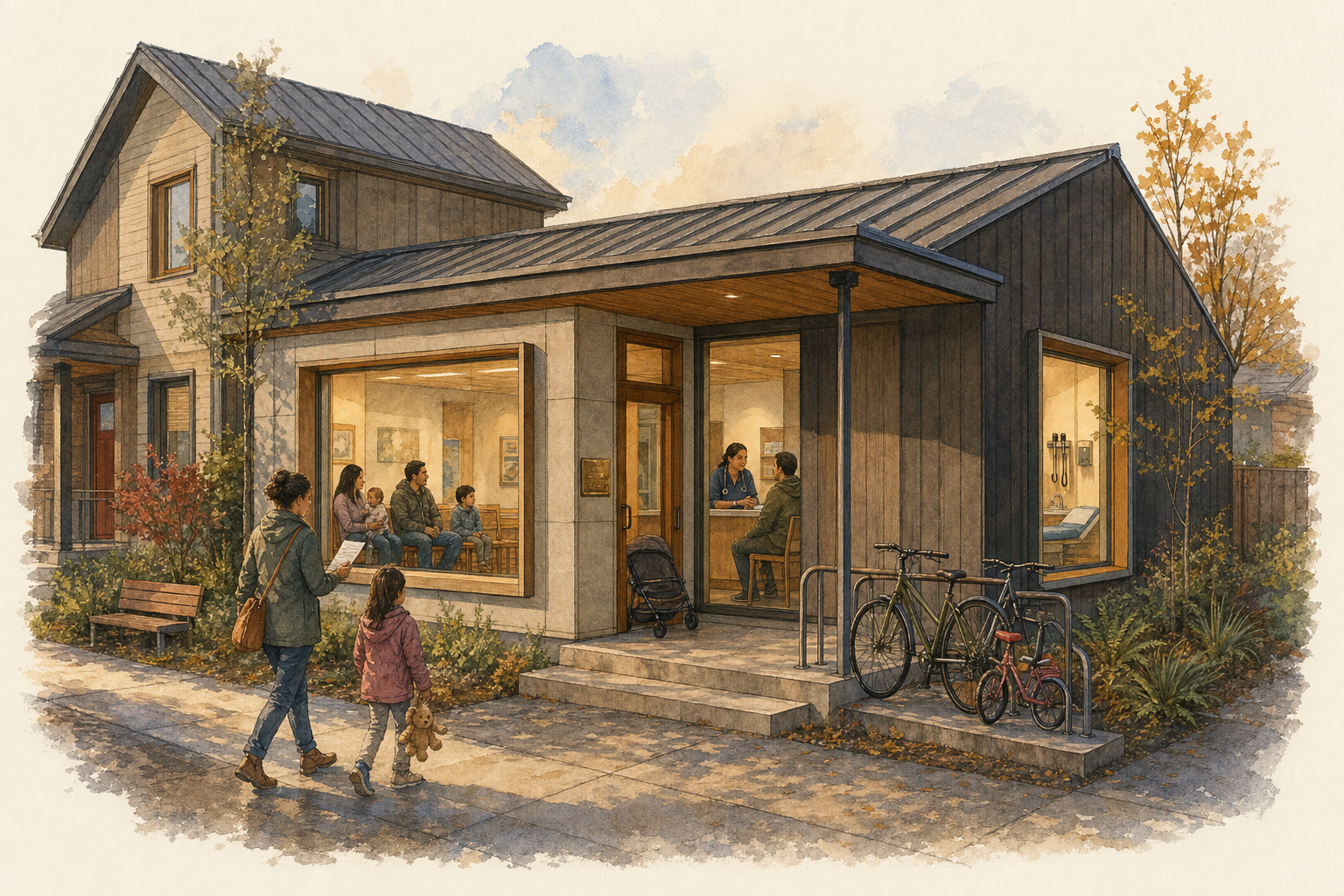
Figure XXII · The clinic.
A Medical Corps building at the corner of the block — dark wood and stone, deep storefront windows. A parent and child walking toward the steps. A waiting area visible inside. Bicycles at the rack. The building the size of a large house.
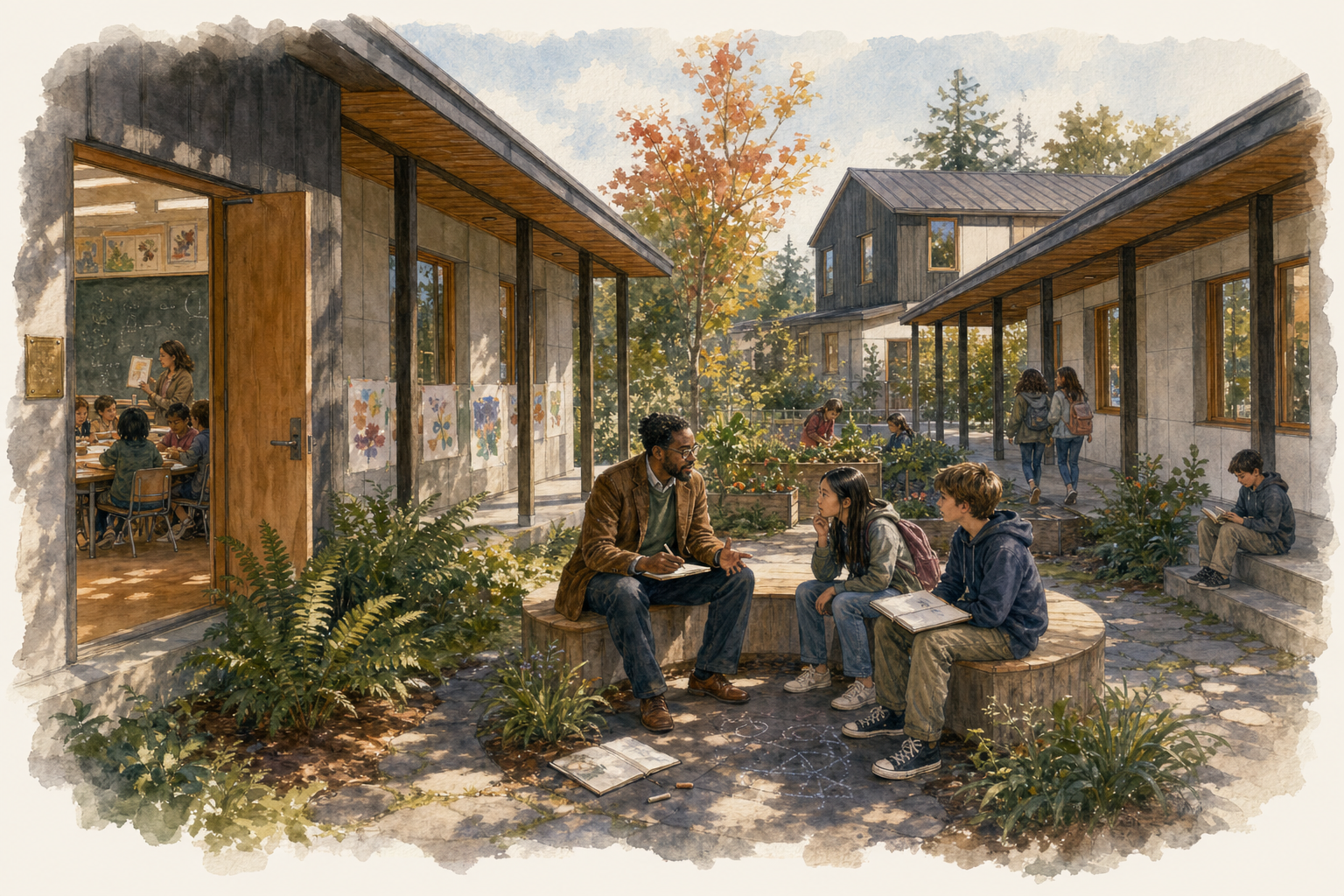
Figure XXIII · The school.
A Learning Corps campus — pavilions connected by covered walkways around an open courtyard. A teacher on a wood bench talking with three teenagers seated around him, notebook open. A classroom visible through the glass doors, students at tables, artwork on the walls. More students along the opposite porch, one reading on a step. Ferns and autumn shrubs in the courtyard beds. Dappled light through the trees.
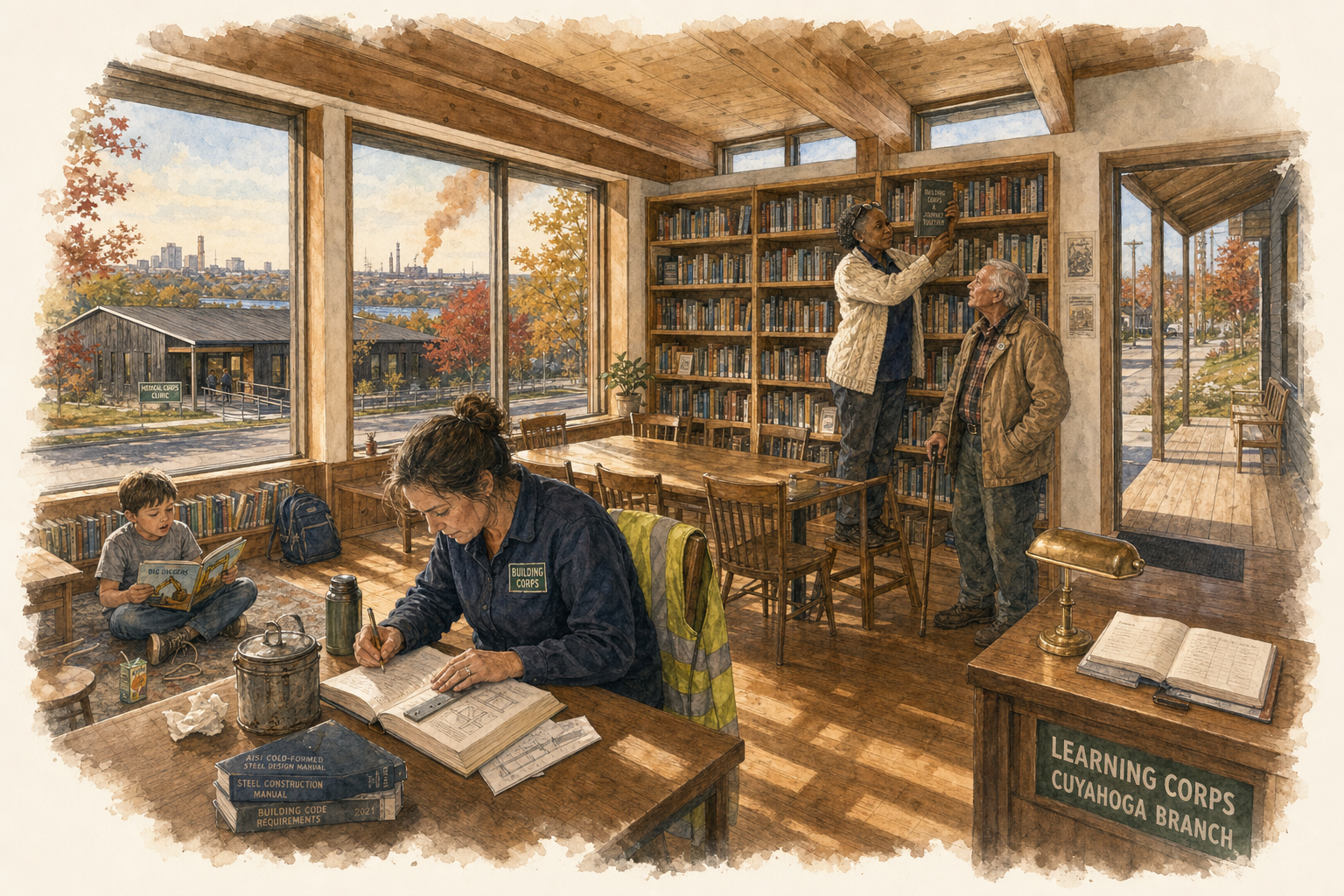
Figure XXIV · The library.
The interior of a Learning Corps library at the Cuyahoga works — a sister works in Cleveland. A woman in corps coveralls in the foreground studying an open ledger at a wooden table, a thermos at her elbow. A boy seated cross-legged on the floor reading. Two older figures at the floor-to-ceiling shelves at center, one on a rolling ladder reaching up. The city skyline and a smoking stack visible through the tall windows. A counter at right with a brass-shaded lamp and a plaque: LEARNING CORPS / CUYAHOGA BRANCH.
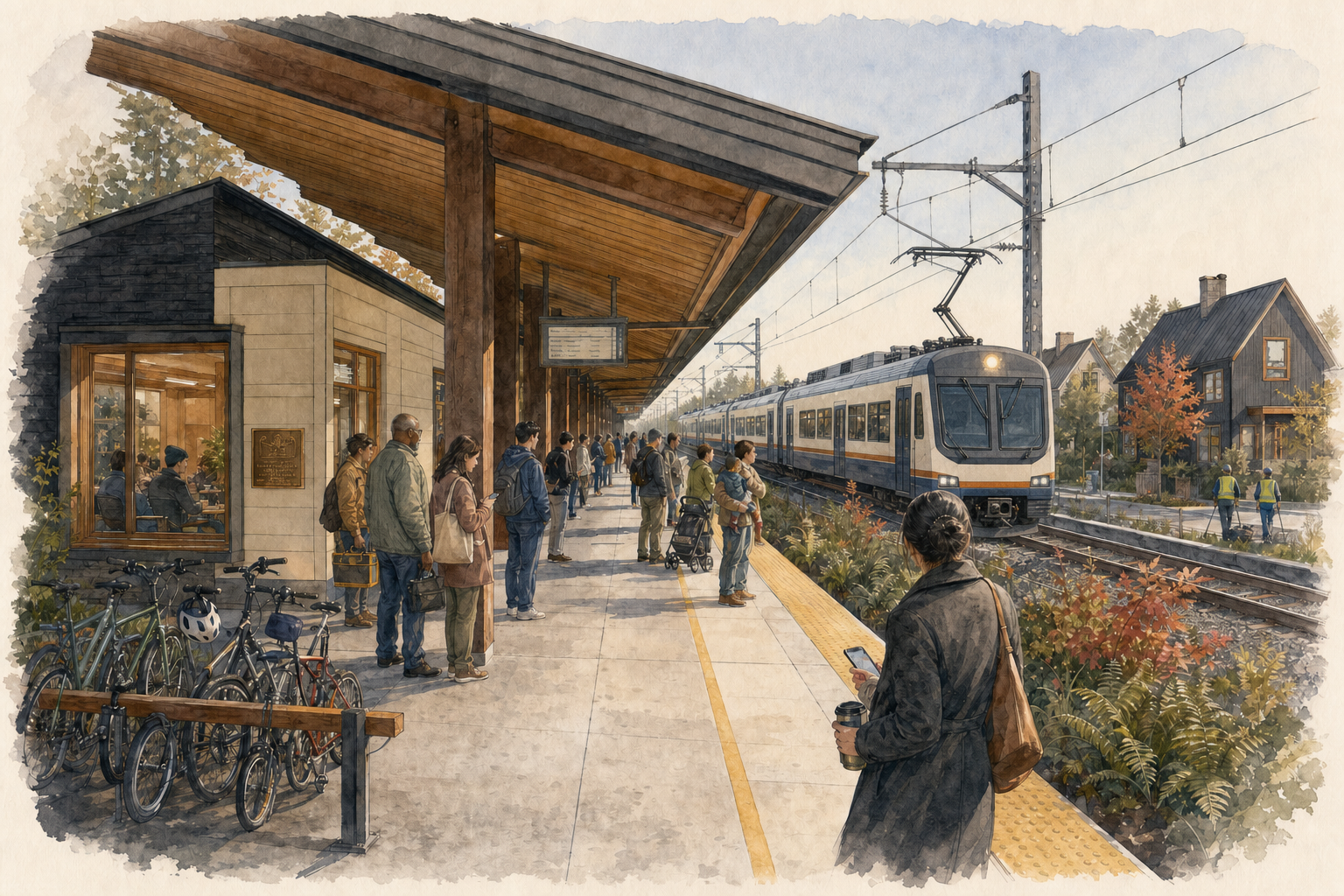
Figure XXV · The platform.
A transit station at the edge of the block — heavy timber canopy over the platform, a small lit wood-and-glass waiting room at left, a row of parked bicycles in a rack beside it. Several people in coats waiting along the platform. A foreground figure in a long coat with a coffee cup and a phone. A silver-and-blue electric multiple-unit train approaching under overhead catenary. Corps houses and autumn trees visible across the tracks.
The clinicis on the corner of the block — same dark wood and stone, the deep storefront windows that say public rather than private. The doctor inside has been there nine years. She knows the family's name. The schoolis a Learning Corps campus — pavilions around a courtyard, the kid who eats cereal at eight walking there every morning through the garden. The libraryis at a sister works — the Cuyahoga works in Cleveland, a thousand miles east, built by the same trade on the same line. A woman in corps coveralls studies under clerestory windows that look out on a different city, a different river, under the same institution. The platformis where the woman who left her porch before dawn stepped onto the train. The canopy she waited under was framed by the same line that framed her house. The catenary wire above the rail runs on the same grid that powers the works, the clinic, the school, and the slab beneath the kitchen floor.
X. How the country stays lit.
— the furnace, the mill, the building line, the district heat, the houses, the clinic, the school, the train. The grid connection is the Bonneville Power Administration intertie at the parcel's east edge — the same corridor that powered Furnace 1 from 1969 to 2003.
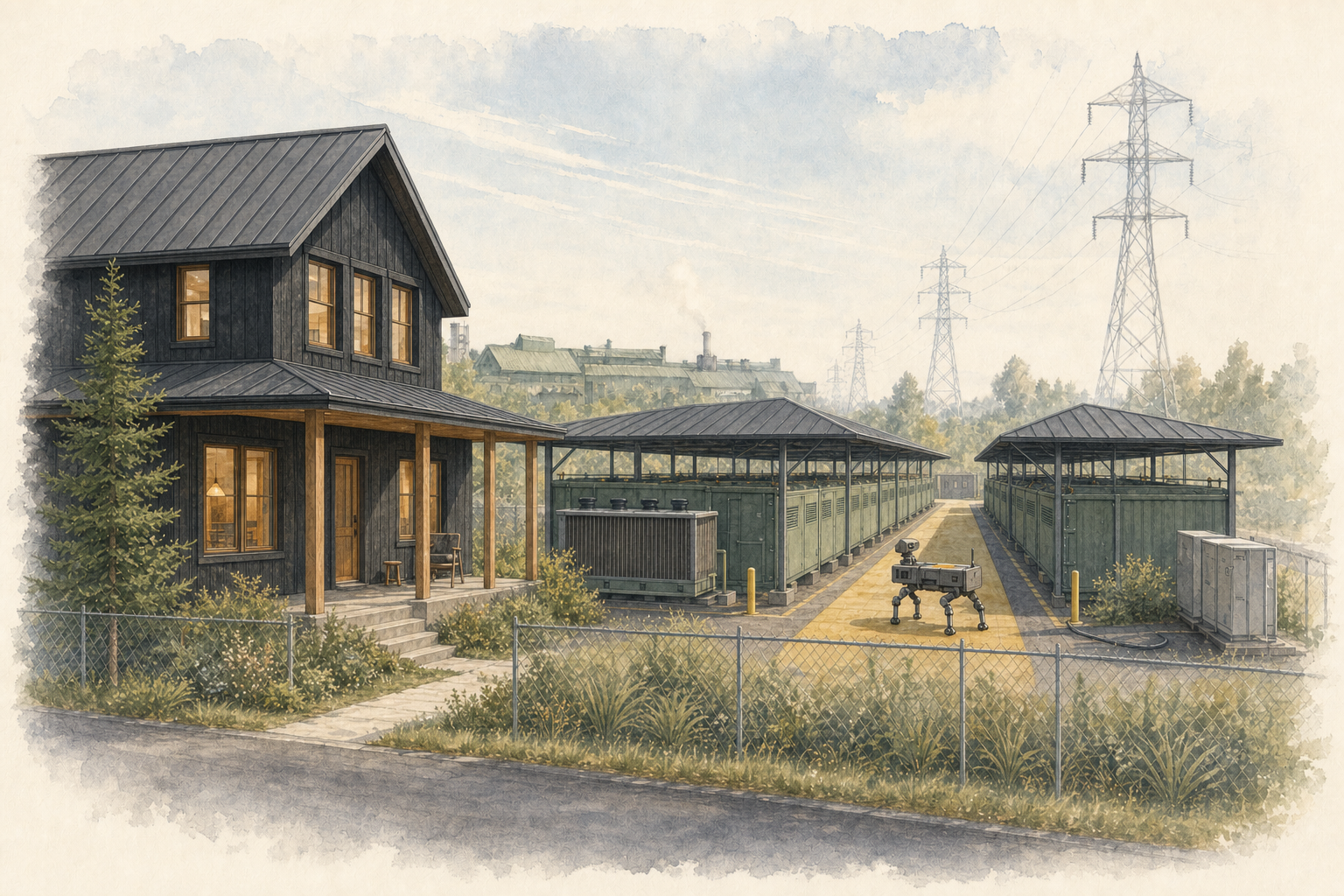
Figure XXVI · The battery bank.
An LFP battery installation beside a corps house — long green cabinet-style units under open-sided shelters, a quadruped inspection unit walking the aisle on its daily patrol. BPA transmission towers visible behind the treeline. The house right there — warm, lit, ten feet from the fence. Ten feet from the porch. The family inside does not hear it running.
Day one.The battery bank beside a corps house — long green cabinets under open-sided shelters, the scale of a two-car garage, the hum inaudible from the porch ten feet away. A quadruped walks the aisle on its daily patrol, reading cell temperatures faster than a technician with a multimeter. Behind the installation, the BPA transmission towers against the treeline. The battery stores overnight power when the rate is lowest and provides the four-hour reserve that lets the block ride through any grid outage Portland has. It is infrastructure — the same order of infrastructure as the water main — sited ten feet from the porch because that is where it serves, and quiet enough that the family inside does not know it is running.
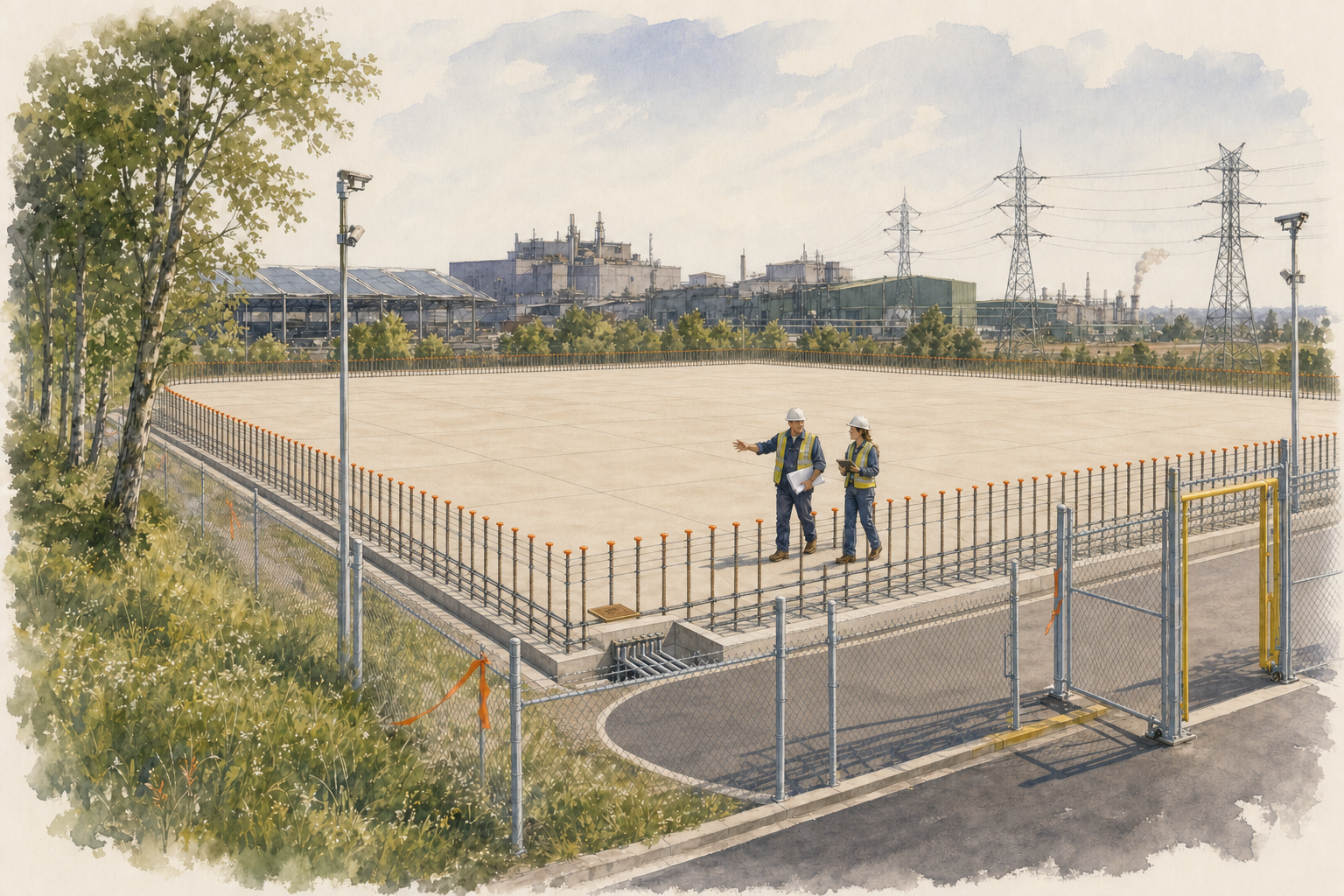
Figure XXVII · The pad.
An empty concrete slab inside a security perimeter mid-parcel — two workers in hardhats and hi-vis vests on the pad, one gesturing with an outstretched arm, the other holding a clipboard. The works visible in the background: dark sheds, stacks, rolling halls, BPA lattice towers stepping off right. The pad is waiting. The concrete is poured. The conduit is in the ground. The pad is waiting.
The pad.An empty slab behind a security fence — sized and connected for a small modular reactor, a high-temperature gas-cooled unit, factory-built, rail-delivered, the kind of reactor American companies have under NRC review today. The reactor is not here yet. The economics have not closed yet. The BPA intertie and the battery bank carry the full load on Day 1, and the pad is what it looks like when an owner can wait. The concrete is poured. The cooling-water connection is stubbed. The conduit is in the ground. When the reactor arrives, it will do two things the grid alone cannot: generate baseload electricity that does not depend on the Columbia's snowpack, and produce process heat. An owner who thinks in quarters would never pour a pad for a reactor it does not need yet. An owner who thinks in centuries pours the pad on Day 1.
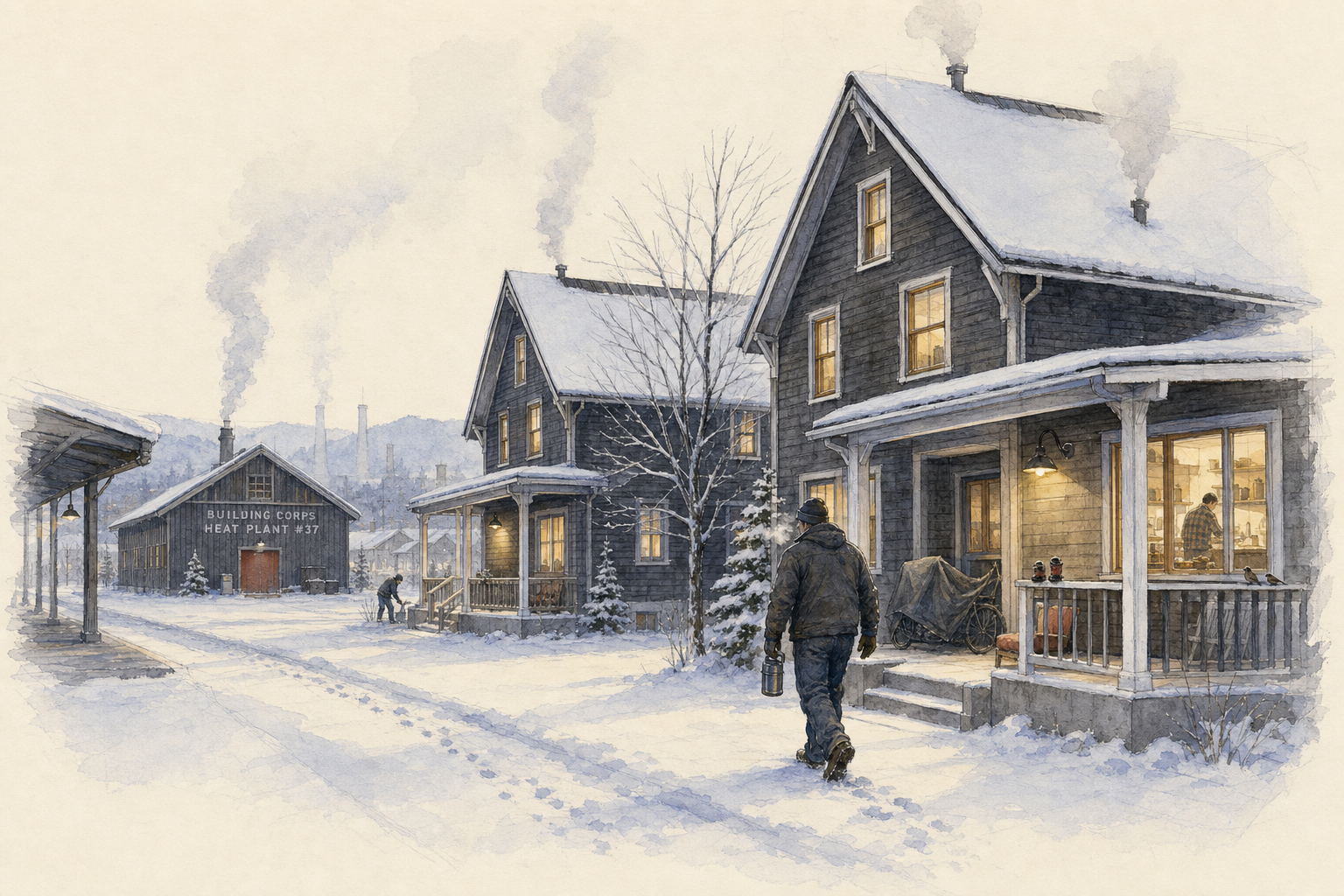
Figure XXVIII · February, before dawn.
A block of corps houses in the snow at first light — dark vertical-board cladding, standing-seam metal roofs, a thin clear stripe melted along each ridge where the radiant loop runs beneath. The nearest house at right with its porch lamp lit, the kitchen window glowing warm, a figure inside working at the counter. A man in dark winter clothing walking the snowy front walk with a thermos, breath visible. A second porch lit two doors down. In the middle distance, the district Heat Plant — same dark cladding, same gabled roof, "BUILDING CORPS" and "HEAT PLANT #37" painted in tasteful white block letters across the front above a red service door, a pale plume from its short stack. The mill stacks of the larger works just visible beyond. A rail platform canopy at left. The Heat Plant heats every kitchen on the block. There is no bill.
The heat.February. A block in the snow — dark wood, metal roofs edged with ice, windows glowing warm from inside. A man walks toward his porch where someone is already up, already making coffee. Behind the block, through bare trees and falling snow, the works rise — stacks, rooflines, plumes of white steam in the grey sky. The plumes are the proof. The reactor's process heat — the same thermal output that runs the zinc bath on the galvanizing line and heats the fabrication halls on the works floor — feeds the district loop under every house, every civic shell, every sidewalk on the block. The slab beneath the kitchen floor where the child eats cereal in February is warm because the reactor and the kitchen are on the same circuit. The institution that heats the works heats the home. There is no meter between them.
XI. The trade.
The furnace runs because someone re-lines the refractory. The wall squares because someone witnesses the fastener. The clinic opens because someone staffs it. The work that holds all of it is a trade — carried by masters and apprentices under the same charter the building trades have run on for two centuries.
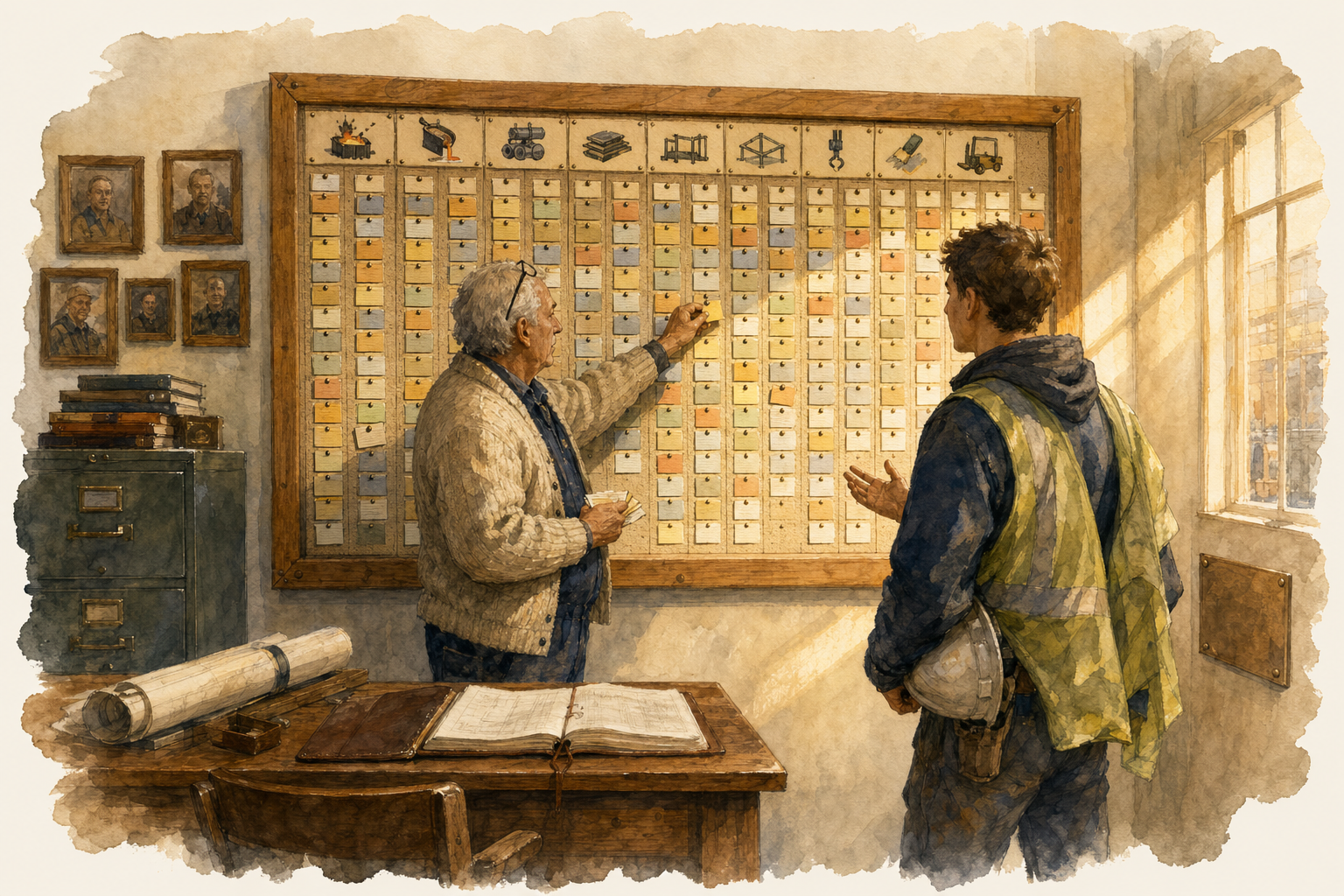
Figure XXIX · The journey board.
An older man in a cardigan and reading glasses standing at a large wall-mounted board in an interior office — columns of trade icons across the top, rows of colored cards beneath, each card an apprentice's station assignment. A younger worker beside him in a hi-vis vest, hardhat under one arm, listening. A cluster of small framed portraits of past masters on the wall above a black card-file cabinet. A logbook open on the wooden desk in front, a rolled drawing beside it. Afternoon light through the window at right catching the board's edge. The trade is carried this way. One hand pointing at a board while another hand holds a hard hat and listens.
The board.The man at the board has been on this parcel for thirty-one years — started as an apprentice the year the furnace first went cold, took his journeyworker credential at twenty-six, his master's ticket at thirty-five. The board behind him is the institutional memory of every apprentice who has walked through these works: trade stations across the top — furnace, caster, mill, roll-form, panel, frame, systems, finish — and every active apprentice down the side, each one a colored card tracking which rotations she has cleared, how many witnessed hours she carries, how far she is from her credential. The card he is pointing at belongs to the apprentice who stood on the melt-shop floor this morning and watched her first heat pour. She has nine stations left. She does not know yet that this parcel will be her life — that she will stand at this board herself someday, pointing at another young worker's card, explaining the next rotation to someone with sawdust on his sleeves and a hard hat under his arm.
The journey.On the wall beside the board, five small framed portraits — the past masters of this works. The first is a woman who took her master's ticket in the parcel's third year of operation and held it for twenty-two years. The last is the man standing at the board now, who will retire in four years and join them on the wall. The logbook on the desk holds every completed journey — the signed rotation sheets, the witnessed hours, the credential recommendations. The trade is carried this way. One hand pointing at a board while another hand holds a hard hat and listens. The portraits on the wall to remind both of them that neither is the first and neither will be the last.
XII. The trees the corps planted.
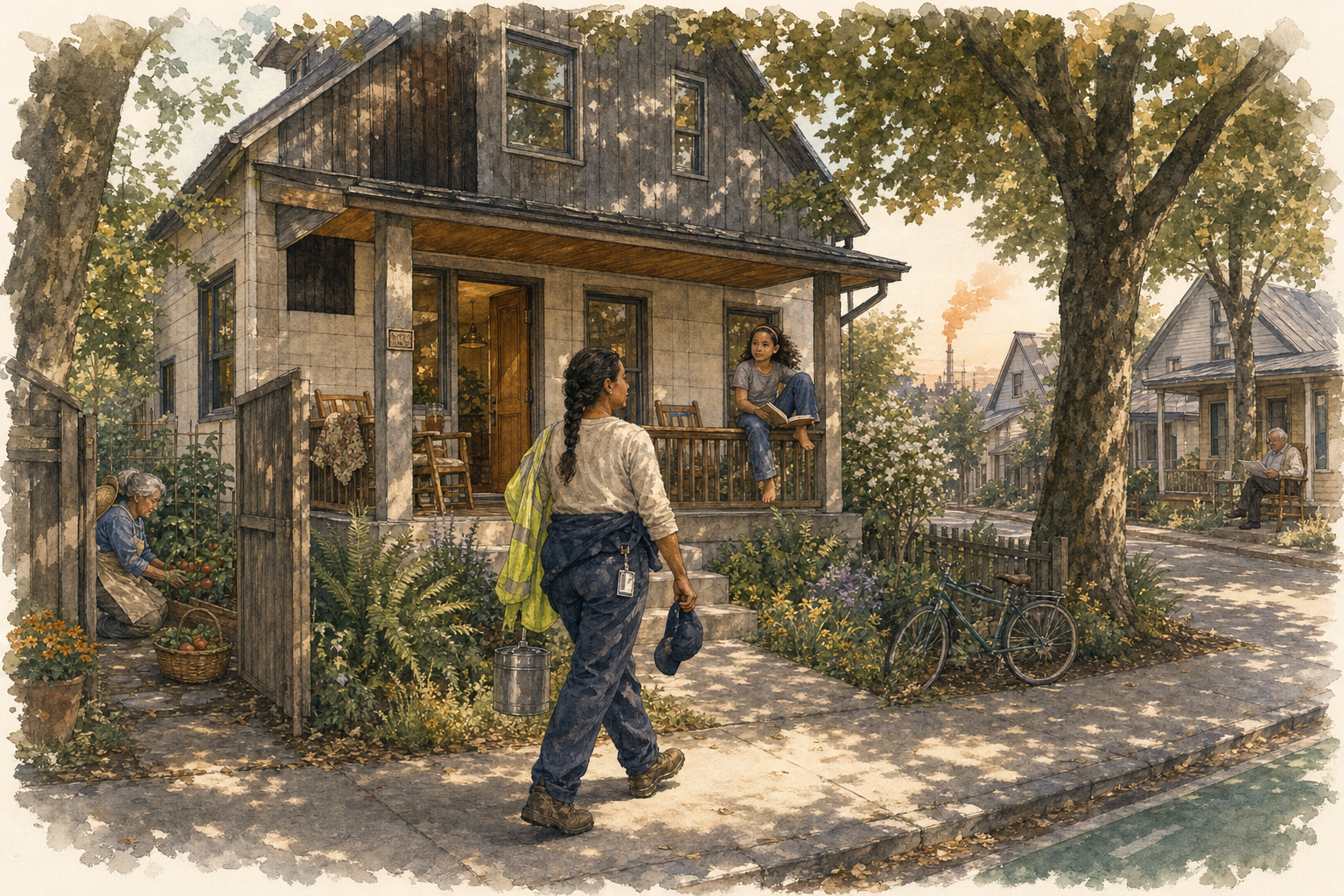
Figure XXX · Three generations.
A woman in work boots and dark canvas walking the sidewalk toward a corps house — a Building Corps yellow vest, a lunch pail in one hand and a hard hat in the other. A younger woman on the porch railing looking up from a book. An older woman kneeling in the side garden among the flowers. A bicycle leaning at the tree, similar houses receding down the block on the right. Enormous trees — forty years of growth — their canopies meeting overhead, dappled light falling across the brick and stone and dark wood. The trees the corps planted are over all of it.
A woman walks up the brick path to her house — work boots, dark canvas, the Building Corps patch on her vest, a lunch pail in one hand and a hard hat in the other. Her shift ended twenty minutes ago. On the porch, a younger woman looks up from a book. In the side garden, an older woman kneels among the flowers — white hair, a trowel in her hand, her other hand resting on her knee the way a body rests when it has done this work in this garden for a long time.
The trees above the house are enormous. Forty years of growth. The corps planted them when the block was new — when the first modules were set, when the first families moved in, when the porch the younger woman is sitting on was bare lumber that had not yet taken the weather. The canopies meet over the path now, over the garden, over the three of them. The house is the same house. The block is the same block. The institution that built it is the institution that holds it.
One parcel on the Willamette. The metal that comes off the floor is the wall a family lives behind, the school the kid walks to, the clinic that knows their name. The trees the corps planted are over all of it. None of it is built. All of it could be.
The Rivergate Works is one of three first-generation works the corps system would operate. The institution that would hold them is the subject of Rebuilding Aristocracy. The amendment that creates the institution is the American Shareholder Amendment.
- Text, research, and illustration direction: the 28shareholder project.
- Architectural watercolors generated by AI under human creative direction.
- Documentary photograph: David Falconer / EPA / NARA, June 1973. Public domain.