Mill Bend

Cherry Street · The block is composite · The lease is real · Dated 2045

The lease is one page.

A block on Cherry Street in Mill Bend. Four blocks west of where the coil leaves the south door at noon. Six voices speak from inside the block.
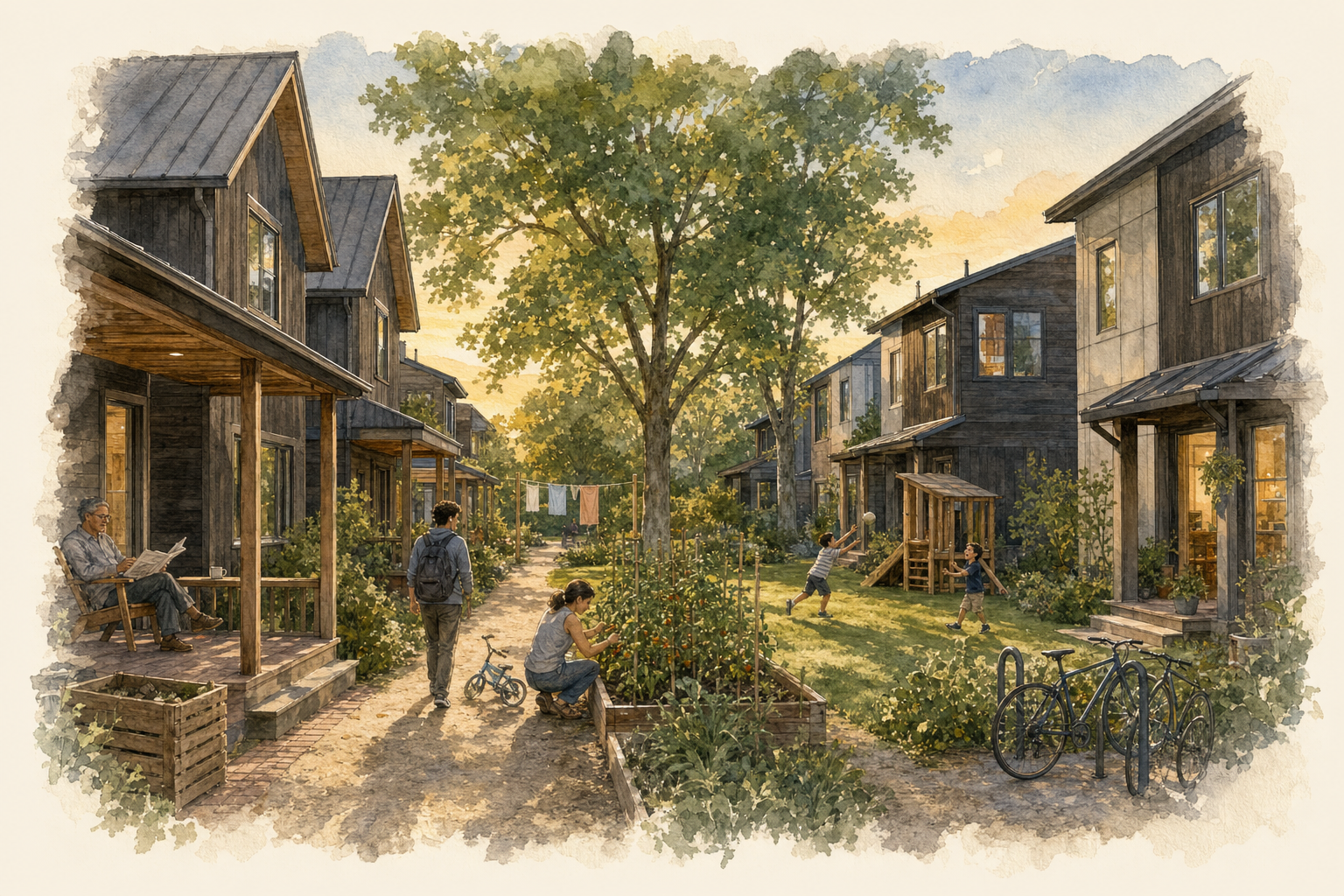
A watercolor courtyard between dark wood-clad two-story houses with standing-seam metal roofs, opening onto a shared garden with raised planter beds, climbing vines, and a tall central tree. A man in a rocking chair on a covered porch at left watches a woman crouched tending plants beside a child's bicycle, while a man with a backpack walks the brick path and two children play on a lawn near a wooden play structure. Warm dusk light catches the upper foliage, bike racks loaded with bicycles, and a wooden produce crate at the porch edge.
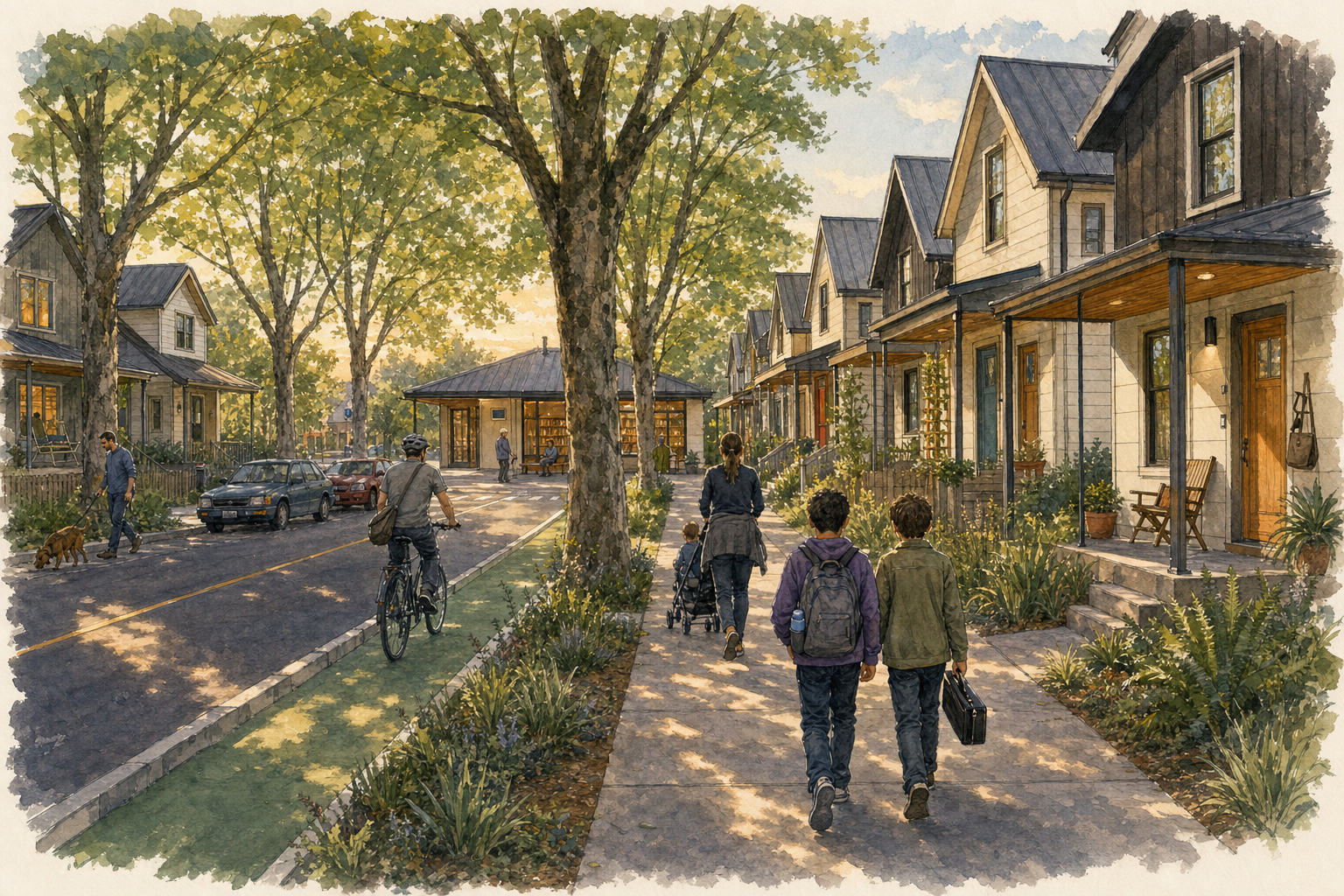
A watercolor view down a residential street lined with two-story gabled houses in cream and pale siding, deep porches with metal roofs, and large mature trees arching over the sidewalk. In the foreground a woman pushes a stroller while two boys walk beside her, one carrying a small case; mid-ground a cyclist rides along a planted bike lane and a figure with a dog stands near parked cars. Late-afternoon light filters through the canopy onto brick paving, garden beds, and a wood-clad building set back among the trees.
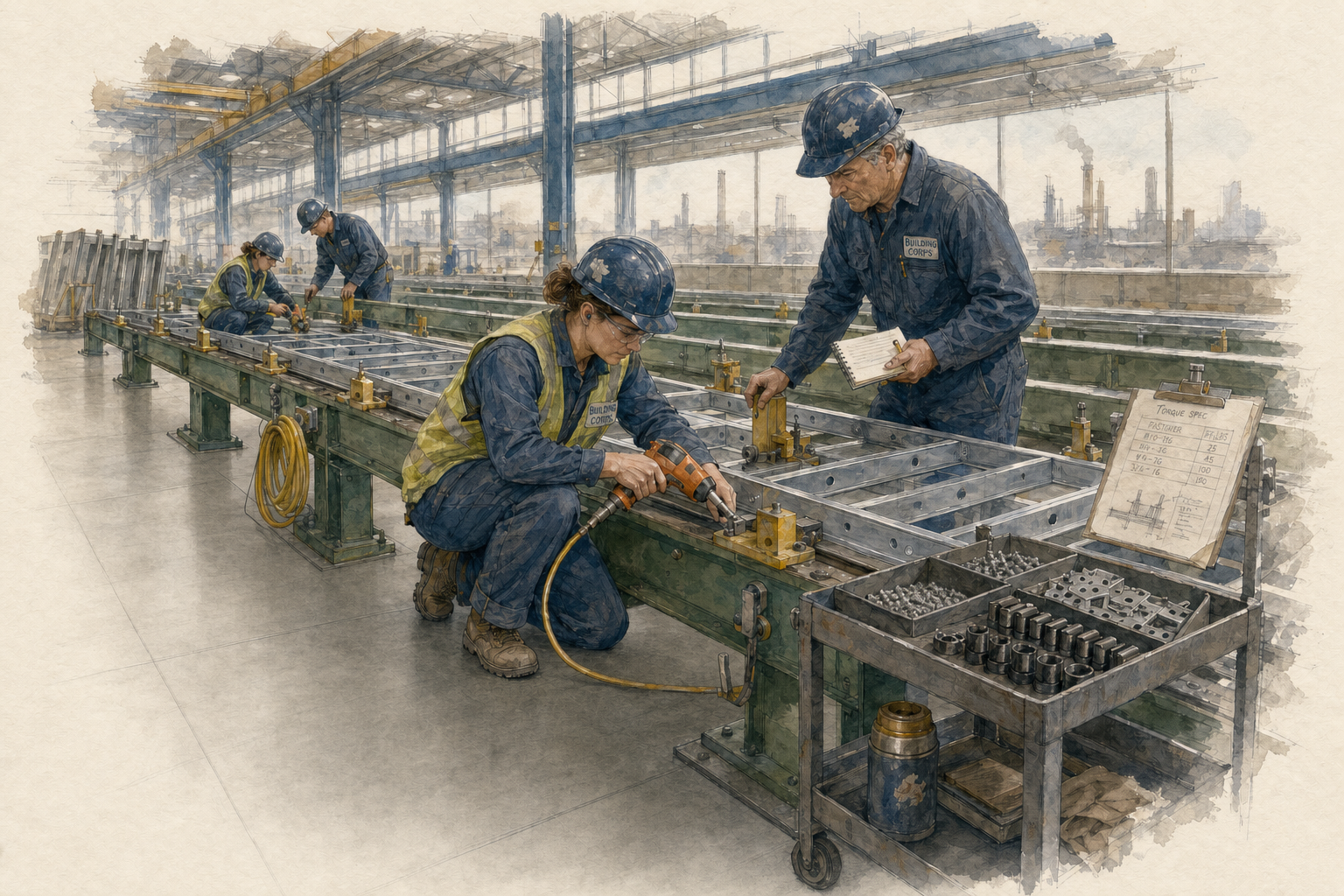
A watercolor of a shop-floor scene inside a tall industrial bay with exposed steel trusses and clerestory daylight. A young woman in navy coveralls and a yellow hi-vis vest, wearing a navy hardhat, is crouched at a long green-painted panel jig with one knee on the concrete floor, both hands on an orange-and-black pneumatic torque wrench engaged with the steel framework on the jig; a yellow coiled air hose loops at her side. Behind her, an older bearded man in matching navy coveralls and hardhat leans over the jig with a small open notebook in his left hand and his right hand resting at a yellow clamping fixture. Between them and the camera, a wheeled gray tool cart with a hardware tray of dark fasteners, a clipped spec sheet on a small stand, and a small brown thermos on the lower shelf. In the middle distance, a second two-person crew works at a second jig. Beyond the high windows at the back, the silhouette of mill stacks against a pale sky.

Janelle Briggs, layout jig, Mill Bend wall shop.

Three years into my apprenticeship. Building Corps, Local 64. I frame walls on the layout jig at the Mill Bend wall shop. The coil that comes off the line at noon at Rivergate is on a flatcar at our yard by 12:30 and on my jig by one.

My grandfather Ray ran mornings at Rivergate from the year the furnace came back. He retired last Tuesday. My aunt Beth is at the Linnton works tonight, third shift, the millwright bay. My cousin Daniel takes the Rivergate floor in the morning. I am twenty-one.

The wall I framed yesterday is going to a foundation in Hamtramck. I do not know the family who is going to live behind it. I know the foundation. I know the dimensions of the foundation. I know the stud spacing was sixteen inches because the load calc said sixteen inches and the foreman did not write a different number on the spec.

My mother's sister framed houses for a production builder in Tennessee for nine years before her shoulder gave out. They paid her by the unit. They had a clock on every stud. The foreman wrote his own measurements against the architect's spec because the architect's spec was slow, and what got built was what the foreman wrote, and what cracked first was the wall that did not get the stud the spec said it needed. She has a settlement from her shoulder and no pension.
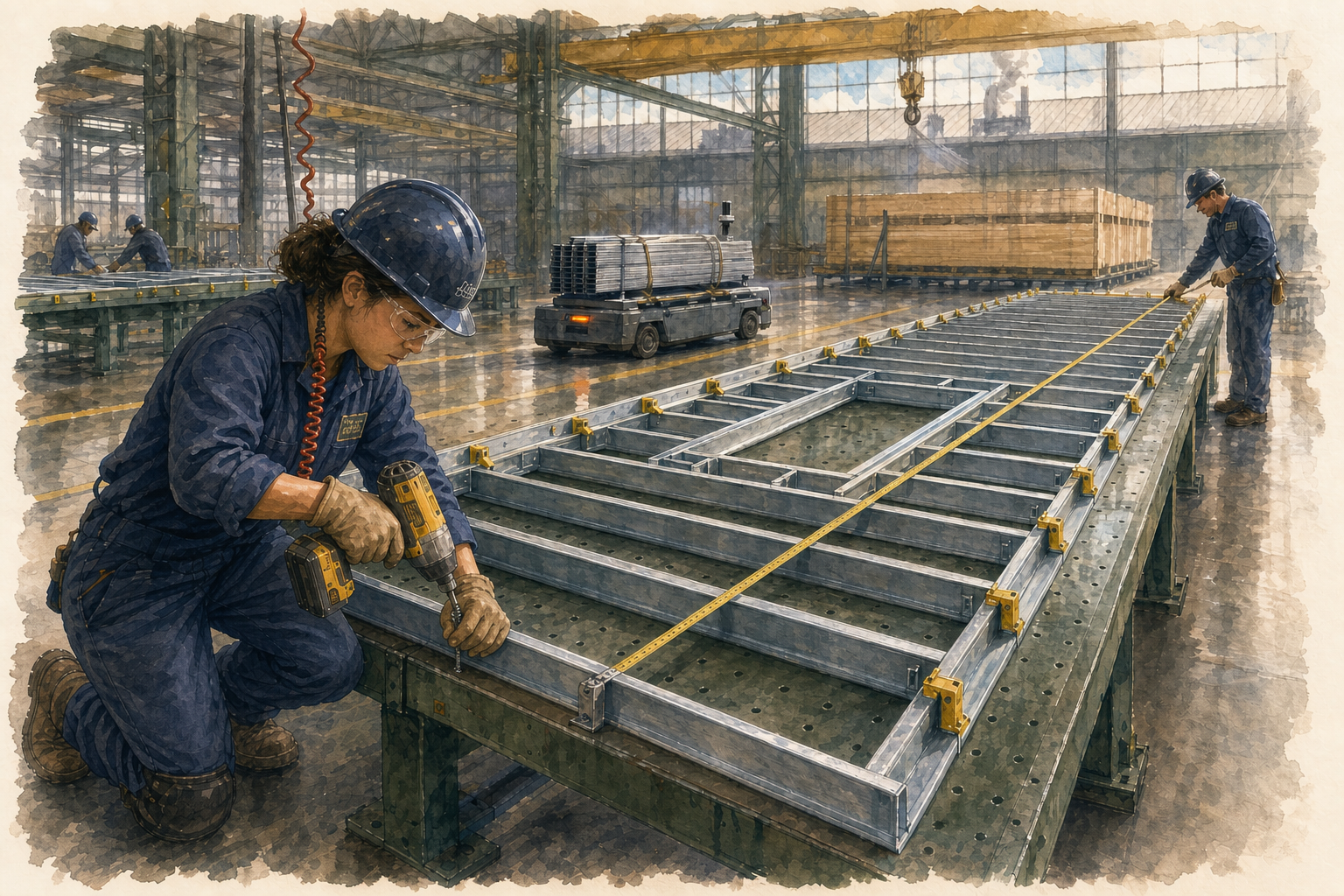
A worker in a navy hardhat and coveralls crouches at the end of a long steel floor or wall frame on a shop floor, holding a power drill against the metal. A yellow tape measure runs along the frame's length, secured by yellow clamps; a second worker in blue stands at the far end pulling the tape. Behind them, a small utility vehicle moves down the aisle of a tall daylit industrial hall with girders and clerestory windows overhead.
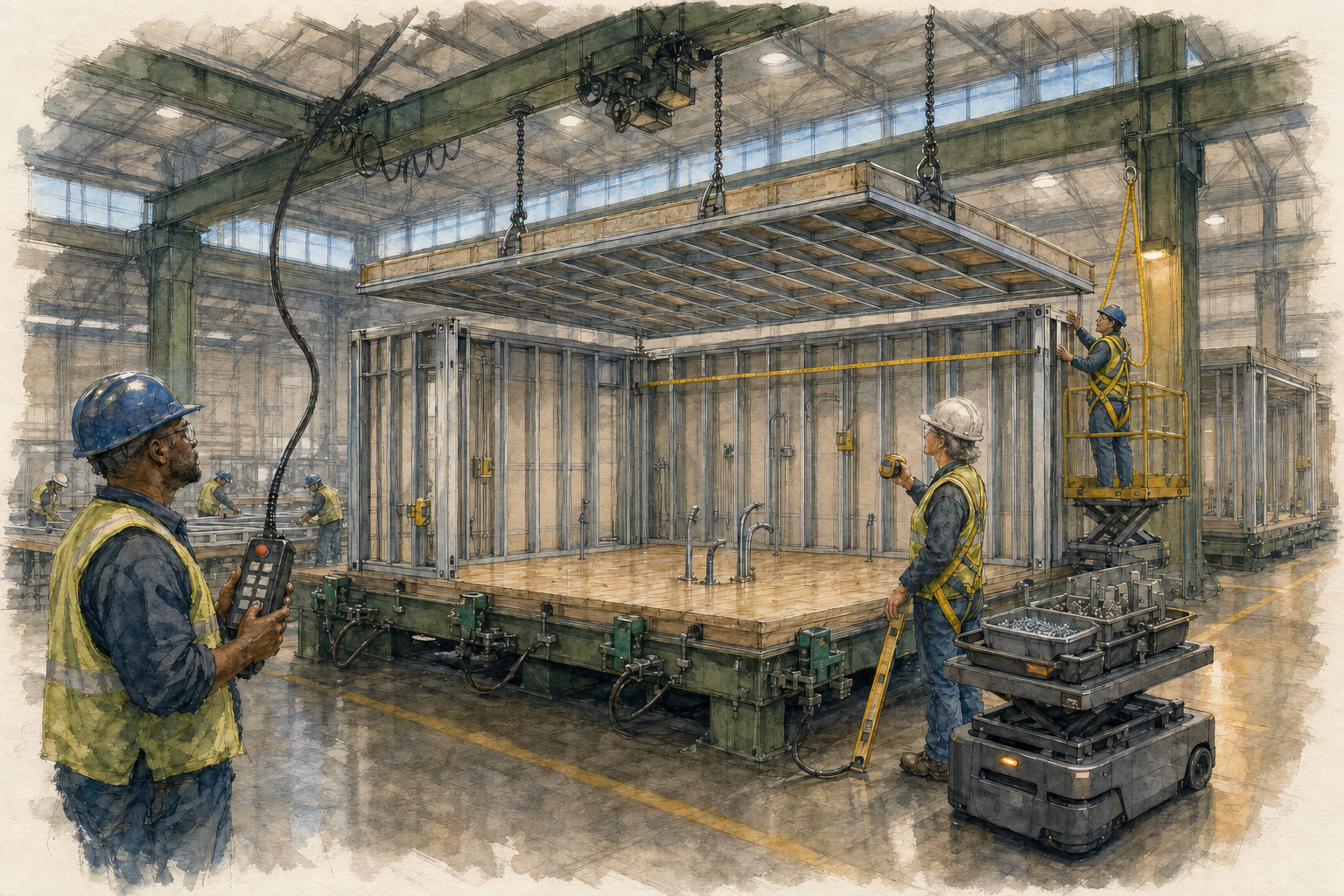
Inside a green-trussed industrial bay, a rectangular steel-stud room frame sits on a low green jig with a plywood deck floor, suspended in part by chains from overhead cranes. A worker in a hard hat and yellow vest stands in the foreground holding a tethered pendant controller, while a second worker in a white hard hat watches from beside the frame and a third works from a yellow scissor lift at the right edge of the module. Light from clerestory windows falls on the polished concrete floor, and a wheeled tool cart with a tray of fittings sits at right.

The foreman on my floor writes the number my tape reads. The wall is built to the spec. The trade is mine to hand to the next apprentice.
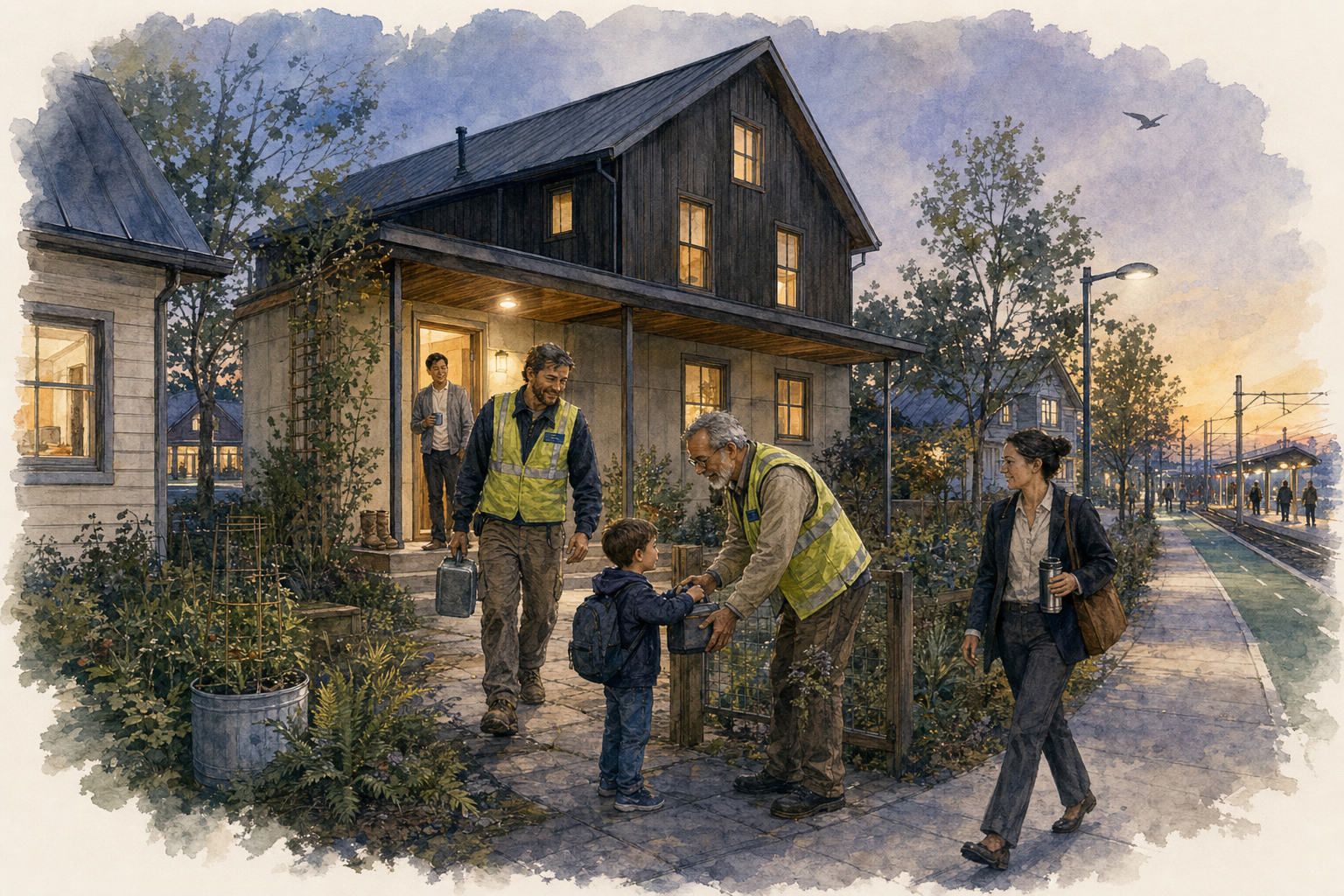
At dusk on a brick walkway outside a dark-sided two-story house with lit windows and a covered porch, a bearded man in a yellow safety vest crouches to shake hands with a small boy wearing a backpack. Another man in a vest carries a lunch pail down the porch steps while a figure stands in the lit doorway behind; a woman with a shoulder bag and water bottle walks past on the right. Beyond a low fence, a train platform with lampposts and a waiting train recedes toward an orange-pink sunset where a bird flies.

Beth Briggs, millwright, Linnton works.

End of third shift. The roll stand on number two came down at 1:15 this morning. I had it aligned and back up at 4:40 — three hours and twenty-five minutes. The screen wanted it back up at three. I held it down.

The screen writes recommendations. The body in the bay writes the call. I made the call at 4:40. The roll stand will run clean for nine months because I held it down for two extra hours.

My father is at the kitchen table tonight writing my son a letter. My son takes the Rivergate floor four miles south of this bay at six. My father came off the floor last Tuesday. My niece Janelle is at the Mill Bend wall shop on the layout jig. I am the body between them.

My mother finished cotton at a mill in Eugene for twenty-eight years. They closed the mill in '02. She had her hands on machinery the rest of her life and never decided when one of them came down for service. The route sheet wrote the call. She took it. The route sheet did not know the bearing. I know the bearing.

I'm going home now. Daniel will be on the bus when I get there. Ray will be asleep at the table. The pail will be gone.
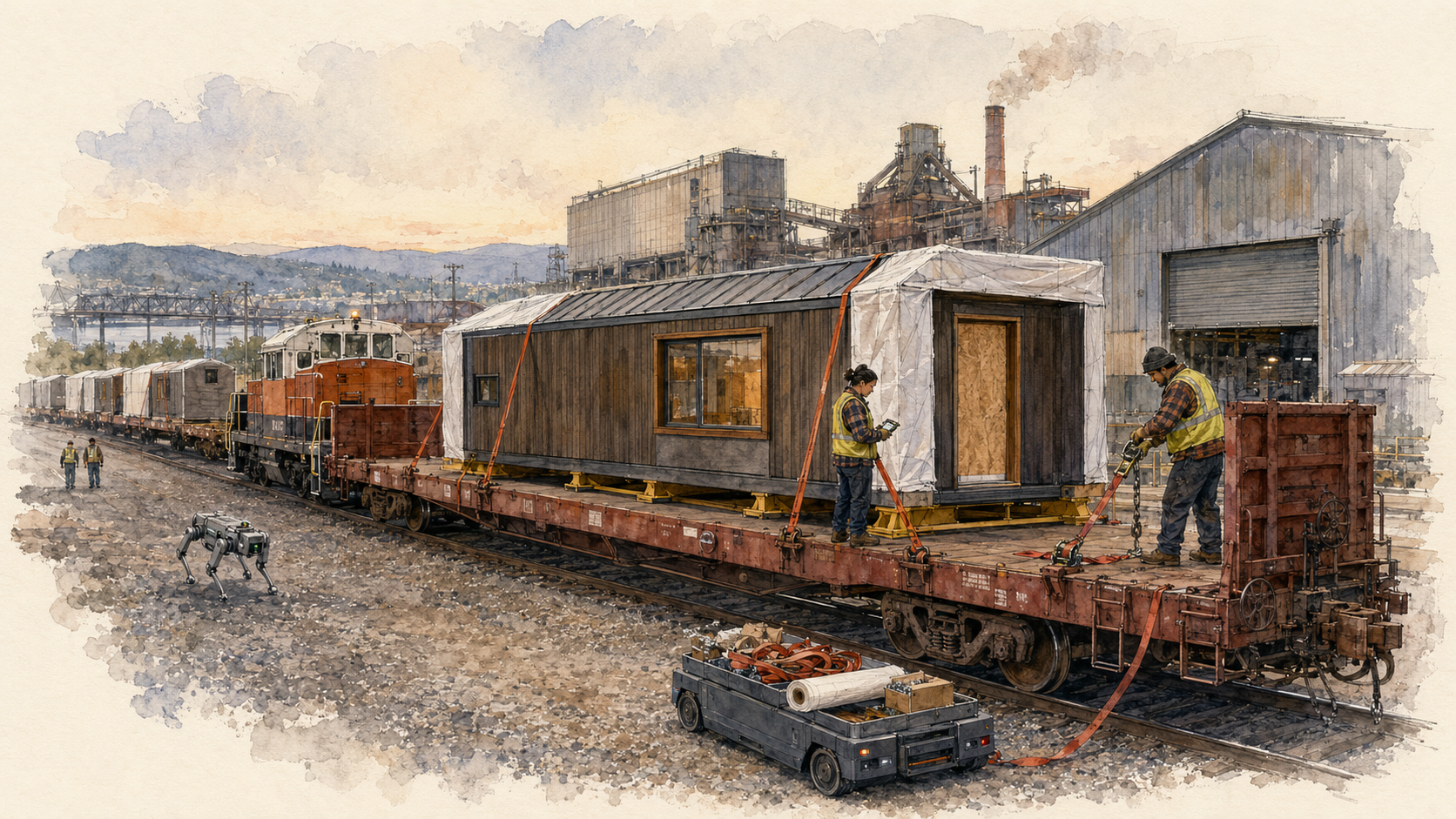
At dusk under an orange sky, an orange-and-black diesel locomotive numbered 2742 and lettered "Transit Corps" idles on a rail siding with a string of flatcars behind it; the nearest flatcar carries a small dark-sided gable-roofed building marked "Transit Corps." Two workers in yellow vests and hard hats are securing the load with red tensioning straps at the right end of the flatcar, while a small wheeled cart with cylindrical equipment sits on the ground beside them. A large industrial plant with stacks and a plume of smoke fills the background, with two more vested figures walking along the tracks at far left.

Curtis Pendleton, freight yard, Mill Bend Works.

Forty-two flatcars went out my yard last month. Each carried a module the wall shop or the foundation shop built. Each was met at its destination by a foundation already poured or a slab already cured.
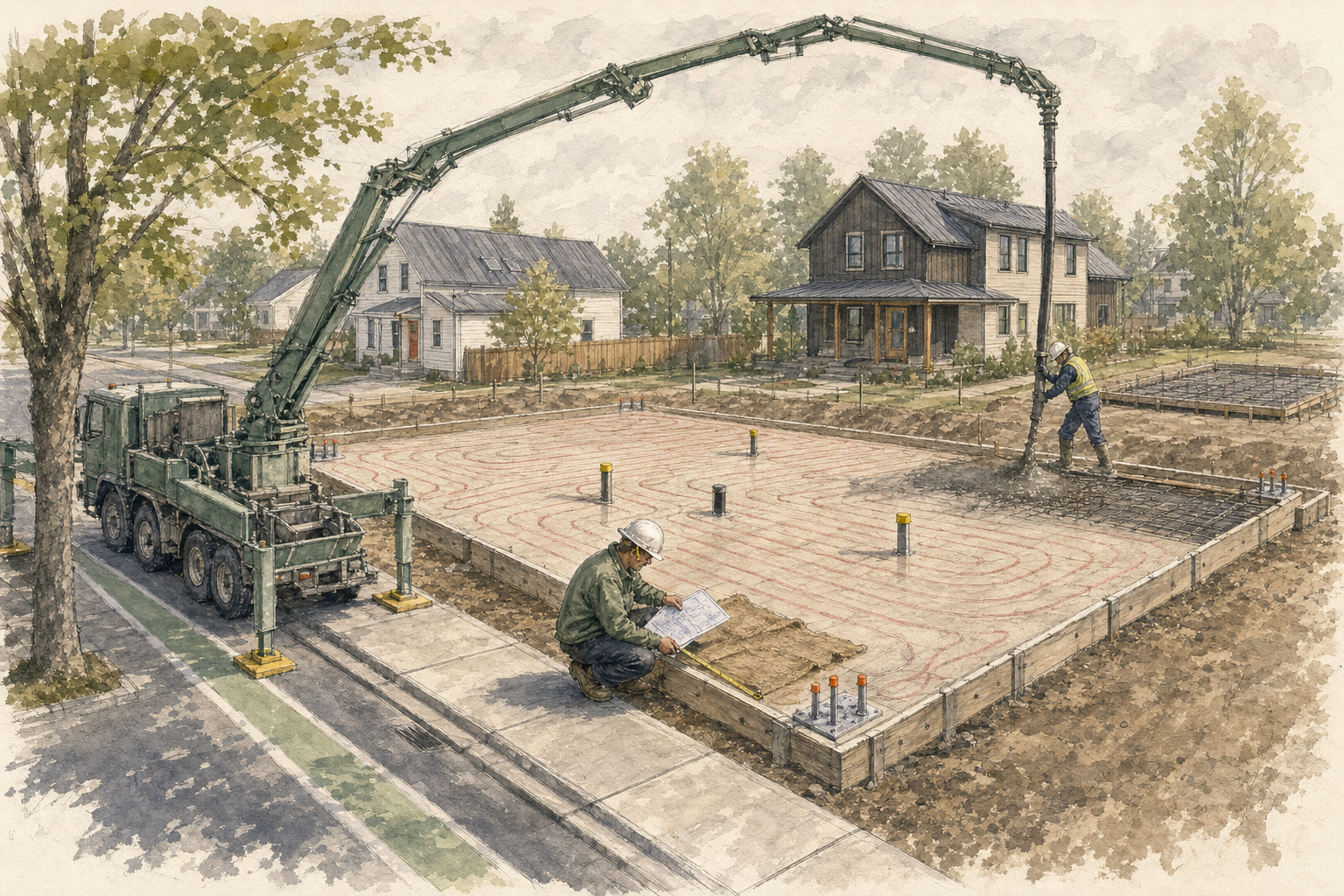
A green concrete pump truck is parked on a residential street with its articulated boom arcing over a rectangular foundation pad ringed by a low concrete stem wall and laced with curved tubing on the slab surface. A worker in green guides the discharge hose at the far corner of the pad, while another in a white hard hat squats at the near edge reading a drawing on a clipboard, with anchor bolts and short pipe stubs protruding from the slab around him. Behind the lot stand two finished wood-sided houses with gabled roofs and front porches, framed by mature trees and a sidewalk.
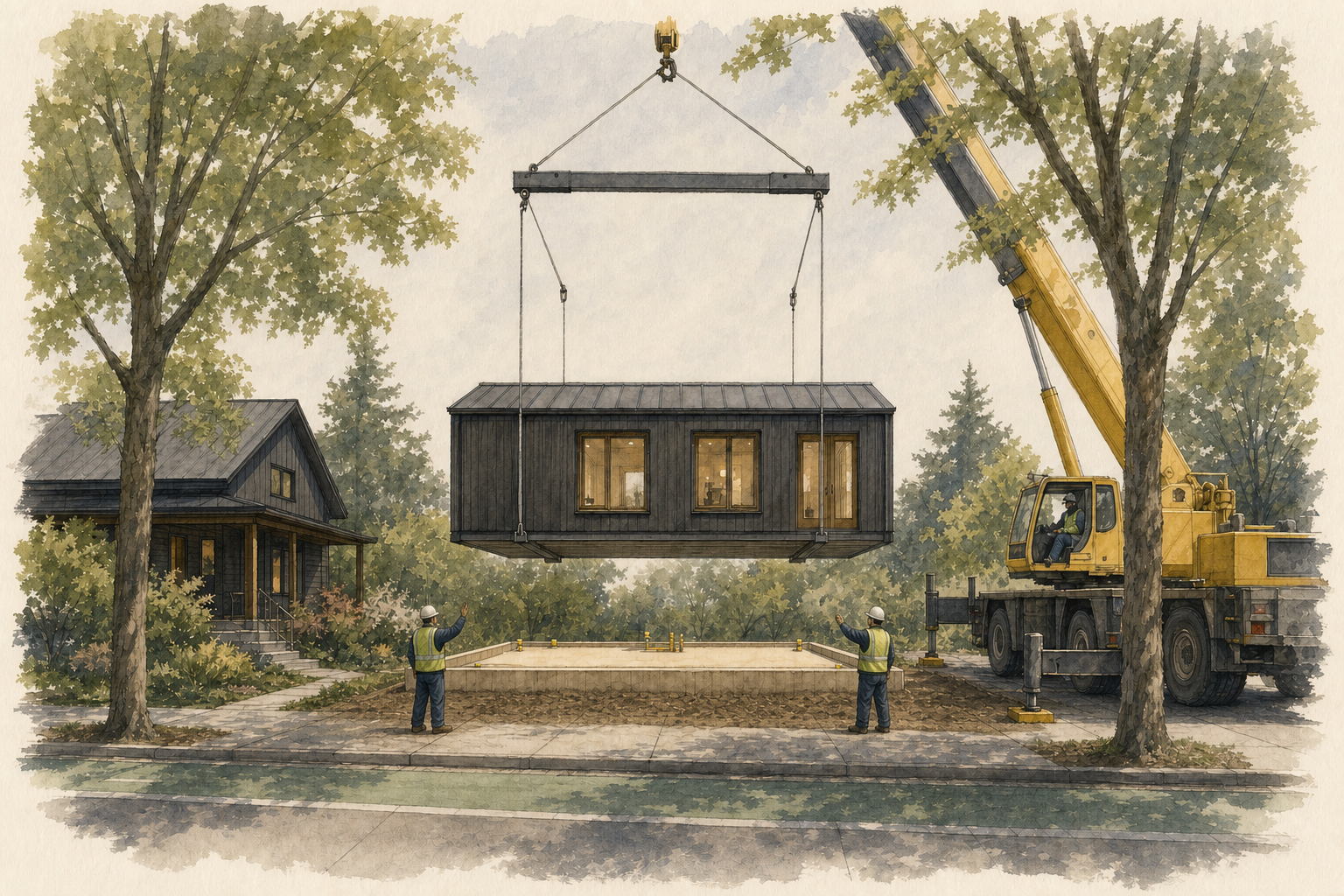
A yellow hydraulic crane at right lifts a long dark-sided single-story building section by a spreader bar and four cables, hovering it above a shallow rectangular foundation pad on a tree-shaded residential lot. Two workers in hard hats and yellow vests stand at opposite corners of the pad with arms raised to guide the module down. A dark gabled house with lit windows sits among trees at the left edge of the frame, and a curb and street run across the foreground.

The Transit Corps locomotive that pulls out of my yard at six this evening will be received at Hamtramck by a crew that knows the load by the bill of lading I wrote myself at 4:14 this afternoon. The bill reads MILL BEND TO HAMTRAMCK. It lists the modules by number. The number is the only intermediary between the wall shop and the foundation. The Transit Corps hauls. The Building Corps receives. Both work for the same employer.

The seam is a line on a bill of lading I wrote by hand. Janelle framed the modules in the load. Frank signs them off at the other end on Saturday.
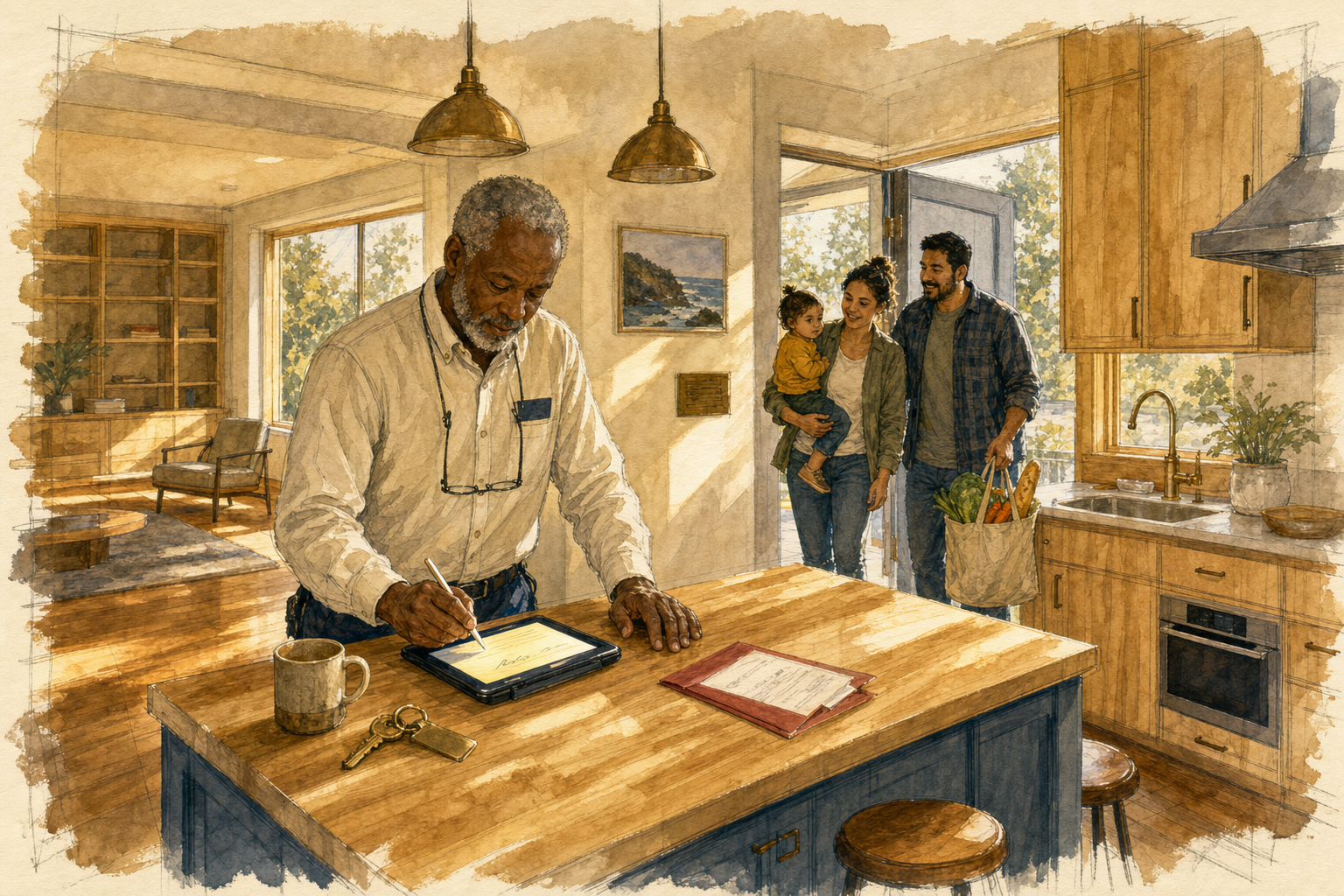
An older bearded man in a button-down shirt with a lanyard leans over a wooden kitchen island, writing on a tablet beside a manila folder, a coffee mug, and a ring of keys. Two brass pendant lamps hang above him; through an open doorway behind, a woman holds a small child while a bearded man carries a paper grocery bag of greens into the room. Warm afternoon light falls across pale cabinetry, a wall-mounted oven, and a framed coastal painting.

Frank Becher, occupancy inspector, Building Corps, District 7, Hamtramck.

I sign off on a house when the house is ready to be lived in. Until I sign, the house is not yet a house.

The signoff Saturday is for the Marek family at 1418 Holbrook Avenue. The modules arrived on Curtis Pendleton's flatcar last Tuesday. The foundation was poured a week before that. Maja Marek signs the lease on Saturday. Her husband signs on Saturday. Their daughter is four.

The closing waits on the signoff. The signoff waits on the house. The stamp has my name on it.

The kitchen subfloor is level. The bath waste line runs. The house is a house.
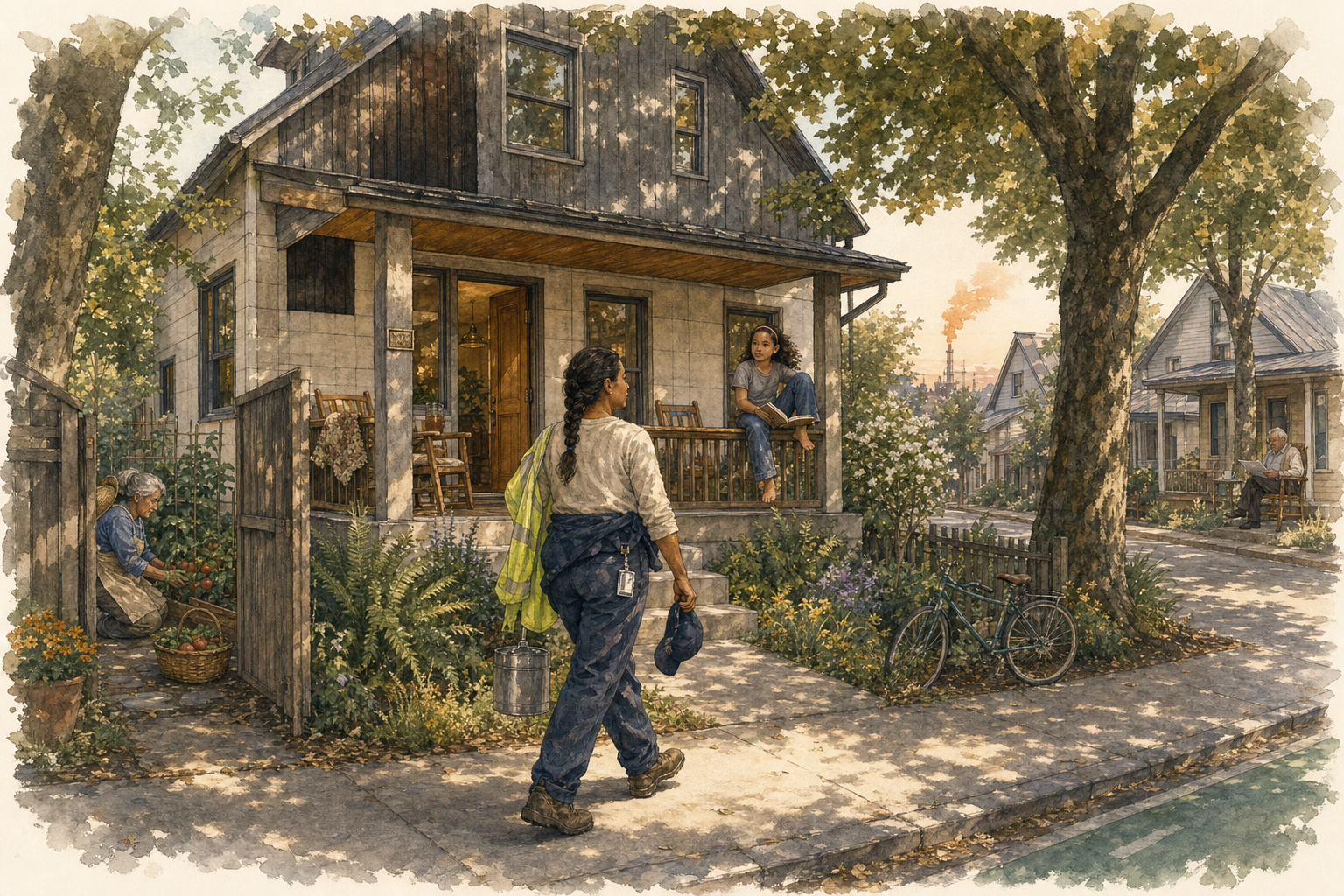
A two-story wood-clad house with a covered front porch sits behind a low fence and a garden of tall green plants on a tree-lined street. A woman with a long braid in dark work pants and a yellow vest walks along the sidewalk carrying a hard hat, glancing toward the porch where a younger woman in jeans sits on the rail reading a book. An older woman kneels in the garden tending plants at left, a bicycle leans against a tree at right, and similar houses recede down the block in warm late-day light.

Geraldine Olmstead, 211 Cherry Street.

Sixty-eight. I bought this house in 2038, on a Building Corps mortgage. It is the first room I have ever owned. My daughter Diane is forty-one, lives at 213, walks down Cherry to her shift at Rivergate at six. Her foreman until last Tuesday was Raymond Briggs. My granddaughter Maria is nineteen, lives in my front room. She took the masonry exam last month. She passed. She starts at the Mill Bend masonry crew on Monday.

My mother died in a rented room in Akron in 1991. She did not own the room. She did not own any room she ever lived in. The room she died in is now part of a property held through a Delaware shell company. I had to look the company up on a state database to learn the name, and the name on the database is not a person. The room is on the market this month for a rent my mother in her best year could not have paid.

They took the room from my mother. They took the trade from my daughter. They took the page from me. Here all of it is back.
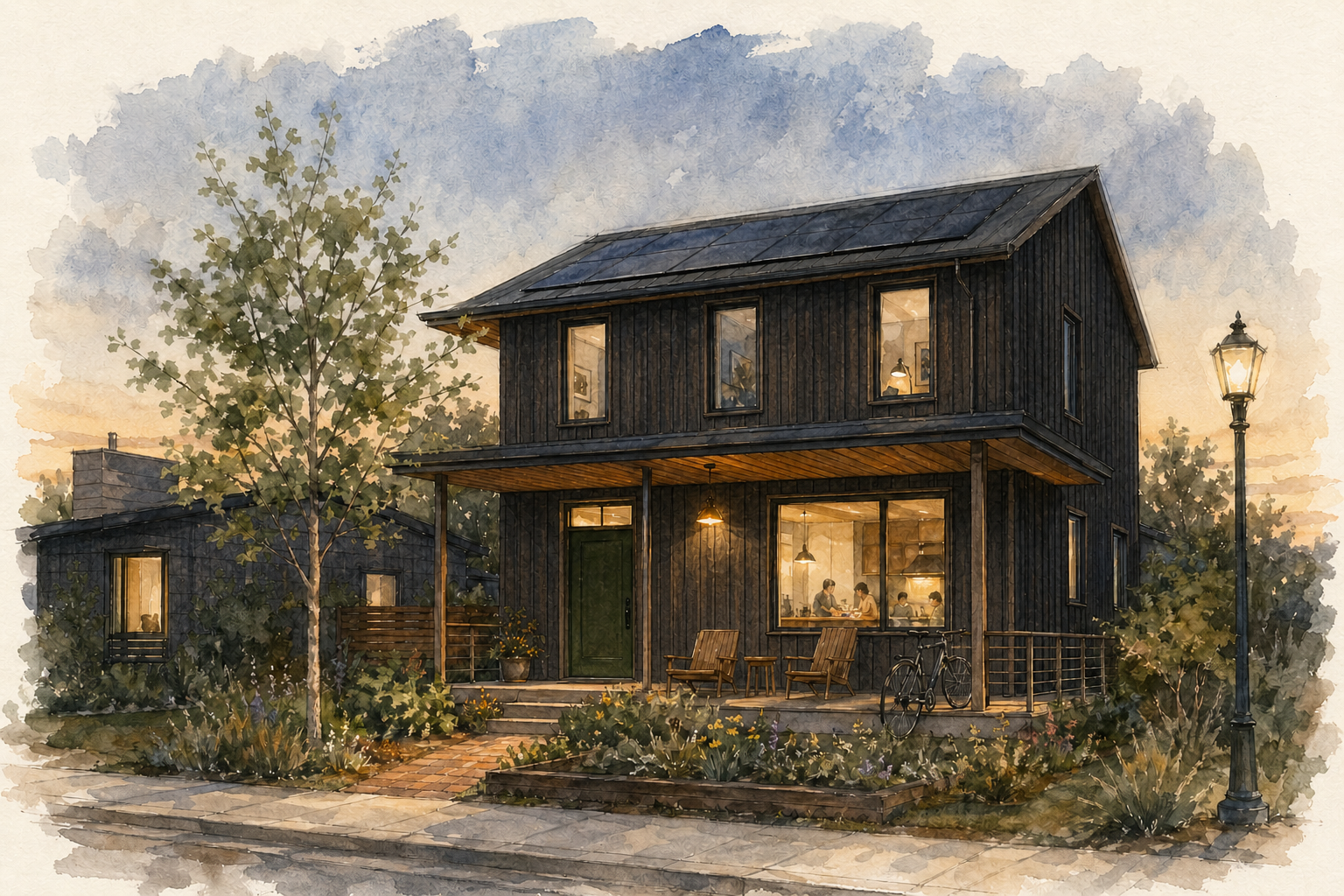
A two-story house clad in dark vertical boards with a standing-seam roof, lit windows on both floors, and solar panels on the front pitch. A covered porch holds two wooden chairs and a small table where two figures sit talking under a hanging lamp; a green front door, a bicycle, and potted plants flank the entry. A leafy tree, a wrought-iron street lamp, and a smaller outbuilding sit at the edges under a soft dusk sky.
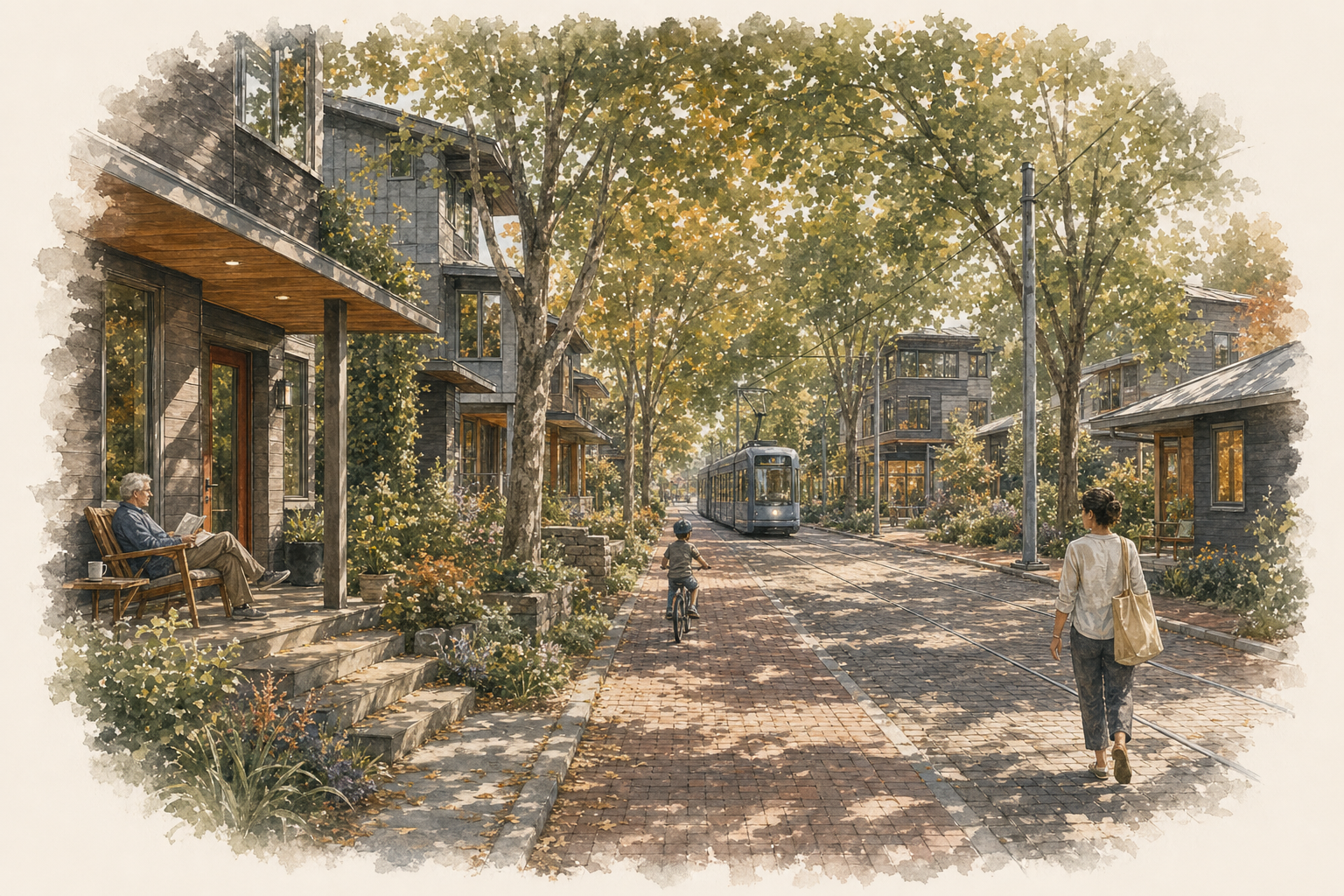
A watercolor street scene with a sleek modern streetcar gliding along tracks set into a brick-paved roadway, framed by leafy trees turning toward yellow. On the left, an older couple sits on a covered porch of a dark-timbered building draped in ivy and flowering shrubs; on the right, a woman with a shoulder bag walks along the bricks while a cyclist approaches from down the line. Warm autumn light filters across the buildings and pavement, with another mid-rise structure visible through the trees in the distance.

Diane is on shift right now at Rivergate. The steel she helped tap this morning is going to a wall framed by Ray's granddaughter Janelle. The wall will be set on a foundation in Hamtramck on Saturday. The family that walks into the room behind the wall is named Marek. None of this would have been true in 1991. None of it would have been true in 2003. None of it would have been true the year my mother died.
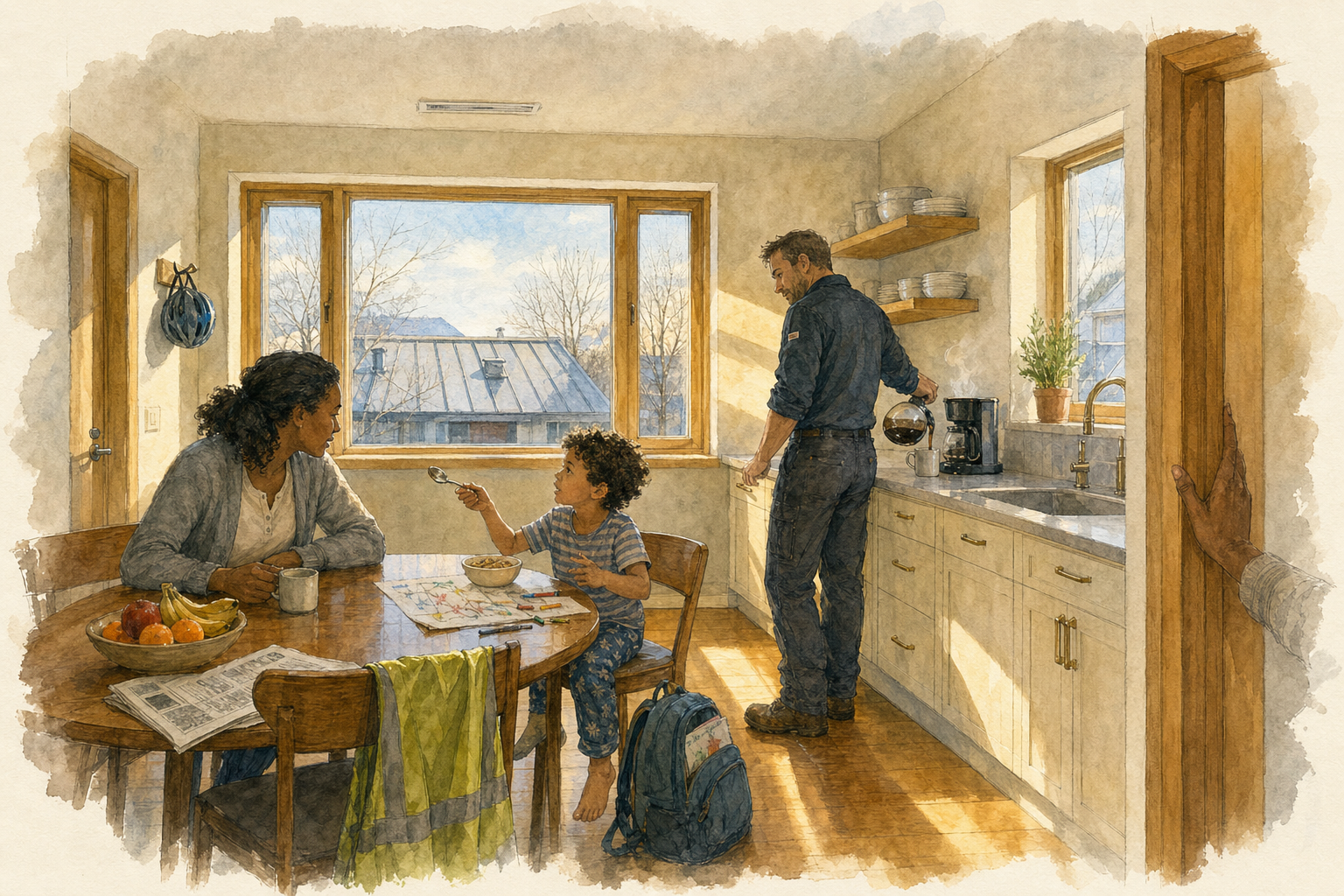
A woman in a gray sweater sits at a round wooden dining table across from a curly-haired child in a striped shirt who is lifting a spoon from a cereal bowl. A man in dark clothing stands at the kitchen counter pouring coffee from a glass carafe beside a potted plant and open shelving. Morning light enters through a large window showing a neighboring rooftop and bare trees; a blue backpack leans against the child's chair and a bowl of fruit and folded newspaper sit on the table.

First Tuesday in May. The block council, Cherry Street.

Lourdes Aguirre's kitchen at 217. Quorum meeting on the year's reserve.

Hector pours coffee. Mrs. Park from 215 brings sweetbread. Diane Olmstead at 213 comes off shift at Rivergate at two and is here by three with her boots still on. The Tran family at 219 is on second shift at the Mill Bend wall shop; Tien Tran signed proxy on her way out the door this morning. Theresa Oliveros — the clerk — sits at the table with the minute book open.

Lourdes reads November's vote on the meter into the record. Four to nothing. The meter stays on the block.

Lourdes: The heat in this kitchen this morning came across the shared wall from the family at 215, because the wall was built so it could and because the boiler at 209 heats all four houses on this end of the block. I pay the cost of the gas the boiler burns, divided by four, plus the five-percent reserve. The meter does not skim, because the meter is owned by the block. The lease I signed in October is one page. There is no second page. The second page was where every page I had ever signed before October put the fees that turned a six-hundred-dollar rent into a thousand-dollar transfer. My mother rented in Phoenix for nineteen years on a thirty-two-page lease. She did not save anything in nineteen years. My daughter is six. The room she sleeps in is hers.

The reserve discussion is in front of the council tonight. The reserve is five percent of operating cost.

Hector: Boiler service first.

Mrs. Park: Boiler service first. And I had to put two blankets on the bed in February. Carla won't sleep in the front room.

Diane: Boiler service then three storm windows on the north end. The windows on the north end are forty years older than the boiler.

Hector reads the Tran proxy. Boiler service, three storm windows, no expansion to the porch. Mrs. Lewinski at 225 didn't sign proxy and didn't show. The reserve passes without her.

Theresa records the vote. Four to nothing. Boiler service and three storm windows.
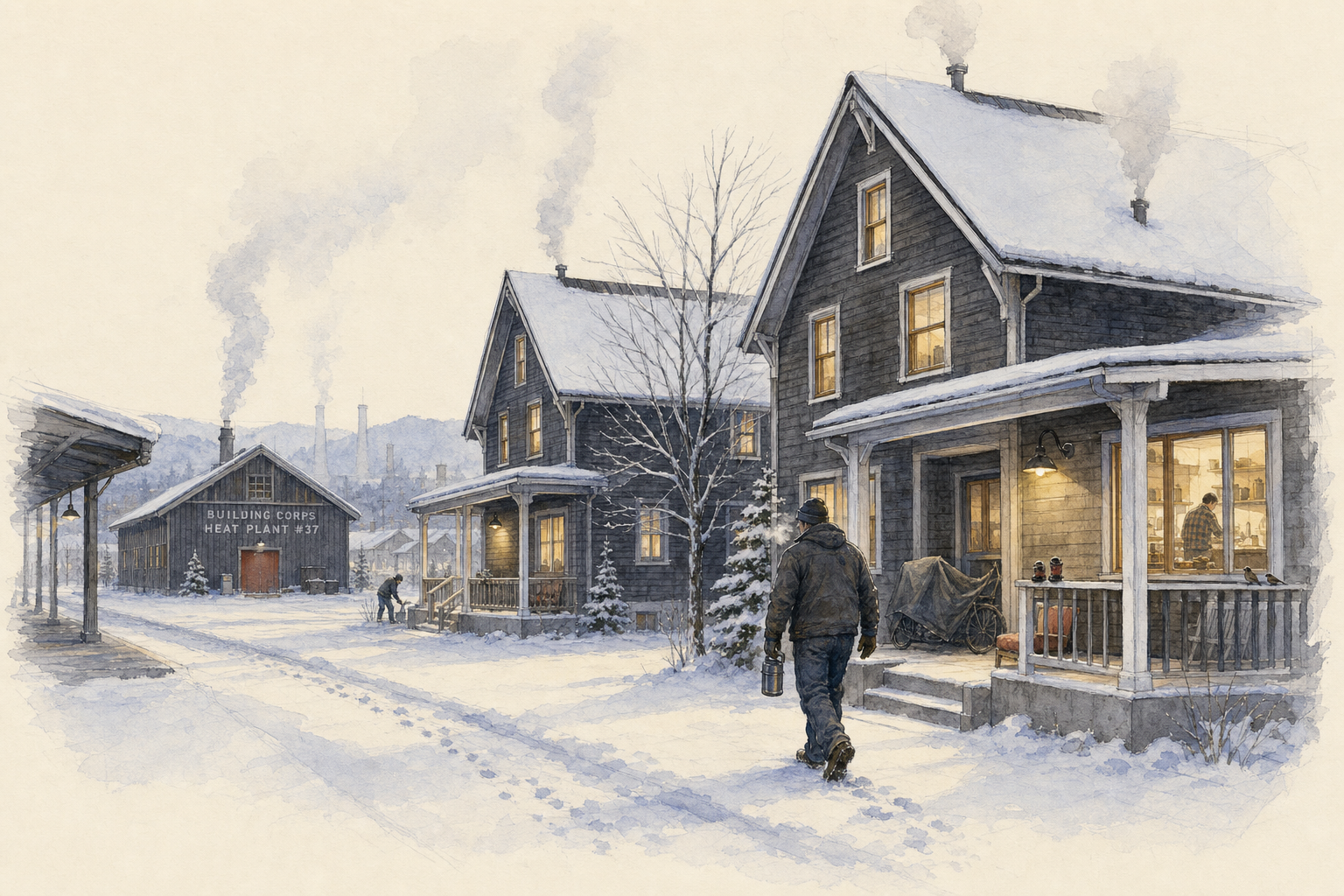
A watercolor of a snow-covered residential street at the cold blue hour of early morning. In the right foreground, a two-story dark-board-clad house with a covered porch — porch lamp lit warm yellow, a kitchen window glowing inside, a figure visible at the counter. A man in dark winter work clothing walks down the snowy front walk carrying a thermos in his gloved hand, breath visible in the cold air. Mid-block, a small utility cabinet at a property line; further down, a second house with its porch lamp on and a small figure on the porch. In the middle distance at left, a low gabled industrial building with snow on its roof and two slim pale plumes rising from short stacks. A rail platform canopy enters from the left edge, and low forested hills band the horizon under a blue-gray dawn sky.
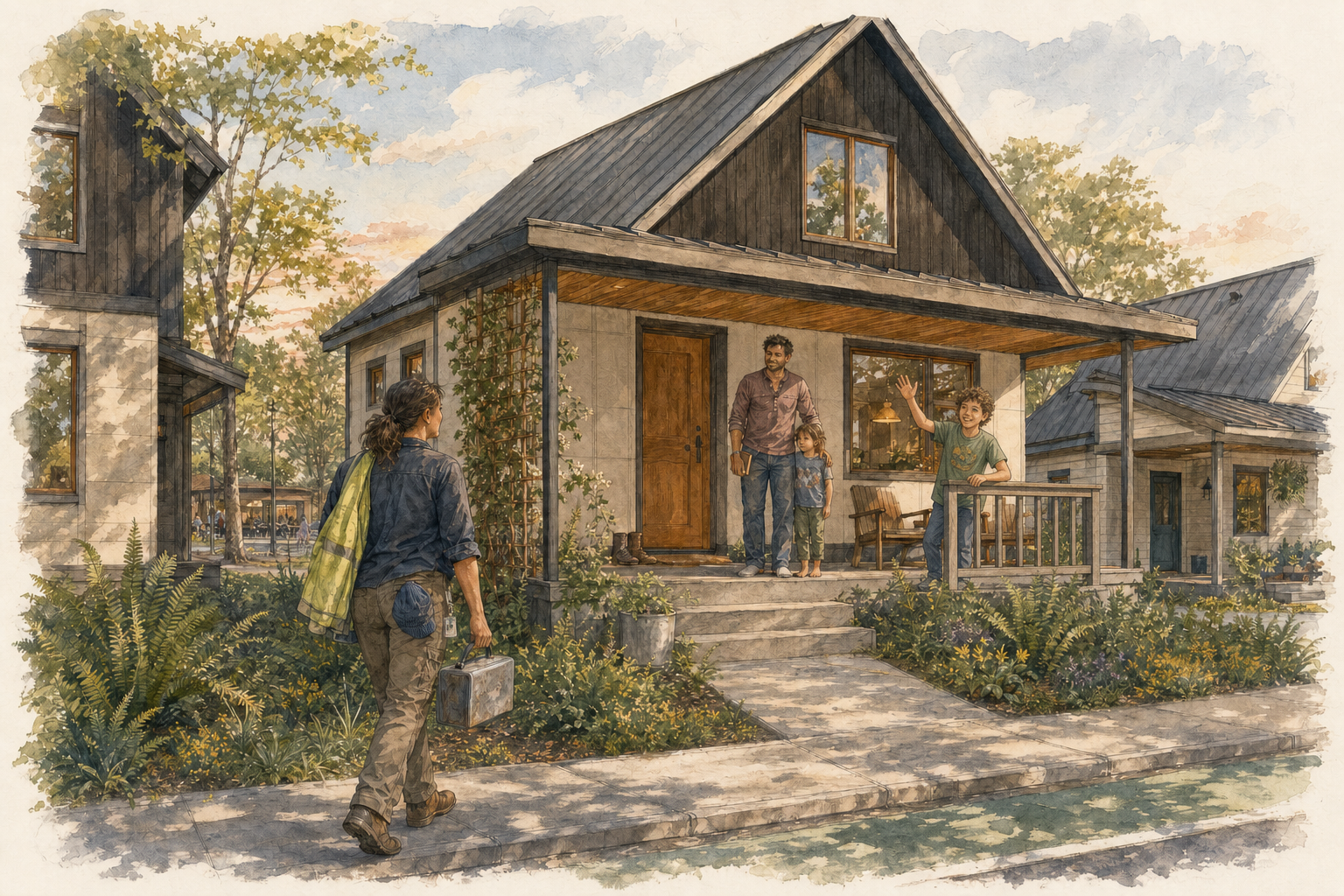
A watercolor of a small gabled cottage with a dark metal roof, pale board-and-batten siding, and a covered front porch glowing with interior lamplight. A woman in a denim shirt and work pants, carrying a green jacket and a metal lunch pail, walks up a stone path through ferns and wildflowers toward the porch, where a bearded man stands in the open doorway with a small child beside him and another figure waves from the lit interior. Soft evening light washes the facade and surrounding garden, with a second similar building visible through trees at left.

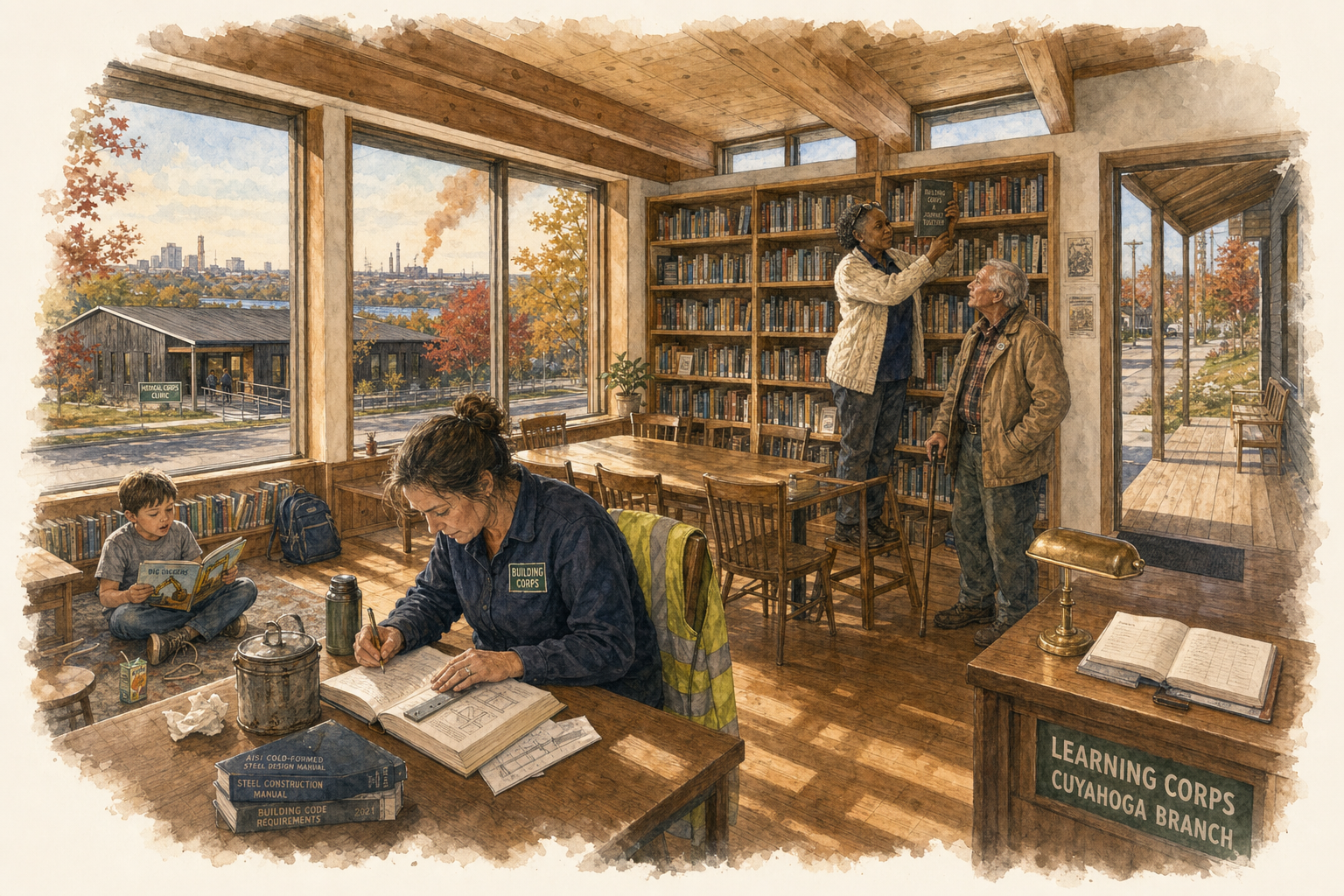
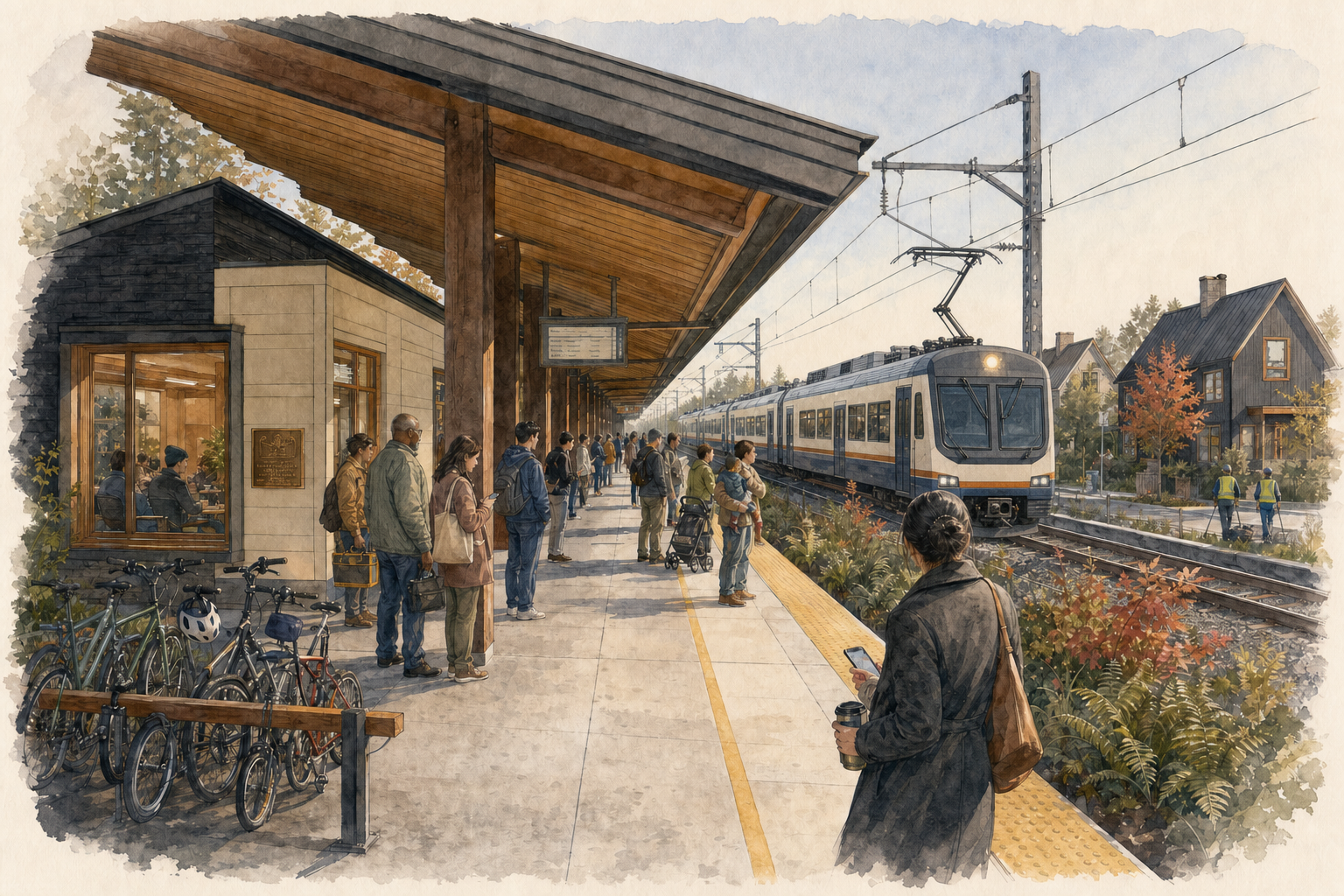
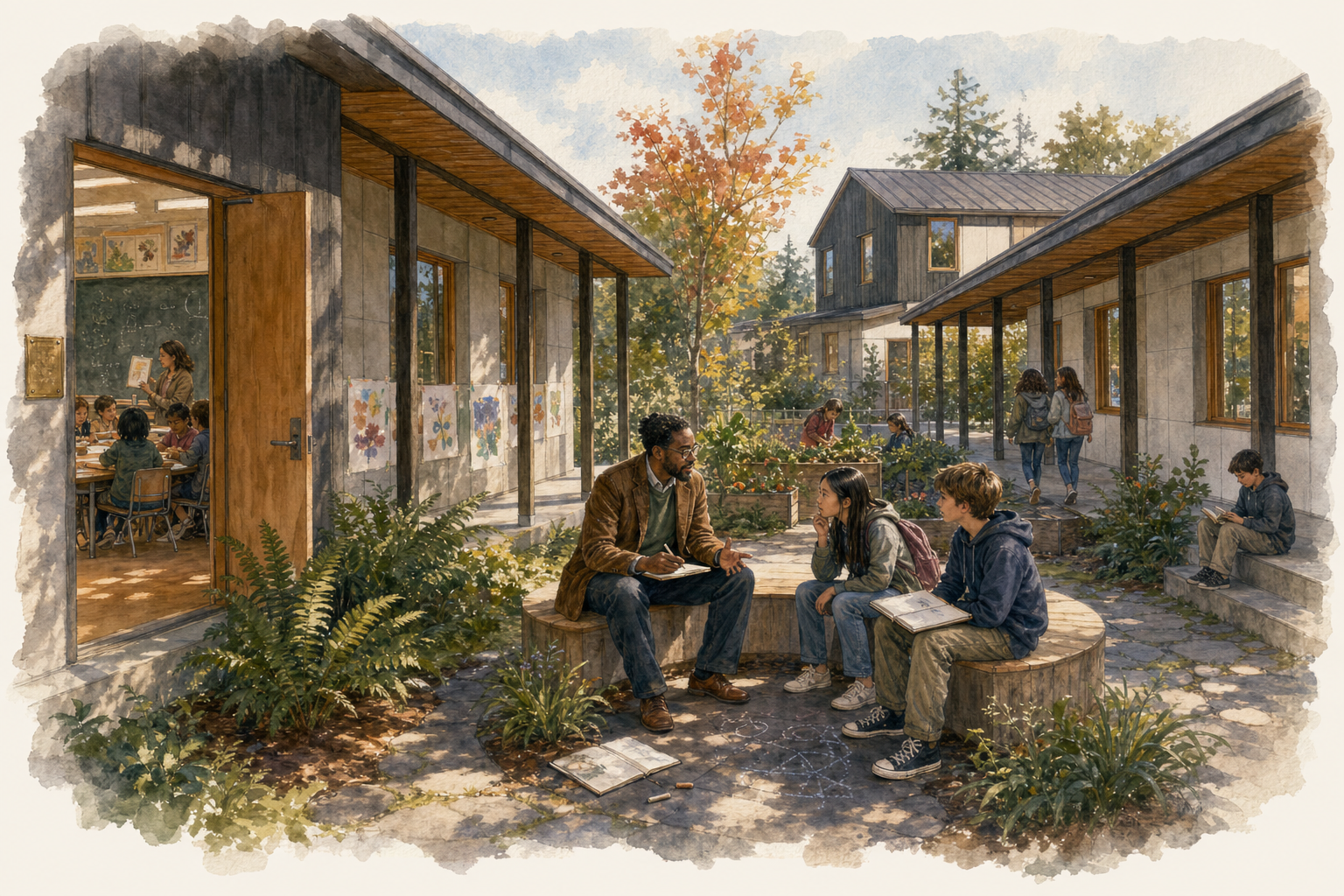
The library on Wabash, which the Learning Corps operates, takes the block's overflow for after-school study tables Monday through Thursday. The clinic on Sixth runs a Saturday well-baby session. The station on Pine runs the bus that took Maria to the Wabash branch on Tuesday and Thursday mornings until last month, when she finished. The school on Elm graduated forty-six children last June.
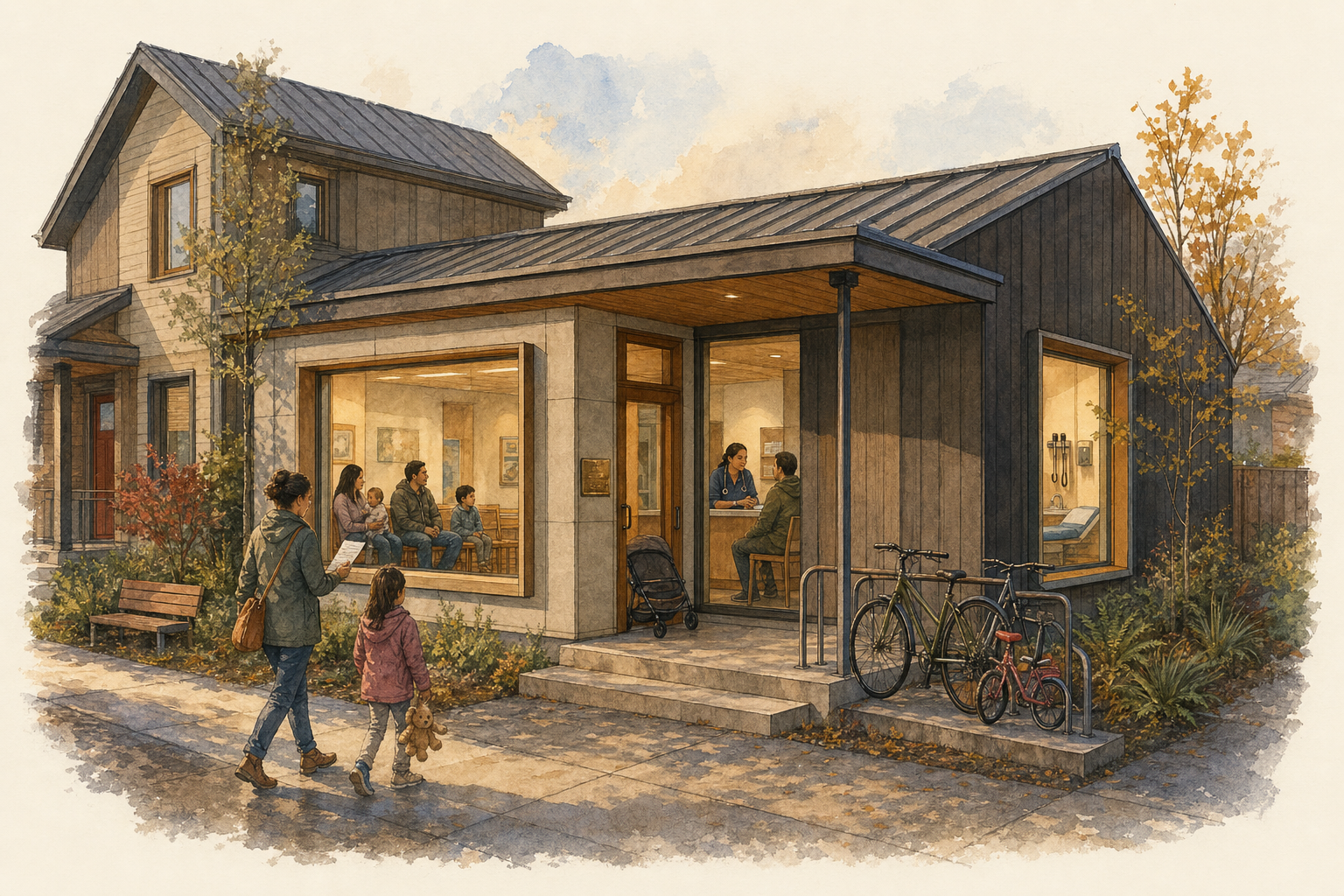
A watercolor of a single-story wood-clad building with a low-pitched metal roof and large plate-glass windows revealing an interior where seated figures face a person gesturing in front of framed pictures, and another room where two people sit talking across a desk. Outside, a woman and a small child in a red coat walk hand-in-hand along a paved path toward the entrance, passing a wooden bench, a rack of parked bicycles, and shrubs turning autumnal yellow and red. Warm light spills from the windows onto the concrete stoop under a softly clouded sky.
A watercolor courtyard between two low pavilion buildings with shed roofs, board siding, and deep covered walkways, opening onto a garden with ferns, shrubs, and a tree in early autumn color. In the center, a bearded man in a brown jacket sits on a log-round bench holding a notebook, talking with three teenagers seated around him, one with a backpack and another reading; an open classroom door at left reveals children's artwork on the walls and students working at tables. At right, more students stand and sit along the opposite building's porch, one reading on a step, under dappled light filtering through the trees.
A timber-ceilinged room with tall windows opening onto a view of autumn trees, a red barn-like building, and a distant city skyline with a smoking stack. A woman in a dark work jacket sits at a wooden table in the foreground reading an open ledger beside a thermos and a metal pail; a boy sits cross-legged on the floor with a book, and at the back two older figures stand at floor-to-ceiling bookshelves, one on a rolling ladder. A small brass-shaded lamp sits on a wooden counter at right beside a sign reading 'LEARNING CORPS / CUYAHOGA BRANCH'.
A train platform under a heavy timber canopy with a small lit waiting room on the left, a row of parked bicycles in a rack, and a yellow safety stripe running along the platform edge. Several people in coats stand waiting while a silver-and-blue passenger train approaches from the right under overhead catenary wires. In the foreground a person in a long coat holds a coffee cup and a phone; beyond the tracks are wooden houses, trees in autumn color, and two figures in yellow vests.

Lourdes signs the minute. Theresa signs. The minute is the document.

Diane's shift ends at two. Ray writes through the night. Walk to the furnace →

Mill Bend · Six voices · Filed under THE WORKS · Issued May 2026