
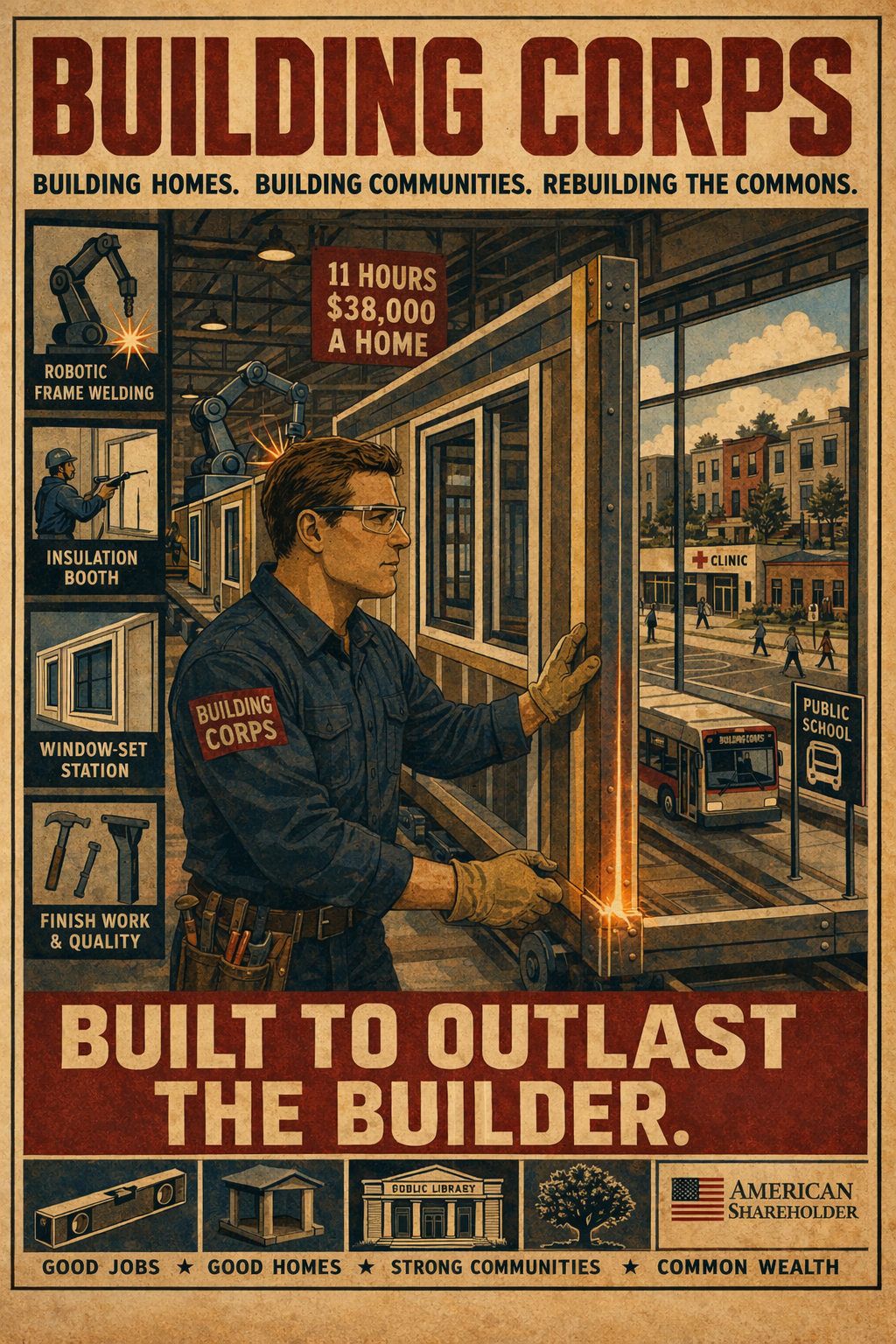
A home in eleven hours. Thirty-eight thousand dollars. Built to outlast the family that lives in it.
WHAT THEY TOOK — PER HOUSE
A representative subdivision house in the American interior. Forty-seven thousand in trades labor and materials. Two hundred eighty-nine at closing. The margin the developer class kept for owning the permit, the lot, and the price — while the ironworker and the carpenter built the house.
Pattern drawn from the public homebuilders' 10-K disclosures and county assessor records. Numbers illustrative of the gap; the gap is the fact.
THE RAILS ALREADY EXIST
Every technology, method, and social form the Building Corps requires has already been demonstrated. The thing that does not exist is an owner whose patience is longer than the next venture-capital exit, and whose shareholders are the families who live in the houses.
Sekisui Heim
Homes finished to 80% at the factory, delivered on a line
Built Robotics
Autonomous earthmoving platforms at production velocity
Figure 02 · Atlas · 1X Neo
Humanoid labor platforms at working-wage unit cost
Autodesk Forma
Generative structural, thermal, and daylight simulation in real time
Katerra
Vertical-integration factory construction — thesis proved, SoftBank capital structure failed
Greenbelt, Maryland
Walkable new town at 18 homes per acre, sidewalks, school, transit — still walkable a century later
None of this is science fiction in 2026. The Corps is a scheduling problem, not an engineering one. What changed is the owner.
SCENE · YOUNGSTOWN, OHIO · THE LINE
Eleven-oh-four on a Tuesday morning. The module comes off the line at station eleven, and the commandant puts his hand on the steel where the robotic welder finished the corner bead an hour ago. It is still warm. His granddaughter is standing next to him with a visitor badge pinned to her jacket. She watches the insulation crew move in behind the module on the rails. She asks him who is going to live in it. He tells her: a family in Akron. She asks if she can do this. He does not trust his voice for a minute. Then he tells her she can build the libraries.
SPECIFICATION

ARCHETYPE · FIRST COMMANDANT
James Harlow*
- Master carpenter. NCCER-certified journeyman welder.
- Twenty-two years residential construction — American interior.
“I spent my career framing garbage that the developer sold at three hundred percent markup. We do not do that anymore.”
Composite — drawn from interviews and public record. The commandant is archetype. Named corporations, settlements, filings, and enforcement actions are matter of SEC, DOJ, or state public record.
BEFORE · AFTER
THE HOUSE
Vinyl siding. OSB sheathing. Window seal separating at install. $47K to build, $289K to sell.
Steel-framed module. < 1.0 ACH50 envelope. 40-year sensor record. $38K to build, handed to the shareholder.
THE STREET
Cul-de-sac platted for lot-sale yield. No sidewalks. School on the far side of a five-lane arterial.
18 homes per acre. Sidewalks on every block. School three blocks. Clinic two. Transit at the corner.
THE MAINTENANCE
Defer to protect quarterly cash flow. Run to catastrophe. Bill the public for replacement.
Per-home sensor stream. Crew of four covers 1,500 homes. Repair before the occupant notices.
THE WORKER
Framing subcontract at $22/hour. No benefits. Three contractors in two years.
Journeyperson at $85,000. Home. Care. Pension. Career track to master, crew lead, plant superintendent.
YOUR NAME ON THE ROLL
The 28th Amendment makes every American a shareholder in the country the Corps are building.
Read the constitutional text. Eighty-seven seconds.
Read the amendment