Yes. This will hurt.
The amendment breaks things. Housing loses its speculative premium. Retirement portfolios concentrated in extraction lose value. Extraction-industry jobs end before the Corps is fully built. Supply chains scramble during the transition. We are not going to pretend otherwise.
Here is what the amendment costs. Here is what doing nothing costs. The pain of the plan is the price of keeping the country. The pain of the alternative is losing it.
THE HOMEOWNER
What you lose under the amendment. Your house loses part of what you thought was its value. The speculative premium that made your home worth five times what it cost to build was never a payment to you. It was a claim on your children's future earnings, and the amendment returns that claim. Your equity number on paper falls. If you bought recently at peak prices you may end up underwater for a period. The Fund cannot make this painless. Your nominal wealth is reduced.
What you lose if the trajectory continues. The line goes past 5.6. Affordability reaches a breaking point within a decade. When it breaks, it breaks the 2008 way, uncontrolled, with foreclosures concentrated in the bottom half of homeowners. Your children will not buy a house anywhere near you. Your grandchildren will not buy one at all. The speculative number on your statement reaches 7x or 8x income and then collapses, wiping out middle-class homeowners while the top ten percent buys the rubble. You do not keep the number. The number takes you with it when it falls.
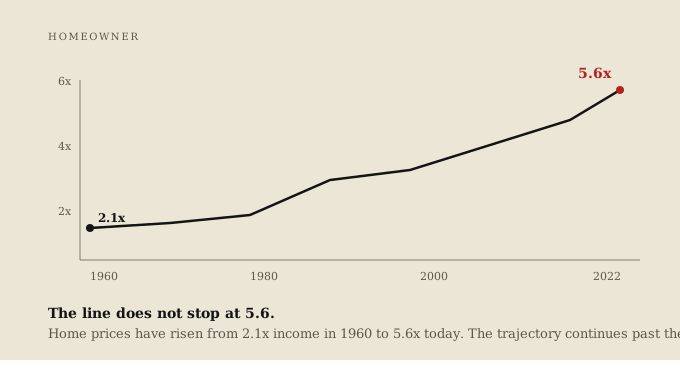
Choose. Take the controlled decline now, with a real home in a real country and children who can live near you. Or wait for the uncontrolled one, which is already on the schedule, and lose the number anyway along with the country.
THE RETIREE
What you lose under the amendment. Retirement positions concentrated in extraction-industry equities lose nominal value. The companies that extract are the companies that stop extracting, and their stock prices reflect it. If your 401(k) is heavy in insurers, PE-adjacent holdings, consumer-credit issuers, or pharmaceutical rent collectors, the paper value drops. The dividend and the provision layer replace what you were trying to buy with retirement savings, but they do not replace the nominal portfolio number. If you were planning to pass financial wealth to your grandchildren, the amount is smaller.
What you lose if the trajectory continues. The line goes past 64. Your Social Security buying power drops below 50 by the mid-2030s. Medicare premiums keep eating your COLA every January. Out-of-pocket medical costs continue rising at 5.8 percent against 2.4 percent COLA. Your prescription drugs get more expensive every year. The stock market corrections that clipped your 401(k) in 2008 and 2022 happen again, and the rescue this time comes with strings attached that leave ordinary retirees behind while institutional holders get made whole first. You end your life rationing care.
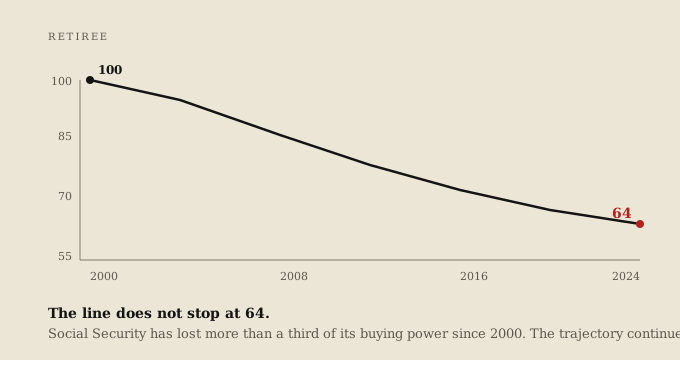
Choose. Take the nominal loss now, with a check that does not depend on extraction, care that is covered, housing that is secure, and a country your grandchildren can live in. Or keep the number and watch it buy less every year until it buys almost nothing.
THE EXTRACTION WORKER
What you lose under the amendment. The industry that employs you ends. Insurance claims departments close. PE-owned nursing homes wind down. Credit-card servicing gets consolidated and then eliminated. Billing companies dissolve. The Corps is the landing, but the Corps does not exist on day one. It scales up over a period of years. During that period, some workers lose paychecks before the Corps has a job to offer them. The transition package catches you, but the transition package is a package, not a seamless swap. You will have a hard period.
What you lose if the trajectory continues. The industry ends anyway. BLS is not projecting these declines because of the amendment. BLS is projecting them because AI and automation are already eliminating back-office extraction work. Your job is on the list with or without the movement. Without the amendment, there is no Corps. There is no transition package. There is no retraining fund. There is a layoff, a COBRA notice, a severance that runs out, and a job market that has three fewer jobs than it had yesterday. The industries that replace your current sector are either gig work at declining wages or nothing at all.
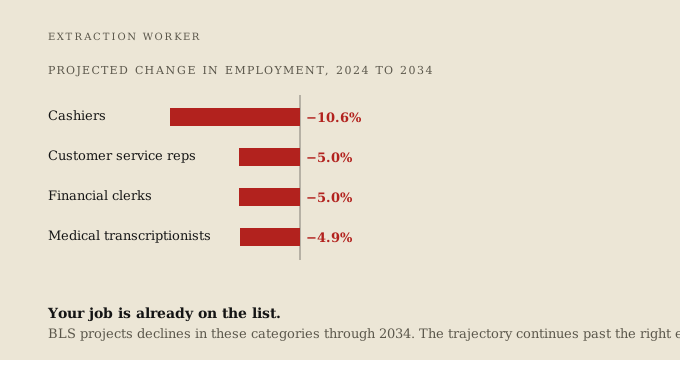
Choose. Take the hard transition now, with a real landing and funded retraining into work that builds something. Or wait for the same industry to end on its own timeline, with no landing and no funding, into a labor market that has been offshored, automated, and consolidated out from under you.
THE SMALL BUSINESS OWNER
What you lose under the amendment. Your supply chain scrambles. The PE-owned distributor you currently buy from goes into dissolution. The billing middleman your industry depends on gets unwound. The software rent-seeker you have been paying monthly either restructures or dies. During the transition period, operating is harder than it is today. You spend time finding new suppliers, rebuilding relationships, and absorbing disruption while the replacement networks form. The amendment cannot prevent this. The shape of your current supply chain was built by the extraction class. It comes apart when the extraction ends.
What you lose if the trajectory continues. The consolidators take your sector. The line goes past 35.6. Small business share of receipts falls below 30 percent by the mid-2030s. PE rollups accelerate. The independent shop disappears from your industry one acquisition at a time until you are competing against a single consolidated operator with infinite capital, no requirement to be profitable, and the patience to lose money for a decade to crush you. You sell at a discount or you fold. Your kids do not take over the business because there is no business to take over.
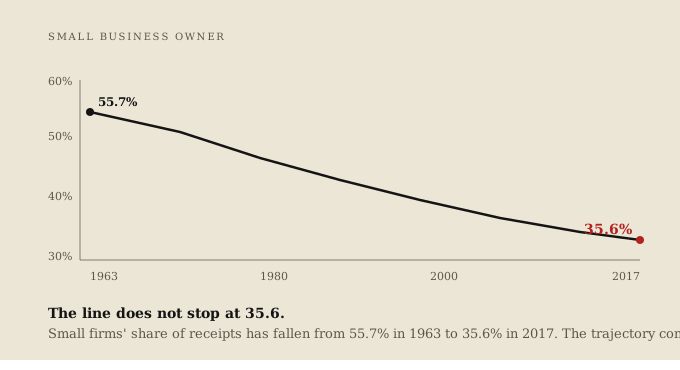
Choose. Take the supply chain disruption now, with customers who can afford what you sell, suppliers who have to earn your order, and a market that works. Or wait for the consolidators to finish eating your sector, at which point there is no market to compete in and your only exit is selling the shop to the operator that crushed you.
Every one of these pains is smaller than the pain of continuing. Every line on every chart continues past the right edge. The amendment is the intervention that bends the lines. Bending them costs something. Not bending them costs the country.
The Revolution cost British trade relationships. Emancipation cost the slaveholders. The New Deal cost the nineteenth-century industrialists. This amendment costs the extraction class fifty years of accumulated rent, and costs the rest of us a transition period that will be hard.
The cost of doing nothing is not zero. The cost of doing nothing is that the children of everyone reading this page are born into a caste system, enforced by AI, that cannot be reversed.
Pick your pain.
That is the honest math.