The American Shareholder Commonwealth
A Complete Specification for Citizen Ownership
Part I: The Promise
What This Is
You own America. You just haven't been paid.
The oil under federal land is yours. The electromagnetic spectrum your phone uses is yours. The research your taxes funded—research that became the drugs you buy at 1,000% markup, the technologies that power the companies worth trillions—is yours.
This system makes your ownership real. Not through redistribution—through production and investment.
The American Prosperity Fund is a vertically integrated engine. It owns the inputs (resources, spectrum, land). It funds the innovation (R&D equity). It employs the production (the Civilian Corps). It delivers the output (healthcare, housing, food, education). It invests the surplus (capacity expansion, compounding returns).
Every layer captures efficiency instead of paying margins to middlemen. The compound returns flow to shareholders. You are a shareholder.
This eliminates the toll collectors between you and the things you need. It replaces extraction with provision. It builds the floor that lets you rise.
The floor is not a hammock. It is a launchpad.
What This Is Not
This is not socialism. Socialism abolishes private property and centralizes production decisions. This system strengthens property rights by extending them to their logical conclusion: you own what you funded, what you preserved, what was held in trust for you. The private market remains unlimited. The Fund produces necessities at cost; everything else is market.
This is not welfare. Welfare is a gift from government, granted to those deemed deserving, revocable at political whim. This is a dividend from ownership. The distinction is not semantic. Gifts can be taken away. Property is yours. Section 3 of the amendment makes conditions unconstitutional.
This is not redistribution. Redistribution takes from producers to give to non-producers. This system does the opposite: it stops the taking. Right now, producers are being extracted to death—30-40% of income to housing, 18% of GDP to healthcare that delivers less than peer nations, a decade of debt for credentials. The extraction layer produces nothing. This system removes it and returns the value to the people who actually produce.
This is capitalism, correctly implemented. Shareholders own assets. Assets generate returns. Returns flow to shareholders. That's the system. What we have now is management looting shareholders—the extraction industries capturing returns that belong to citizens. The Commonwealth corrects the breach. It enforces the property rights you already have.
Part II: The Architecture
The Financial Foundation
Every proposal to finance necessities does one of two things: it adds real resources, or it reroutes claims on existing resources.
This one reroutes. And produces. And invests.
The Fund doesn't passively collect and redistribute. Through the Civilian Corps, it delivers the same healthcare, housing, food distribution, and education that currently exists—performed by the same workers doing the same productive work. The nurse still heals. The teacher still teaches. The builder still builds. The overhead disappears.
And every efficiency gained compounds. The Fund invests in capacity—more clinics, more housing, more training pipelines. Those investments generate returns. The returns fund more investment. The flywheel accelerates.
The Accounting Identity
At the system level, total spending on a necessity resolves into four components:
Where
- •Premiums, taxes, out-of-pocket
- •Interest, fees, mandatory charges
- •All dollars paid by households, employers, government
- •Direct labor (market-competitive)
- •Physical inputs and consumables
- •Capital maintenance and depreciation
- •Training pipelines
Excludes:
- ×Financial engineering
- ×Scarcity rents
- ×Adversarial admin processes
- •Claims processing & billing
- •Eligibility verification
- •Denial management
- •Collections & financing spreads
- •All remaining spend not required to produce the service
- •Not a moral claim—an accounting residual
- •The extraction layer
Formally
W = S(1−r) − CThis is not ideology. It is arithmetic. The wedge is the design space.
The Wedge: A Precise Definition
This is not a moral claim. It is an accounting residual. A dollar is classified as wedge (W) if it meets any of the following conditions:
Does not directly increase delivered service quantity or quality
Does not expand future productive capacity
Exists solely due to fragmentation, adversarial pricing, or scarcity monetization
Would disappear in a vertically integrated, non-extractive system without reducing output
If the service can be delivered at the same scale and quality without the expense, the expense is wedge.
What Counts as Wedge
- Insurance underwriting margins
- Claims denial labor (payer and provider)
- Hospital billing departments beyond clinical documentation
- Financial interest above risk-free capital maintenance
- Monopoly rent from regulatory scarcity
- Transaction fees from fragmented payment rails
- Executive compensation not tied to delivered output
- Legal, compliance, and consulting spend from multi-payer conflict
- Pharmaceutical pricing games (not R&D)
- Collections, servicing, and financing spreads
Empirical Ranges
Using OECD comparisons, Medicare cost structures, and sectoral decomposition. These ranges deliberately under-claim—they assume current quality, competitive labor compensation, and exclude secondary effects.
| Category | Total Spend (S) | Sustainable Cost (C) | Wedge (W) | W as % of S |
|---|---|---|---|---|
| Healthcare | $4.2–4.8T | $2.8–3.3T | $1.2–1.8T | 25–38% |
| Housing | $2.7–3.2T | $2.2–2.6T | $0.4–0.8T | 15–25% |
| Education | $0.8–1.0T | $0.5–0.7T | $0.2–0.4T | 25–40% |
| Total | $7.7–9.0T | $5.5–6.6T | $1.8–3.0T | 23–35% |
If critics dispute a figure, the burden is to show which wedge component is necessary for production.
Why the Wedge Is Real
The wedge is not theoretical inefficiency. It is observed dispersion:
International Comparators
Peer nations deliver the same or better outcomes at materially lower spend, using the same technologies and labor classes.
Single-Payer Subsystems
Medicare administrative overhead: 2–3%. Private insurance: 12–18%.
Vertically Integrated Systems
VA healthcare, public utilities, municipal housing—consistently lower per-unit costs when adversarial billing is removed.
Within-U.S. Variance
Identical procedures vary 2–3× across regions without outcome differences—explained by pricing power, not care.
The Design Implication
Because:
- C (sustainable cost) is bounded by real resources
- r (payment overhead) can be minimized through unified rails
- W (wedge) produces no output
The wedge is the only legitimate design space.
Eliminating or capturing it does not reduce production. Does not require increased labor. Does not require money creation. Does not require redistribution.
It is a conversion of waste into capacity.
This is why the system works: The Fund doesn't "fund" necessities. It replaces an extractive architecture with a productive one and retains the surplus.
If someone claims the wedge can't be captured, they are implicitly claiming that billing wars, denial processing, monopoly rent, and financial friction are necessary inputs to healthcare, housing, or education.
That's the line that forces them to show their work.
Public Assets
Natural Resources
- Oil, gas, minerals
- Timber, water
- Federal land
Infrastructure
- Spectrum licenses
- Grid, waterways
- Data infrastructure
Innovation
- Patents from public R&D
- Equity in funded tech
- Research returns
THE AMERICAN PROSPERITY FUND
Constitutional mandate: Hold assets, distribute returns, radical transparency. Every transaction public. Auditable by any citizen.
Revenue Streams
- 1. Resource royalties (25%+ floor)
- 2. Spectrum licensing (auction)
- 3. R&D equity returns
- 4. Redirected federal spending
- 5. Fund investment returns
- 6. Land value capture
Expenditure Priorities
- 1. Provision systems (at cost)
- 2. Capacity investment (mandatory %)
- 3. Corps compensation (dividend)
- 4. Citizen dividend (residual)
- 5. Reserve accumulation
BUDGET CONSTRAINT: Dividend = max(0, Revenue - Provision - Capacity - Admin - Reserves)
PROVISION LAYER
CIVILIAN CORPS
ALL provision labor (healthcare, educators, food, housing)
- Full provision
- Enhanced dividend
- Ownership acceleration
- Capability development
Creates PARALLEL labor market that gives ALL workers bargaining power.
CITIZEN DIVIDEND
- Unconditional
- Algorithmic
- No bureaucrat decides
- Higher base
- Increases with skill
- Increases with need
Private Market
Everything above the floor. Unlimited upside. Real competition. Luxury housing, premium food, elective procedures, entertainment, innovation.
Part III: The Constitutional Lock
Why An Amendment
Legislation can be repealed. Any law creating citizen ownership can be unwound by the next Congress. Any fund can be privatized. Any provision system can be defunded, conditioned, or captured.
The extraction industries have armies of lobbyists. They write legislation. They fund campaigns. They will fight this with everything they have, and if this is merely law, they will eventually win.
The only way to make ownership permanent is to make it constitutional. Property rights at the constitutional level cannot be removed by simple majority. They require supermajority in Congress AND ratification by 38 states.
This is not about trust. It is about mechanism design. The amendment creates a structure where the default behavior of self-interested actors—politicians seeking power, corporations seeking profit, bureaucrats seeking budget—cannot easily unwind citizen ownership.
Definitions (Non-Negotiable)
Before the operative sections, the amendment requires precise definitions. Eighty percent of legal exploitation dies here.
- Citizen: Any natural person holding United States citizenship at the time of distribution.
- Common Property: Assets held in trust whose ownership vests equally and indivisibly in all citizens.
- Fund Principal: Assets and capital whose alienation would reduce future productive capacity.
- Fund Returns: Net revenues generated by the productive use of Fund principal, after maintenance and reserve requirements.
- Distribution: A citizen's pro-rata share of Fund returns, executed automatically.
These definitions close the exploit holes before they open.
The Seven Sections
Each section exists because history teaches the attack pattern.
Section 1: Citizen Ownership
The natural resources of the United States, and the returns from infrastructure and research funded by public investment, are the common property of all citizens. Each citizen holds one equal, non-transferable share in this common property.
What It Does: Establishes the property right. You own it. This is not a benefit granted—it is your property, recognized in the highest law.
Why It Matters: Property cannot be taken without due process. Benefits can be withdrawn at will. The word "property" is load-bearing.
Critical Clarification: Citizens own an equal, inalienable claim on the returns generated by assets—not the underlying assets for private use. You own the dividend, not the drilling rights.
Section 2: The American Prosperity Fund
Congress shall establish a Fund to hold these assets and distribute returns to citizen-shareholders. The Fund shall operate with full public transparency; all transactions, holdings, and operations shall be public record, auditable by any citizen.
What It Does: Creates the vehicle. Mandates radical transparency.
Why It Matters: You can audit the Fund from your phone. Every transaction public. Every holding visible. Opacity enables corruption. Transparency prevents it.
Section 3: Inalienability
No law shall condition, reduce, delay, or withhold any citizen's share or distribution based on income, employment, behavior, criminal history, or any other criteria. The share vests with citizenship and cannot be sold, seized, transferred, or encumbered.
The Attacks It Prevents:
- "Only hardworking Americans deserve their share" (work requirements)
- "We need to drug test recipients" (behavioral conditioning)
- "Felons forfeit their shares" (criminal disenfranchisement)
- "Your share can be garnished for debts" (creditor seizure)
Every welfare program in American history has been weaponized through conditions. Section 3 makes conditions unconstitutional.
One Narrow Carve-Out: Distributions may be temporarily suspended solely for identity verification, fraud resolution, or duplicate claim prevention—under uniform rules with prompt appeal. This is about who you are, not what you did.
Section 4: Automatic Distribution
Distributions to citizens shall be calculated by published formula and executed automatically. No official shall have discretion to alter, delay, or condition individual distributions.
What It Prevents: Payments delayed for political enemies. Bureaucratic discretion becoming corruption. Politicians threatening to withhold your dividend.
The formula is published. The calculation runs automatically. No human in the loop means no human can corrupt it.
Section 5: Corporate Exclusion
Legal entities, including corporations, trusts, and partnerships, are not citizens and shall hold no shares. Only persons holding citizenship status are shareholders.
What It Prevents: One wealthy individual creates 10,000 LLCs, claims 10,000 shares. Corporations argue they deserve shares as "persons."
Corporations are legal fictions. Useful—but they don't breathe. They don't vote. They don't hold shares. One citizen, one share. No exceptions.
Section 6: Fund Integrity
The Fund shall not be borrowed against, raided, or used as collateral for any purpose other than direct returns to citizen-shareholders. Congress shall make no law diverting Fund assets to other uses.
The Attacks It Prevents:
- "We need the Fund for the war"
- "The hurricane requires emergency diversion"
- "We'll pay it back" (they never do)
Social Security's "trust fund" was raided and replaced with IOUs. Section 6 makes raiding unconstitutional.
The Accounting Lock: Fund principal and Fund returns are accounted for under separate public ledgers. Principal may not be reclassified as returns by statute or regulation. This blocks the sophisticated raid: "redefine principal as 'returns' and distribute it."
Section 7: Provision Constraints
Provision systems funded by the Fund shall operate through publicly-owned infrastructure, nonprofit entities, or price-regulated providers. No provision system shall permit charges exceeding documented cost plus a published reinvestment allowance capped at five percent (5%). Profit distributions are prohibited.
The Attack It Prevents: When federal student loans became unlimited, colleges raised tuition to absorb them. When Medicare pays whatever hospitals charge, costs spiral.
If the Fund pays for something, prices are tied to documented cost. Not "what the market will bear." Cost. Plus 5% for reinvestment. That's it.
Allowable Cost:
- Direct labor at market rates
- Direct inputs at market rates
- Depreciation and maintenance of productive capital
- Reinvestment allowance (capped at 5%)
Disallowed Cost:
- Profit distributions to shareholders
- Executive compensation above defined multiples
- Financial engineering and related-party markups
- Administrative overhead from adversarial payment (gone—single payer)
- Marketing and advertising (you don't need to market necessities)
The Gold-Plating Problem
Cost-plus pricing has a known failure mode. If I get cost + 5%, my incentive is to maximize cost—gold toilets, unnecessary staff, bloated procurement—to maximize the absolute value of that 5%.
Target Cost Pricing (The Fix)
The Fund sets regional benchmark costs for procedures, housing units, educational outcomes—based on best-performing providers.
- Deliver at benchmark: You get cost + 5%
- Deliver below benchmark while meeting quality metrics: You keep a portion of the savings (up to a cap) for reinvestment pool
- Deliver above benchmark: Automatic audit, required cost reduction plan
This shifts the incentive from "bloat costs to increase margin" to "efficiency increases your capacity and standing."
Providers compete to beat the benchmark. The benchmark ratchets down as best practices spread. Efficiency compounds. The opposite of the current system where costs ratchet up.
Governance & Capture Resistance
The amendment says "radical transparency." Adults ask: what are the mechanics?
Fund Board
- Fiduciary Duty: Owed to citizen-shareholders, not Congress. Citizens have standing to sue for breach.
- Removal: Only for cause, via supermajority vote. No political firing.
- Revolving Door: 10-year employment bar. No Board member may work for Fund contractors after leaving.
Audit
- Continuous Public Ledger: Real-time. Every transaction visible as it occurs.
- Independent Audit Authority: Constitutionally-mandated body with subpoena power.
- Automatic Criminal Referral: Misclassification of costs triggers automatic DOJ referral.
Procurement
- Open Bidding: All contracts publicly bid. No sole-source above thresholds.
- Vendor Concentration Caps: No single vendor may hold majority of Fund contracts in any category.
- Mandatory Re-Competition: All contracts expire and must be re-bid. No perpetual relationships.
This isn't a bureaucracy bible. It's enough to show you understand capture patterns and have mechanisms to resist them.
Part IV: The Provision Layer
Necessities at cost. Not free—at cost. The system can prove where every dollar went.
The private sector will not deliver most provision services. The profit motive doesn't work when profit is prohibited. This is by design. Provision is delivered through publicly-owned infrastructure, non-profit entities, or price-regulated providers. Different services may use different models. What they share: no extraction layer.
Healthcare
The Problem
America spends 18% of GDP on healthcare. Peer nations spend 10-12%. They live longer. Their babies die less often. The difference is not quality of care—American doctors are as skilled as German doctors. The difference is the system between you and care: insurers profit from denying claims, hospitals maintain billing armies, every provider employs coders, billers, collectors, lawyers.
The billing war consumes $500-700 billion per year. Neither side treats patients with any of it.
The Model: Single Payer, Competing Providers
The Fund as Payer
- One payer for all citizens
- One set of rules, one claims process
- No denials to fight (if medically indicated, it's covered)
- Administrative overhead: 2-3% (vs. 15-20% for private insurance)
Single payer eliminates the billing war. One payer, automatic payment. The hospital doesn't need an army to fight insurers. The $500-700 billion stays in the productive economy.
Healthcare Collectives as Providers
- Quasi-independent regional organizations (not one federal bureaucracy)
- Receive per-capita funding from Fund
- Employ providers directly (corps labor)
- Governed with provider representation
- Compete for patients on quality
How Competition Works
- Prices are fixed (at cost). You can't compete on price.
- Quality is measurable. Wait times. Outcomes. Patient satisfaction. Complication rates.
- Metrics are published in real time. Everyone can see how every collective performs.
- Patients choose their collective. Choice is real because provision covers you regardless.
- Collectives that perform well attract patients → more funding
- Collectives that perform poorly lose patients → less funding → leadership replaced
Market discipline without market pricing. Competition on the variables that matter (quality, access, outcomes) rather than the variable that enables extraction (price).
For Providers
- Salaried (stable income, no billing battles)
- Corps members (provision + enhanced dividend)
- Governance voice in their collective
- Judged on care quality, not volume
- No prior authorizations, no denials to process
- Enhanced dividend for underserved area service
Doctors entered medicine to heal people, not to fight insurance companies. This model lets them do the former and eliminates the latter.
Specialists and Rural Care
Specialists
- Regional specialty centers
- Collectives contract with specialist pools
- Transport covered if needed
- Telemedicine for consultations
Rural Areas
- Highest dividend enhancement
- Fastest ownership path
- Telemedicine as first line
- Mobile clinics for in-person care
The Transition
Years 1-2: Route existing Medicare/Medicaid through Fund. Same spending, different pipe. Begin collective formation from willing hospital systems.
Years 3-5: Expand coverage to all citizens. Existing nonprofit hospitals convert to collective model. For-profits choose: convert to nonprofit collective status, or stay private for elective/cosmetic market only.
Years 5+: Full system operational. Insurance industry wound down. Billing armies disbanded. Workers absorbed into collectives or redeployed via corps.
What You Experience
Before
Sick → Fear of cost → Forms → Coverage check → Treatment → Surprise bill → Fight insurance → Appeal → Pay thousands → Debt
After
Sick → Go to doctor → Get treatment → Go home
The Fund pays. You're a shareholder. Shareholders don't get billed for using company infrastructure.
Housing
The Problem
Housing is treated as an investment asset. You buy hoping it appreciates. "Homeownership is building wealth." This creates perverse incentives: scarcity increases value (existing owners oppose new construction), zoning restricts supply (NIMBYism is rational self-interest), financial intermediaries extract mortgage interest, landlords extract profit from necessity, speculation creates volatility, wealth concentrates across generations.
You spend 30-40% of income on housing. Your parents spent 20%. Their parents spent 15%. The trend is extraction, not value.
The Model: Housing as Utility
The fundamental reframe: housing is shelter, not investment. The value is use value, not exchange value. You own for stability and autonomy, not appreciation.
The Homestead Path
- Apply for homestead lease on Fund-owned property
- Pay maintenance + utilities only (no mortgage interest, no landlord margin)
- Live there, maintain it, participate in your community
- After 5 years: title transfers to you
- You own the structure
This is not charity. It's a path to ownership that doesn't require 30 years of mortgage payments with half going to bank interest.
The Fund's Housing Portfolio
The Fund acquires and builds housing where people need it:
- Foreclosure purchases (already happening, redirect to Fund)
- Tax-lien acquisitions
- New construction (especially multi-family)
- Adaptive reuse (empty offices → apartments)
Not "40 acres in a desert." Housing in cities, suburbs, towns—where jobs and communities exist.
Zoning Reform
Local zoning is captured by existing homeowners protecting their property values. This is a collective action problem—individually rational, collectively disastrous.
The amendment enables federal override of exclusionary zoning for Fund housing projects. When the Fund builds housing, local regulations cannot block it through endless review or restrictive zoning.
This is controversial. It's also necessary. You cannot solve housing scarcity while allowing localities to prohibit housing construction.
Progressive Taxation
Housing above baseline is still market. But taxed progressively:
- Average regional housing: low/no property tax
- Above average: progressive rate kicks in
- Far above average: heavily taxed
This breaks speculation. Want a mansion? You can have one—and you pay society for the excess resources. Want modest housing? It's essentially free (homestead) or lightly taxed (purchase). Revenue funds capacity expansion.
Movement and Mobility
Life happens. People need to move. The system accommodates this:
- If you want to move: Sell your owned home on market. Re-enter homestead queue at lower priority than first-timers, or at full priority in designated growth areas.
- If you must move (work, family emergency): Transfer mechanism. Forfeit equity in property A, enter homestead at property B with clock reset. Not punished for circumstances.
Inheritance
When you die:
- Descendants can move in as primary residence (priority access)
- If they don't want to live there, property returns to Fund
- Cannot be held as investment property or rental
- Cannot accumulate housing wealth across generations
Your children can live in your home. They can't become landlords collecting rent on your home. Housing is for living, not for extracting.
The Transition: Existing Homeowners
Middle-class wealth is 60% housing equity. Crash home values and you destroy the balance sheets of the very coalition you need. This is real.
The Grandfathered Equity Bond
At ratification, existing homeowners can swap their current home equity for a Fund-guaranteed bond:
- Value: Assessed equity at time of ratification
- Appreciation: Indexed to CPI (stable, real value preserved)
- Redemption: On sale of home, or transferable to heirs
Existing homeowners trade uncertain appreciation for guaranteed stability. They're not harmed. Future buyers enter the utility model. The transition is politically viable because you're not destroying anyone's existing wealth—you're converting its form while changing the rules going forward.
What Gets Killed
- Landlord extraction (~$600B/year)
- Mortgage interest extraction
- Speculation and flipping
- NIMBYism (they can't block Fund construction)
- Housing as wealth concentration vehicle
What You Experience
Before
30-40% of income to housing. Decade of saving for down payment. 30 years of mortgage payments, half to bank interest. Trapped by location and equity.
After
Maintenance and utilities only. 5 years to ownership. Stable. Secure. Mobile when you need to be. Wealth accumulated through work and investment, not sitting on land.
Food
The Problem
Food insecurity exists in the wealthiest nation in history. Not because of production scarcity—America throws away 40% of food produced. Because of access.
SNAP (food stamps) involves means testing, applications, eligibility determination, benefit calculation, fraud enforcement, appeals, EBT administration. A bureaucracy designed to determine who "deserves" food.
Grocery margins are thin (2-3%). The waste isn't at the store level. It's in the system deciding who qualifies.
The Model: The Food Commons
Government grocery stores carrying staples. Identity-verified access. No payment at point of use. No means testing. No bureaucracy deciding who deserves to eat.
What the Commons Carries
- Grains: rice, flour, oats, pasta, bread
- Legumes: beans, lentils, chickpeas
- Produce: basic vegetables, seasonal fruits
- Dairy: milk, eggs, cheese, butter
- Protein: chicken, ground beef, basic fish
- Basics: cooking oil, salt, sugar, coffee, tea
- Prepared food made in-store from staples
What the Private Market Handles
- Restaurants
- Premium groceries
- Specialty items
- Snacks, soda, alcohol
- Convenience
- Variety beyond staples
Why This Is Easiest
America already has socialist agriculture. Price supports, crop insurance, strategic reserves, production quotas. The government already manipulates food markets heavily. The infrastructure exists. Grocery stores everywhere. Food distribution networks mature.
Implementation options: Dedicated government stores (cleaner separation), contract with existing chains for "commons section" (faster deployment), or hybrid (some dedicated, some contracted).
The commons is staffed by corps. Food service skills are useful across the system (hospitals, schools, collective cafeterias). Training in commons is capability development for other roles.
What Gets Killed
- SNAP bureaucracy (means testing eliminated)
- Food insecurity (universal access)
- The indignity of proving you're poor enough to eat
What You Experience
Walk into commons, show citizen ID, get staples. Done. Want steak? Go to market. Want dinner? Commons has you.
No one starves. Everyone eats. The floor is nutrition, not gastronomy.
Education
The Problem
The bachelor's degree is a medieval credential. Four years sitting in lecture halls, demonstrating compliance, signaling class status. The degree says "I can sit still for four years" more than "I can do this job."
Tuition has risen 1,200% since 1980. Students carry $1.7 trillion in debt. The debt cannot be discharged in bankruptcy—a special cruelty written by the lending industry. The return on degree has flattened. The "college premium" exists not because graduates earn more (wages flat), but because non-graduates have been pushed out of jobs they used to hold.
The system exists to credential, not to educate. To filter, not to develop. To extract, not to invest.
The Model: Learning, Not Credentialing
The university should not be organized around the four-year degree ritual. It should be organized around developing human capability.
- Modular: Courses, certificates, programs of varying length. Take what you need.
- Competency-based: Prove you can do X, not that you sat in class. Demonstration, not attendance.
- Stackable: Add capabilities over time. Return for new skills as needs change.
- Continuous: Access at any age. The 40-year-old retooling is as welcome as the 18-year-old starting.
- Multiple pathways: Trade school = university. Different paths, equal dignity. The electrician and the engineer both contribute.
What the Fund Pays For
- K-12 (reformed)
- Public post-secondary (modular programs)
- Trade and vocational pathways
- Lifelong return access
You want to learn? The Fund pays. No debt. No trapping you with loans you can't discharge. Investment in capability development pays returns for decades.
The Credential Revolution
Not government licensing. Evidence registry. Standardized competency assessments—rigorous, transparent, auditable. You demonstrate capability, it's recorded. Employers check the registry.
The market decides what evidence it trusts. As Fund-backed assessments prove predictive of job performance, employers learn to trust them. "Fund-verified data analyst" competes with "BA in Computer Science" and may prove more predictive of actual job performance. The degree monopoly breaks not by prohibition but by competition.
Corps Integration
Learn while you serve. The corps training pipeline is integrated with the education system.
Want to serve in healthcare corps? Here's the pathway:
- Basic training → certified nursing assistant
- Service + continued learning → LPN
- More service + more learning → RN
- Specialists pathway for those with aptitude
Apprenticeship model. Learning embedded in doing. Not four years of theory, then practice. Theory and practice integrated from day one.
Research
Research is different from teaching. Don't conflate them. Two tracks:
Applied Research
Fund takes equity in commercialized output. If NIH funded 40% of the research, Fund holds 40% of licensing revenue. Researchers get enhanced dividend tied to commercialization value. Incentive to create useful knowledge.
Basic Research
Grants judged by peer review. No expectation of commercial return. Funded because knowledge has value beyond immediate application. The researchers who did basic physics eventually enabled everything.
Innovation Prizes and R&D Buyouts
"Provision at cost" creates a problem: where's the incentive to innovate within the provision layer? The Fund maintains an innovation acquisition budget:
- Lump-sum buyout: Fund purchases breakthrough IP for large one-time payment
- Deployment at marginal cost: Innovation rolls out across all provision at cost of production only
- Inventor keeps the prize: The innovator gets paid handsomely, then moves on to the next invention
High incentive to invent. Zero incentive to extract. Innovation benefits all citizens immediately, not just those who can afford monopoly pricing.
K-12
- Teachers are corps (provision + enhanced dividend)
- Funding disparities disappear (universal provision, not local property tax)
- School choice within public system (competition on quality)
- Published metrics (outcomes, not inputs)
- SLA accountability (automatic consequences for failure)
What Gets Killed
- Student debt ($1.7T eliminated)
- Credential gatekeeping (competency replaces compliance)
- Administrative bloat (provision constraint caps overhead)
- The fiction that sitting in lecture halls develops capability
What You Experience
Before
Four years. $100K+ debt. Credential that may or may not relate to work. Payments for a decade. Can't discharge in bankruptcy. Trapped.
After
Learn what you need. Demonstrate competency. No debt. Return anytime for new skills. You are evaluated on what you can do, not what institution's name is on your wall.
Part V: The Civilian Corps
Three Things You Must Know First
The Corps is voluntary.
Private employment is unrestricted.
The Corps does not set wages outside provision sectors.
If you read anything below and think "forced labor" or "federal monopoly" or "wage controls," return here. These assertions are load-bearing.
The Key Insight
The corps is not a program. It is not a bureaucracy. It is the production engine.
Everyone staffing the provision layer—healthcare providers, educators, food distribution workers, housing construction crews—is corps. They produce. The nurse heals patients. The teacher develops capability. The builder constructs homes. This is real work creating real value.
The difference from the current system isn't what they do. It's what's missing: the extraction layer that currently consumes 20-40% of every dollar before it reaches the person doing the work.
Same production. No toll collectors. Every dollar of efficiency flows back to the system—and to you.
The Compensation Structure
| Component | What It Is |
|---|---|
| Full provision | Housing, healthcare, food, education—covered |
| Enhanced dividend | Cash payment above citizen base |
| Ownership acceleration | Faster homestead path |
| Capability development | Learn while serving |
| Governance voice | Representation in collective management |
The Math
If provision saves you $30K+/year, then a $40K enhanced dividend gives you $70K+ total compensation with zero survival costs.
Corps Path
Private Sector
After housing, healthcare, taxes, debt service
Corps compensation is competitive without requiring competitive cash wages.
The Parallel Labor Market
This is the mechanism that fixes labor markets without mandates.
Currently, workers have limited alternatives: work for available employers, or starve. This asymmetry creates exploitation. Employers don't have to offer good terms. They just have to offer better-than-starvation.
The corps creates a real alternative. When workers have a credible outside option, private employers must compete. Not against starvation, but against a decent alternative.
This is how you raise all wages without minimum wage laws. Not by mandating floors, but by creating alternatives that make exploitation impossible.
The Incentive Gradient
| Role | Compensation | Ownership Path |
|---|---|---|
| Citizen (no service) | Base provision + base dividend | Standard homestead (5 years) |
| Corps entry | Full provision + enhanced dividend | Accelerated (4 years) |
| Corps skilled | Full provision + further enhanced | Fast-track (3 years) |
| Corps critical/underserved | Full provision + highest dividend | Fastest (2 years) |
Want a homestead fast? Serve where we need you. Want the highest dividend? Develop skills, take hard assignments. The gradient pulls people toward contribution. Not through coercion, but through better deals for harder work.
Structural Clarifications (Defusing the Attacks)
No Labor Monopoly
Corps labor is limited to provision systems funded by the Fund. Period. Private healthcare, education, housing, and food systems may exist above the floor. The Corps operates in provision. The private market operates everywhere else.
No Work Mandate
The citizenship dividend is unconditional. Corps participation affects enhanced compensation only. You get the base for breathing. You get enhanced for contributing. The opposite of a work mandate.
No Federal Super-Employer
The Corps is not one employer. It's a framework for regional collectives. Workers move between collectives. Collectives can fail (receivership). Competition between collectives creates accountability.
Liability & Credentialing
Professional Licensure: Remains intact. A Corps nurse is a licensed nurse. The Corps is a compensation model, not a regulatory override.
Malpractice: Handled at collective level. Patients retain right to sue. No individual bankruptcy risk—collective backs coverage.
Unions: Permitted. Corps workers may organize. Collective bargaining happens at collective level.
Strike Rights: Preserved, with continuity planning. The system must be good enough that strikes are rare. It cannot rely on prohibiting them.
Once you say this explicitly, the "forced labor / New Deal jobs program / federal monopoly" attack collapses.
Part VI: The Citizen Dividend
The Base
Every citizen receives a dividend. Every citizen. No conditions.
No work requirements. No drug tests. No means testing. No bureaucrat deciding if you "deserve" it.
The formula is published. The calculation runs. The money deposits. Automatically.
The Gradient
| Status | What You Receive |
|---|---|
| Citizen (no corps) | Base provision + base dividend |
| Corps entry | Full provision + enhanced dividend |
| Corps skilled | Full provision + further enhanced |
| Corps critical/underserved | Full provision + highest dividend |
| Private market worker | Base provision + base dividend + wages |
The private market path: Base floor plus everything you earn. Unlimited upside. The corps path: Full provision plus enhanced dividend. Good life, stable, meaningful work. The minimum path: Simple life. Roof, food, healthcare, survival. Not comfortable. But not homeless.
No Welfare Cliff
Current system: Earn too much, lose benefits. The marginal tax rate on the poor often exceeds 100%—earn a dollar, lose a dollar and a half in benefits. Work is punished.
Commonwealth: The dividend never disappears when you work. Work adds to it. Every dollar of private earnings makes you better off. There is no cliff.
This is the incentive structure conservatives claim to want. This delivers it.
The Freeloader Question
"What about people who just take the dividend and don't work?"
First: You're already paying for them. More.
The person who won't work is currently cycling through: emergency rooms ($3,000+ per visit), jail ($50,000/year to incarcerate), shelter system, police interactions, property crime to survive. Total cost to society: easily $75,000+/year.
Base provision + base dividend: $25,000-30,000/year. Give them a small house, food, and a modest check. They stay out of your way. That is cheaper than the alternative.
Second: Almost nobody wants that life.
You cannot stop humans from wanting more. It's wired in. The base dividend is a simple life. Not a good life. Simple. You can eat. You won't freeze. You cannot: travel, eat at restaurants, buy nice things, have status, attract mates, feel accomplishment.
Most people want those things. The dividend doesn't buy them. Work does. Contribution does.
Third: The freeloaders aren't the expensive ones.
The expensive ones are the people desperately trying NOT to be freeloaders, getting crushed by the system anyway. The guy working two jobs who ends up in the ER. The family declaring bankruptcy over medical bills. The kid with potential who takes the dead-end job because she can't risk losing health insurance to start the business.
Fix that, and the small percentage of genuine freeloaders is rounding error.
The Dividend as Macroeconomic Stabilizer
The dividend is residual: Revenue minus provision minus capacity investment minus reserves. This makes it an automatic stabilizer.
Recession
Fund revenue drops (investment returns down, royalties down). Dividend automatically compresses. But provision continues—nobody loses healthcare, housing, food. The floor holds.
As the economy contracts, the dividend contracts, but the floor doesn't. Automatic countercyclical policy.
Boom
Fund revenue rises. Dividend increases. Productivity gains distribute broadly rather than concentrating in capital returns. Inflation pressure? Dividend can be modulated (larger reserve accumulation).
The Fund becomes a macroeconomic stabilizer by design, not by discretionary policy. More direct than the Fed manipulating interest rates and hoping transmission mechanisms work.
Part VII: The Accountability Framework
If we eliminate private extraction, we risk replacing it with bureaucratic capture. The Soviet Union had no private healthcare extraction. It also had healthcare quality you wouldn't wish on your enemy.
How do you get the efficiency of market discipline without the extraction of market pricing?
Service Level Agreements
Published metrics. Automatic consequences. No political protection.
1. Define Metrics
- Healthcare: Wait times, outcomes, satisfaction, denial rates, complication rates
- Housing: Occupancy, maintenance response, unit availability, quality scores
- Food: Distribution coverage, access times, stock availability, freshness
- Education: Learning outcomes, completion rates, competency achievement
2. Set Targets
- Based on best-performing systems globally
- Published, specific, measurable
- Ambitious but achievable
3. Publish Performance
- Real-time dashboards
- Every collective, every school, every center
- Anyone can see how any unit performs
- Comparison across units visible
4. Automatic Consequences
- Miss target → automatic review triggered
- Continued failure → automatic termination
- No political protection
- Data controls employment
What This Prevents
Soviet indifference
"Nobody cares because there's no consequence." → Consequences are automatic. Miss SLAs, face review. Keep missing, get fired.
Political capture
"The manager is protected by the senator." → Automatic triggers. The senator cannot intervene in algorithmic consequence.
Bureaucratic self-protection
"The department covers up its failures." → Radical transparency. Data is public. You can't hide what everyone can see.
Quality degradation
"Things slowly get worse and nobody notices." → Real-time metrics. Degradation shows immediately. Triggers activate.
The Exit Mechanism: Receivership
In private markets, bad firms go bankrupt. The structure dies. This is healthy—it clears out failure. The Corps needs an equivalent.
The Receivership Trigger: If a collective fails SLA targets for 18+ months despite leadership changes:
- Receivership declared automatically (no political discretion)
- Patients/students/residents transferred to neighboring units
- Assets assessed for redeployment
- Staff reassigned to functional units or retrained
- Collective dissolved and re-chartered, or territory absorbed by successful neighbors
This is the death mechanism that keeps the system healthy. Bad structures don't persist indefinitely consuming resources. They die and get replaced.
The Capacity Forcing Function
SLAs create mandatory capacity expansion. If demand exceeds capacity: Queues form → Wait times increase → SLA violation → Automatic expansion trigger → Mandatory capacity investment.
The system must respond to constraint by building, not by rationing or by letting quality slide.
A constitutional percentage of Fund revenue is earmarked for capacity investment: training pipelines (more doctors, nurses, teachers), facilities (more hospitals, housing, schools), technology (automation, efficiency gains). This is not discretionary. The Fund must invest in capacity.
The Comparison to Markets
Markets provide accountability through competition and price signals. Quality failures lose customers. Bad businesses go bankrupt.
The Commonwealth provides accountability through transparency and automatic consequence. Quality failures show in metrics. Bad managers get fired.
Different mechanism. Same function. The key insight: accountability doesn't require prices. It requires measurement, transparency, and consequence.
Part VIII: The Private Market
Everything above the floor.
The provision layer handles necessities at cost. The private market handles everything else at whatever price the market will bear.
- Luxury housing (above baseline)
- Premium food, restaurants
- Elective and cosmetic procedures
- Private education options
- Entertainment, travel, experiences
- All discretionary goods
- Entrepreneurship
- Innovation
The market is unlimited. Upside uncapped. Wealth accumulation unrestricted (through productive contribution, not through extracting from desperation).
Why Markets Work Better With A Floor
Markets fail when one party is desperate. When you're choosing between "accept these terms" and "die," you accept the terms. The employer doesn't need to offer good terms. They just need to offer better-than-death.
When survival is handled:
- You can negotiate (you have alternatives)
- You can say no (you won't starve)
- You can wait (you have runway)
- You can take risks (failure isn't fatal)
- You can start businesses (healthcare doesn't depend on employer)
- You can walk away (from bad deals, bad jobs, bad employers)
The floor doesn't suppress markets. It enables them.
The Entrepreneur's Launchpad
Currently, starting a business requires: family money (most don't have), savings from high-paying job (excludes most), or willingness to gamble your family's survival on an idea (irrational for parents).
How much innovation never happens because the person with the idea couldn't risk their kids' healthcare?
With the floor:
- Healthcare doesn't depend on employment (quit the job to build the company)
- Housing is secure (failure doesn't mean streets)
- Food is covered (you can eat ramen by choice, not necessity)
- Your family survives (you can take the rational risk)
The cost of the floor is known and bounded. The upside of unleashing 330 million people to build, create, and innovate is unbounded.
Part IX: Fund Revenue & Transition
Revenue Sources
The Fund generates revenue from assets it owns and services it produces:
| Source | What It Is | Estimate |
|---|---|---|
| Resource royalties | Returns on publicly-owned resources (oil, gas, minerals) | $200-300B |
| Spectrum licensing | Returns on electromagnetic spectrum | $50-100B |
| R&D equity returns | Returns on publicly-funded innovation | $100-200B |
| Redirected federal spending | Existing programs through more efficient rails | $1.7T |
| Fund investment returns | Compound returns on accumulated principal | $400-600B |
| Land value capture | Returns on publicly-created location value | $100-200B |
| Total (Steady State) | $2.6-3.1T |
Note what this is: returns on ownership and production. The Fund owns assets that generate value. The Fund produces services more efficiently than the extraction system. The Fund invests surplus and compounds returns. This is not taxation. It's not redistribution. It's how any well-managed enterprise works.
The Transition Phases
Bootstrap
Years 1-3$1.8-2.2TRoute existing programs through Fund. Begin collective formation. Housing acquisition. Food commons pilots. Corps recruiting. Small/no dividend—all revenue to infrastructure.
Buildout
Years 4-7$2.2-2.6TFull coverage expansion. Collective conversion accelerates. Housing construction at scale. Food commons national rollout. Education reform. Corps at full scale. Dividend begins.
Maturation
Years 8-12$2.5-2.9TCapacity targets largely met. Quality optimization. System refinement. Fund principal reaches $5-8T. Dividend growing.
Steady State
Years 12+$2.6-3.1TProvision maintenance and improvement. Capacity expansion matching population. Fund principal $10-12T. Meaningful citizen dividend. System runs itself.
Transition Shock Absorbers
The transition is where big systems break. Named mechanisms that prevent catastrophic failure:
Phased Geographic Rollout
Not national day-one. Start in willing regions with existing infrastructure. Prove the model. Expand from success.
Parallel Pricing Periods
Both systems operate during transition. Prices visible in both. Citizens can compare. The Fund demonstrates superiority—doesn't force conversion.
Provider Opt-In Windows
Hospitals, schools, housing providers choose when to convert. Early converters get favorable terms. Late converters get less. The incentive gradient does the work.
Capacity-First Sequencing
The iron rule: build, then distribute. Don't promise coverage until capacity exists. Underpromise, overdeliver.
The transition isn't a leap of faith. It's a ramp with guardrails.
What Happens to Existing Industries
Healthcare Insurance
Winds down over transition period. Workers get floor (provision covers them). Retraining available (education provision). Corps absorption path (healthcare collectives need administrators). Some find private market roles (supplemental insurance for above-baseline services).
Hospital Systems
Nonprofits convert to collectives. For-profits choose: convert to nonprofit collective status to receive Fund payment, or stay private for elective/cosmetic market only. Staff become corps (similar work, different comp structure).
Real Estate / Landlords
Large institutional landlords face competition from Fund housing. Values decline as speculation dies. Transition runway (housing doesn't change overnight). Some become property managers for Fund (corps).
Student Lending
Winds down (no new debt). Existing debt handled (fund pays off or debt forgiveness—policy decision). Workers redeploy (floor catches them).
The Honest Statement
Some industries shrink or transform. The losers are those who profit from extraction—companies whose entire business model is standing between people and necessities, charging tolls.
- If your business model requires desperate customers, you lose.
- If your wealth comes from claims on future extraction, you lose.
- If you produce nothing and charge for access, you lose.
Everyone who actually produces gains. Workers gain. Entrepreneurs gain. Innovators gain. Families gain. The economy gains—because resources flow to production instead of extraction.
The Retirement Question
"My 401(k) holds those stocks!"
Yes. The extraction industries tied everyone's retirement to extraction intentionally. They made you complicit. They made opposition to extraction feel like opposition to your own retirement. Clever hostage-taking.
But think about what retirement actually is. What are you saving for?
- Healthcare when you're old
- Housing security
- Money to live on
- Not being a burden on your children
The Fund provides all of this directly. The dividend IS retirement income. The provision IS healthcare and housing security. The floor IS the safety net.
Your 401(k) balance might drop as extraction industry stocks decline. But what did those stocks represent? Claims on future extraction from sick people, desperate renters, indebted students. Paper wealth built on other people's suffering.
What replaces it: Actual security. Guaranteed healthcare. Stable housing. Unconditional income. Not paper claims—real provision.
Your actual retirement security increases even if the number on your statement decreases. You trade uncertain paper claims for guaranteed real goods.
That's not a loss. That's the trade you were always trying to make—you just couldn't see through the financial engineering.
Part X: The Inflation Question
This is the primary attack. It reveals a fundamental misunderstanding.
Where Does Value Come From?
The same place it always did: work.
Doctors still heal patients. Teachers still teach students. Builders still build homes. The Corps performs the same productive labor that currently happens—it just captures the value instead of leaking it to extraction.
A nurse in a healthcare collective does the same job as a nurse at a private hospital. The care is identical. The difference isn't the nursing. It's that there's no insurance company overhead, no hospital billing army, no denial processors consuming resources while producing nothing.
The production is real. The extraction was waste. Remove the waste, keep the production, invest the savings.
"You're Printing Money"
No. The Fund produces.
The Fund does not print dollars. The Fund does not run deficits. The Fund does not borrow. The Fund owns assets that generate returns: resources that produce royalties, spectrum that produces license fees, R&D that produces equity returns, capacity that produces services, investments that produce growth.
This is production and investment, not money creation. The returns are real because the underlying assets are real and the work is real.
"You're Adding Spending"
No. The Fund is replacing spending—and doing it more efficiently.
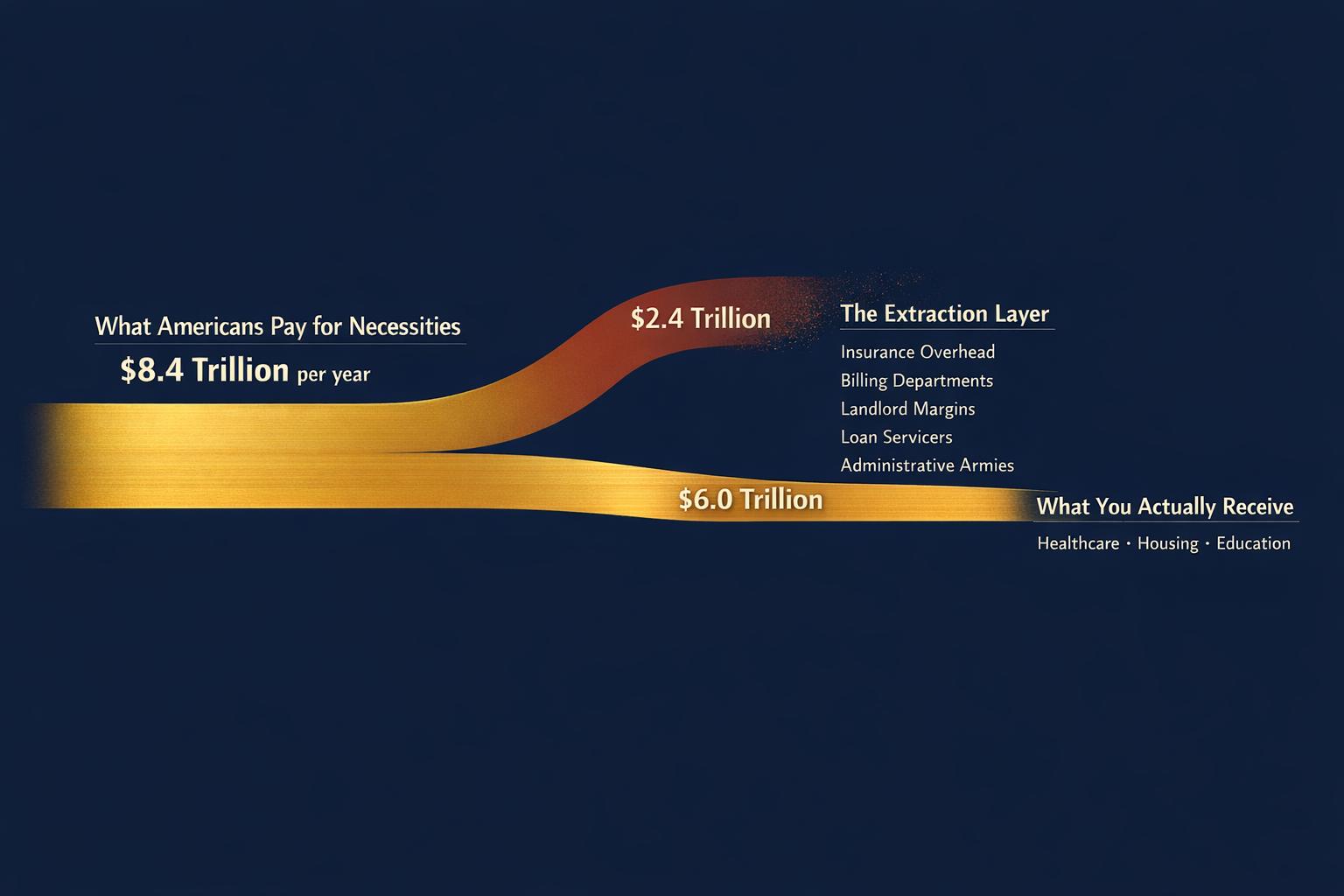
Americans already spend $4.5T on healthcare. Already spend $3T on housing. Already carry $1.7T in student debt. The Fund doesn't add to this. It replaces it—and captures the $2.4T extraction wedge in the process.
When the Fund pays for your healthcare, you stop paying your premium. But here's the key: the Fund pays $82 for what you were paying $100. The $18 difference was overhead and extraction. It's gone now.
That's not neutral—it's deflationary for necessities.
The Flow Changes, Not the Total
Current Flow
You ($100) → Insurance company → (keeps $18) → Hospital → Care
New Flow
Fund ($82) → Hospital → Care
You keep: $18
The $100 you were paying? $82 goes to care (same care). $18 stays with you (was going to insurer overhead and profit). That $18 is now in the productive economy instead of the extraction economy.
"Giving Everyone Money Causes Inflation"
The Fund isn't "giving everyone money." It's delivering services more efficiently and returning the savings.
The insurer received $18 and produced nothing with it—overhead, profit, denial processing, appeals, executives. Now that $18 stays with you. You might spend it. You might save it. You might invest it. Either way, it's in the productive economy instead of the extraction economy.
- For necessities: This is deflationary. Same care, lower cost. The overhead is gone.
- For discretionary goods: Increased demand from people who have more to spend. This signals entrepreneurs to build capacity. Investment flows. Supply expands. This is healthy economic activity.
The inflation that matters is the kind that traps people: housing costs rising faster than wages, healthcare consuming ever-larger shares of income. The Commonwealth eliminates that inflation by eliminating the extraction that causes it.
"Unlimited Funding Causes Price Absorption"
Yes—if prices are unlimited. This is the Student Loan Trap. Unlimited federal loans → colleges raise tuition to capture the money → students get no benefit, just more debt.
Section 7 prevents this. Prices are tied to documented cost. Not "whatever you want to charge." Cost.
If the Fund pays for healthcare at cost, hospitals cannot absorb unlimited funds by raising prices. The price is what it costs. Increases require documented cost increases. The constitutional structure closes the absorption loophole.
"Healthcare/Housing/Education Costs Rose 12-18x"
Yes. That's the evidence FOR this system, not against it.
- Healthcare did not become 18x more valuable since 1980. It became 18x more extractive.
- Tuition did not increase 12x because education got 12x better. It increased because unlimited loans enabled unlimited charging.
- Housing did not cost 4x more to build. Zoning restricted supply while financial engineering extracted from demand.
The price increases are extraction, not value. Removing extraction is deflationary for these goods.
The Binding Constraint
Money cannot buy what doesn't exist. If more patients chase fixed clinician-hours, you get queues (rationing by time) not price spikes (rationing by money).
The system handles this through mandatory capacity investment:
- Training pipelines (more providers)
- Technology (more productivity per provider)
- Facilities (more capacity)
The SLA system forces this investment. Queues form → SLA violation → mandatory expansion.
Short-term: Some queues during buildout. Rationing by time, which is fairer than rationing by money.
Medium-term: Capacity expands. Queues diminish.
Long-term: Capacity meets demand. System runs smoothly.
The honest statement: There will be friction during transition. Building capacity takes time. The question is whether that friction is worse than the status quo.
The Velocity Question
If 300 million people suddenly have disposable income and security, they spend differently. A dollar in the hands of someone who was barely surviving moves faster than a dollar in the savings account of someone already comfortable.
Velocity will increase. This is real.
Why It's Manageable:
- Necessities (healthcare, housing, food, education): Prices fixed by Fund at cost. Velocity can't inflate them.
- Discretionary (restaurants, electronics, travel): Prices are market. Velocity creates demand-pull.
What happens when demand-pull hits the discretionary sector? It signals capital to build capacity there. Entrepreneurs see opportunity. Investment flows. Supply expands to meet demand.
This is healthy inflation—the kind that drives growth and investment. The inflation is quarantined to the sector where it drives productive response, while the necessities that define survival remain stable.
The Capacity Constraint Rule
This turns inflation from a philosophical argument into an engineering constraint:
The Fund may not expand coverage or distributions faster than demonstrated increases in productive capacity.
Make it explicit. Make it measurable. Make it binding.
| Sector | Capacity Measure |
|---|---|
| Healthcare | Clinician-hours per capita, beds per capita, procedure throughput |
| Housing | Housing units per capita, construction pipeline, occupancy rates |
| Education | Educator throughput, seat availability, completion capacity |
| Food | Distribution points per capita, throughput, stock levels |
Expansion of coverage is gated by demonstrated capacity expansion. You cannot promise more than you can produce. The system must build before it can distribute.
This is what distinguishes the Commonwealth from magic-money-tree proposals. Critics who say "but you can't build that fast" are making an engineering argument, not an economic one. The answer is: "You're right. That's why we gate expansion to demonstrated capacity."
Part XI: The System Dynamics
The Investment Flywheel
The Fund isn't a transfer program. It's an investment engine with compounding returns.
Accelerates
Own
Fund owns assets
Resources, spectrum, R&D equity, infrastructure
Generate
Assets generate returns
Royalties, fees, dividends, services
Produce
Returns fund production
Corps delivers healthcare, housing, food, education
Capture
Production eliminates extraction
~$2.4T/year overhead removed
Invest
Savings build capacity
More clinics, housing, training pipelines
Compound
Capacity generates returns
Cycle accelerates
Own
Fund owns assets
Resources, spectrum, R&D equity, infrastructure
Generate
Assets generate returns
Royalties, fees, dividends, services
Produce
Returns fund production
Corps delivers healthcare, housing, food, education
Capture
Production eliminates extraction
~$2.4T/year overhead removed
Invest
Savings build capacity
More clinics, housing, training pipelines
Compound
Capacity generates returns
Cycle accelerates
This is how sovereign wealth funds work. This is how endowments work. This is how any well-managed capital pool works. Invest, produce, compound, grow.
The difference: the shareholders are 330 million citizens instead of a university or a Gulf state.
The Vertical Integration Advantage
The Fund captures efficiency at every layer of the value chain:
- Inputs: Owns the resources, spectrum, land
- Innovation: Holds equity in publicly-funded R&D
- Production: Employs the workforce through Corps
- Distribution: Delivers services directly to citizens
- Reinvestment: Channels surplus back into capacity
No middleman margins at each step. No extraction layers between production and consumption. The entire supply chain operates as one integrated system optimized for citizen returns, not intermediary profits.
Currently: Debt begets debt. Extraction begets extraction. Each generation starts with more overhead than the last. The compound interest runs against the population. The Commonwealth reverses the direction. Efficiency begets efficiency. Investment begets returns. Each generation starts with more capacity than the last.
The Feedback Loops
Health → Productivity → Returns
Healthy citizens work more effectively. Miss fewer days. Think more clearly. Live longer productive lives. Generate more value. Return more to the Fund that funded their health.
Education → Innovation → Equity
Educated citizens innovate. Create companies. Build technologies. Generate equity returns to the Fund that funded their education.
Housing Security → Risk-Taking → Growth
Citizens with secure housing take entrepreneurial risks. Don't fear homelessness from failure. Some succeed massively. Growth returns to Fund.
Low Overhead → Savings → Investment
Citizens keeping 70-85% of income instead of 15-30% save more. Invest more. Compound personal wealth alongside collective wealth.
Corps Alternative → Wage Pressure → Fair Labor Markets
Workers with real alternative (corps) demand better terms. Employers must compete. Wages rise to fair levels. Exploitation ends.
Why This Stabilizes
The system has negative feedback loops that prevent runaway failure:
Revenue Shortfall
Revenue drops → Dividend compresses → Provision protected → Floor holds → Economy recovers → Revenue recovers
The dividend absorbs economic shocks. The floor doesn't.
Quality Degradation
Quality drops → SLAs violated → Automatic review → Management replaced → Quality restored
The accountability system catches problems before they compound.
Capacity Shortage
Demand exceeds capacity → Queues form → SLA violation → Mandatory investment → Capacity expands
The system must build, not ration indefinitely.
The Bimodal Economy
This is the architecture that emerges:
The Provision Layer (The Floor)
- Necessities at cost
- Universal access
- Quality-based competition (not price)
- Stability, security, dignity
The Market Layer (The Ceiling)
- Everything above necessities
- Price-based competition
- Unlimited upside
- Innovation, growth, wealth creation
Two modes. One economy. The floor removes desperation from economic decisions. The ceiling rewards contribution without limit. You get stability where you need stability. You get dynamism where you want dynamism.
Part XII: What You Get
If You're Struggling
- Healthcare: $0 at point of service
- Housing: Maintenance only, path to ownership
- Food: Staples covered
- Education: No debt, lifelong access
- Dividend: Modest but unconditional
- Dignity: Not a supplicant, an owner
If You're Striving
- Corps path: Full provision + enhanced dividend + ownership acceleration
- Private path: Floor + unlimited upside
- Entrepreneurship: Runway to build without risking family survival
- Negotiating power: Real alternatives enable real negotiation
If You're Successful
- Keep everything you build
- Floor remains (insurance against catastrophe)
- Markets work better (less extraction, more value)
- Stable society (reduced crime, desperation, social breakdown)
What Changes
For Individuals
The fear diminishes. The choices expand. The dignity increases. The future opens. Your productive capacity is unleashed—not consumed by survival overhead.
For Families
Children become economically rational again. Housing is stable. Healthcare isn't feared. Generations can build wealth—not just service debt. Time returns.
For the Economy
Markets function properly. Labor allocates efficiently. Entrepreneurship flourishes. Productivity compounds. Innovation accelerates. The flywheel spins faster each year.
You are not a taxpayer. You are not a consumer. You are not a beneficiary.
You are an owner.
You've always owned them. You just haven't been paid. This system pays you.
Part XIII: The Ask
Pass The American Ownership Amendment.
That's it. Not a party. Not a candidate. Not a platform. One constitutional amendment. Seven sections. Citizen ownership, locked in.
The Fund structure, the provision systems, the dividend formula—all of that is legislation. It can be adjusted, improved, refined based on experience.
But the amendment is what makes it permanent. The thing that says: You own this. They can't take it.
Why It Has To Be Constitutional
Legislation can be repealed. The extraction industries have more money than you. They have more lobbyists. They write the laws. If citizen ownership is merely law, they will eventually repeal it.
Constitutional amendments require 2/3 of Congress AND 3/4 of state legislatures (38 states). This is hard. It should be hard. Property rights should require supermajority consensus.
But it's achievable. 38 states is not a partisan split. It's a coalition: everyone who produces, everyone tired of extraction, everyone who believes work should pay, everyone who wants ownership not dependency.
This is not left versus right. It is owners versus extractors. Producers versus toll collectors. Citizens versus the system that extracts from them.
The Future
AI is coming. Automation will accelerate. Productivity will increase exponentially. The question is: who captures the productivity gains?
Current path: Capital captures everything. Wages stagnate. Wealth concentrates. The extraction economy becomes permanent—and automated.
Commonwealth path: The Fund holds equity in AI companies built on public research. The Fund employs the workers who train the models. The Fund owns the infrastructure. Productivity gains flow through Fund to citizens.
As automation reduces the cost of producing necessities, provision becomes cheaper. The Fund's costs drop. The surplus grows. The dividend increases. The more productive the economy becomes, the more the Fund returns to citizens.
Automation doesn't threaten you—it enriches you. Because you own it.
The Floor Is Not A Hammock.
It Is A Launchpad.
It does not catch you at the bottom. It lifts you to the start.
It is not where you rest. It is where you begin.
The Enlightenment promised that human beings have inherent dignity. That productive work deserves reward. That arbitrary extraction by an entitled class is illegitimate.
America was founded on that promise. Then we let the aristocracy return wearing different clothes—insurance executives instead of lords, private equity instead of landed gentry, toll collectors hiding behind corporate structures.
This system honors the original promise. It doesn't redistribute wealth—it stops the theft. It doesn't give handouts—it pays dividends on ownership. It doesn't create dependency—it unleashes productive capacity.
330 million Americans, freed from extraction, building on a secure foundation. The cures not yet discovered. The businesses not yet founded. The art not yet created. The problems not yet solved. The lives not yet fully lived.
Now rise.