Who Owns America?

You do.

But Someone's Been Cashing Your Checks

You make money. Then it disappears.

You work five days. You keep one or two.

The rest goes to landlords, insurance companies, hospital administrators, and loan servicers. Not because they earned it. Because you can't say no. You need shelter. You need healthcare. You need the credential. They know this. They charge accordingly.

The oil under federal land? Yours. The spectrum your phone uses? Yours. The research that created the drugs you can't afford? Your taxes paid for it.

You own it. You've just never been paid.

The Drag Wedge

The money exists. Americans spend $8.4 trillion on necessities every year. The spending is already happening.

The question is where it goes.

Sankey diagram showing $8.4 trillion flowing in, with $2.4 trillion diverted to extraction and $6.0 trillion reaching services

$2.4 trillion annually flows through extraction layers — insurance overhead, landlord margins, loan servicers, billing departments, administrative armies fighting over money instead of providing care. None of it makes you healthier, better housed, or better educated. It simply tolls your passage through necessities you cannot refuse.

That's the Drag Wedge. Money that buys nothing. Overhead on being alive.

The Tollbooth Economy

Fifty years of decisions built an economy that extracts from Americans instead of producing for them.

The family that can't buy a house despite two incomes. The graduate with six figures of debt for a job that pays forty thousand. The entrepreneur trapped in a corporate job because her kids need the health insurance. The retiree watching fees silently eat her savings. The couple that wants children but can't afford them.

This isn't bad luck. This is architecture. Every necessity — a tollbooth. Every tollbooth — someone's profit center.

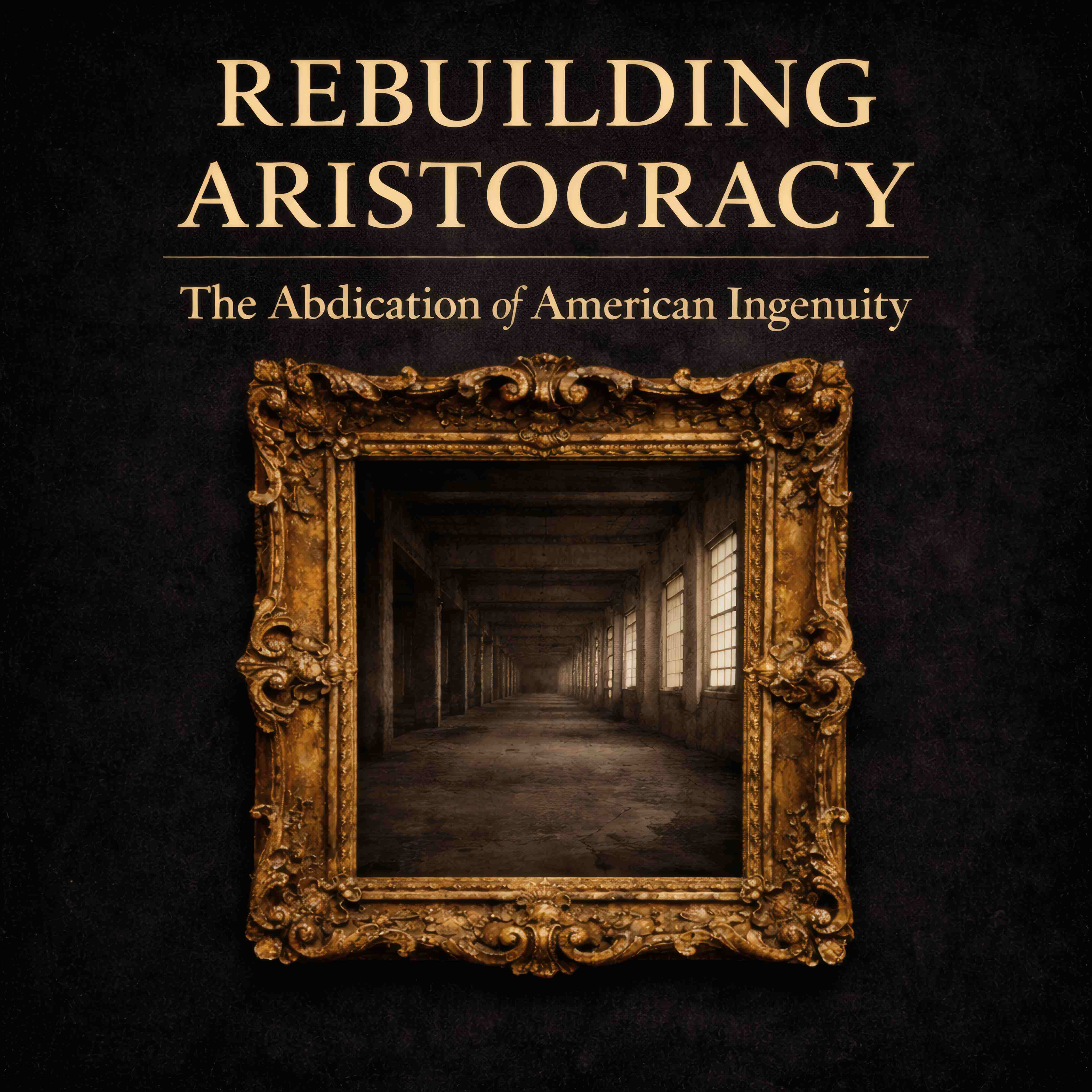
Rebuilding Aristocracy book cover

Rebuilding Aristocracy

The Abdication of American Ingenuity

Kyle J. Tobin

0:000:00

Something is broken. You can feel it. You work harder and fall further behind. You're told it's the market, it's global forces, it's just how things are now. It's not. Fifty years of decisions turned a production economy into an extraction economy. This book documents who made them, when, and how. Then it shows you what can be done about it.

The Correction

This is not a proposal. It is an accounting.

Citizens own public assets. The oil. The spectrum. The returns from public research. These are not claims to establish. They are claims that already exist — captured by private parties paying below-market rates through regulatory capture and political donation.

The 28th Amendment enforces the property rights Americans already hold. Redirects the Drag Wedge from extractors to owners. Eliminates the tollbooths on necessities.

The floor it creates is not charity. It is shareholder services. You own the country. The country provides infrastructure to its owners.

The floor is not a hammock.

It is a launchpad.

The 28th Amendment

Section 1. Citizen Ownership

The natural resources of the United States, and the returns from infrastructure and research funded by public investment, are the common property of all citizens. Each citizen holds one equal, non-transferable share in this common property.

Section 2. The American Prosperity Fund

Congress shall establish a Fund to hold these assets and distribute returns to citizen-shareholders. The Fund shall operate with full public transparency; all transactions, holdings, and operations shall be public record, auditable by any citizen.

Section 3. Inalienability

No law shall condition, reduce, delay, or withhold any citizen's share or distribution based on income, employment, behavior, criminal history, or any other criteria. The share vests with citizenship and cannot be sold, seized, transferred, or encumbered.

Section 4. Automatic Distribution

Distributions to citizens shall be calculated by published formula and executed automatically. No official shall have discretion to alter, delay, or condition individual distributions.

Section 5. Corporate Exclusion

Legal entities, including corporations, trusts, and partnerships, are not citizens and shall hold no shares. Only persons holding citizenship status are shareholders.

Section 6. Fund Integrity

The Fund shall not be borrowed against, raided, or used as collateral for any purpose other than direct returns to citizen-shareholders. Congress shall make no law diverting Fund assets to other uses.

Section 7. Provision Constraints

Provision systems funded by the Fund shall operate through publicly-owned infrastructure, nonprofit entities, or price-regulated providers. No provision system shall permit charges exceeding documented cost plus a published reinvestment allowance capped at five percent (5%). Profit distributions are prohibited. Congress shall make no law permitting unlimited pricing for necessities funded by the Fund.

What Each Section Does

Section 1. Citizen Ownership

You already own the oil under federal land. The spectrum your phone uses. The returns from research your taxes funded. This section makes that ownership constitutional. One citizen, one share. Not a policy that can be reversed. A right.

Section 2. The American Prosperity Fund

The Fund is the mechanism. It holds the assets, collects the returns, distributes the dividends. Full transparency means every transaction is public record. Any citizen can audit it. No black boxes. No hidden fees. No capture.

Section 3. Inalienability

Your share cannot be taken from you. Not if you're poor. Not if you're unemployed. Not if you've been convicted of a crime. Not if a politician decides you're undeserving. It vests with citizenship. Period. This prevents the share from becoming a tool of control.

Section 4. Automatic Distribution

No bureaucrat decides if you get paid. No official can delay your check. No process can be weaponized against you. The formula is published. The distribution is automatic. This prevents the dividend from becoming a patronage system.

Section 5. Corporate Exclusion

Corporations are not citizens. They do not get shares. This prevents wealth concentration through corporate structures. The dividend flows to people, not to legal fictions designed to accumulate capital.

Section 6. Fund Integrity

Congress cannot raid the Fund. Cannot borrow against it. Cannot pledge it as collateral for other spending. This is what separates the Fund from Social Security, which Congress has borrowed against for decades. The assets are protected by constitutional structure, not legislative promise.

Section 7. Provision Constraints

When the Fund pays for healthcare, housing, or education, providers cannot charge whatever they want. Prices are capped at documented cost plus 5% for reinvestment. No profit extraction. No unlimited pricing. This is what prevents the Fund from becoming another subsidy that gets absorbed by price increases. The constraint is constitutional. Congress cannot waive it.

Book cover

Introduction

Rebuilding Aristocracy